Home Blog Page 8

Discover 14 Types of Blue Birds in Florida

Florida, known for its lush landscapes and vibrant ecosystems, is home to a diverse range of bird species. Among these, blue birds hold a special charm, captivating bird watchers and nature enthusiasts alike with their striking hues. This article explores the various types of blue birds in Florida, their habitats, behaviors, and identifying features. From the Eastern Bluebird to the elusive Florida Scrub-Jay, let’s dive into the world of these feathered marvels.

Types of Blue Birds in Florida

1. Eastern Bluebird (Sialia sialis):

Blue Birds in Florida  Eastern Bluebird

Appearance:

  • Males: Vivid blue plumage on the back, rusty red chest, and white underbelly.
  • Females: Softer blue tones with more grayish-brown on the back.

Habitat:

  • Open fields, meadows, and suburban areas with scattered trees.
  • Often found perched on fences or power lines.

Behavior:

  • Eastern Bluebirds are cavity nesters, often using tree holes or birdhouses.
  • Diet consists of insects, berries, and small fruits.

Fun Fact:

Known for their melodic song, Eastern Bluebirds symbolize happiness and renewal.

Which green bird in California mimics human speech but is often mistaken for a wild parakeet?

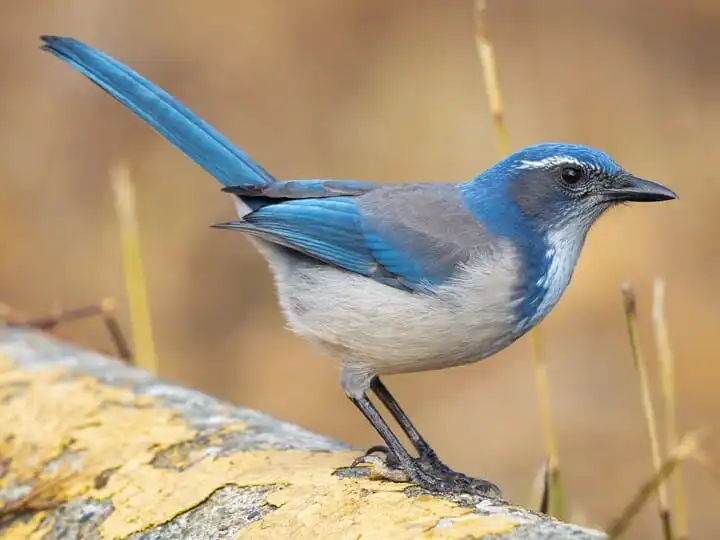
2. Florida Scrub-Jay (Aphelocoma coerulescens)

Blue Birds in Florida Florida Scrub-Jay
Richard Crossley, CC BY-SA 3.0, via Wikimedia Commons

Appearance:

  • Entirely blue body with a lighter grayish-white chest and belly.
  • Distinctive lack of a crest compared to other jays.

Habitat:

  • Endemic to Florida, thriving in scrubby flatwoods and sandy soils.
  • Prefers habitats with scrub oaks and palmettos.

Behavior:

  • Highly intelligent and social, often forming family groups.
  • Known to cache food for later use, such as acorns and small insects.

Conservation Status:

Listed as threatened due to habitat loss and fragmentation.

3.Blue Jay (Cyanocitta cristata)

Blue Birds in Florida Blue Jay

The Blue Jay is a bold and beautiful bird that brightens Florida’s landscapes. With dazzling blue feathers, a white face, and black accents, including a striking crest, it’s a true showstopper.

Habitat and Adaptability

These adaptable birds thrive in forests, parks, and even suburban gardens, making them a familiar sight across the state.

Unique Behaviors and Vocal Mimicry

Known for their loud calls and mischievous mimicry of hawk sounds, Blue Jays are as entertaining as they are resourceful.

A Versatile Diet

Their diet includes seeds, nuts, insects, and occasionally small vertebrates.

Environmental Contributions

Blue Jays also help the environment by burying acorns, inadvertently planting oak trees.

A Favorite Among Birdwatchers

Intelligent, colorful, and full of character, they’re a favorite among birdwatchers and nature enthusiasts alike!

4. Indigo Bunting (Passerina cyanea)

Blue Birds in Florida  Indigo Bunting

The Indigo Bunting is a dazzling visitor to Florida, bringing vibrant beauty to the landscape. During the breeding season, males shine with iridescent blue plumage, while females keep it subtle with brown feathers accented by hints of blue.

Preferred Habitats

These birds thrive in open woodlands, shrublands, and farmland edges, often stopping in Florida during their winter migration.

Cheerful Songs and Performances

Known for their cheerful and intricate songs, Indigo Buntings are natural performers that delight bird enthusiasts with their melodic tunes.

Versatile Feeding Habits

Their diet includes seeds, berries, and small insects, showcasing their adaptability as versatile feeders.

A Magical Addition to Birdwatching

With their stunning appearance and captivating songs, Indigo Buntings add a touch of magic to Florida’s birdwatching experiences.

5. Tree Swallow (Tachycineta bicolor)

Blue Birds in Florida Tree Swallow

The Tree Swallow is a sleek, acrobatic bird that graces Florida’s skies with its metallic blue-green back and crisp white underbelly.
Preferred Habitats
These agile flyers are often found near open areas close to water, such as lakes, marshes, and wetlands.
Masterful Aerial Hunters
Tree Swallows are aerial insectivores, skillfully catching their prey mid-flight with unmatched precision.
Nesting and Social Behavior
They nest in tree cavities or birdhouses, often forming colonies in ideal locations.
Mesmerizing Migration Flocks
During migration, Tree Swallows gather in massive, mesmerizing flocks, creating a breathtaking spectacle.
A Joy to Observe
Their graceful flight and shiny plumage make them a joy to watch. Whether gliding over water or perched in the sun, Tree Swallows bring energy and elegance to Florida’s landscapes.n the sun, Tree Swallows bring energy and elegance to Florida’s landscapes.

6. Barn Swallow (Hirundo rustica)

Blue Birds in Florida Barn Swallow

The Barn Swallow is a charming and agile bird, easily recognized by its deep blue back, reddish-orange throat, and long, forked tail.

Habitat and Nesting Preferences

These migratory birds grace Florida’s open fields, farmlands, and areas near water, often building their cup-shaped mud nests on structures like barns, bridges, and even houses.

Masterful Flyers and Insect Hunters

Known for their extraordinary flying skills, Barn Swallows swoop and dart gracefully as they hunt flying insects, their primary diet.

Social and Vocal Nature

Social and vocal, they are often seen in small groups, chattering as they work and interact.

Vibrant Addition to Florida’s Landscape

With their distinctive appearance and lively behavior, Barn Swallows add vibrancy and a touch of rural charm to Florida’s diverse bird population.

7. Painted Bunting (Passerina ciris)

Blue Birds in Florida Painted Bunting

The Painted Bunting is a breathtaking bird, often considered one of North America’s most beautiful. Males are a living rainbow, with vibrant blue heads, greenbacks, and red underparts, while females and juveniles display a subtle olive green, ideal for blending into foliage.

Preferred Habitats

These shy birds thrive in dense shrublands, coastal hammocks, and overgrown fields, frequently seen in Florida during the winter months.

Foraging Habits

Painted Buntings forage close to the ground, feeding on seeds, berries, and insects, showcasing their adaptable diet.

A Hidden Treasure

Despite their secretive nature, spotting a Painted Bunting feels like uncovering a hidden gem, making them a favorite among birdwatchers exploring Florida’s lush landscapes.

8. Cerulean Warbler (Setophaga cerulea)

Blue Birds in Florida Cerulean Warbler

The Cerulean Warbler is a delicate, sky-colored gem that graces Florida during migration in spring and fall. Males flaunt brilliant sky-blue upperparts with white underbellies accented by black streaks, while females showcase softer greenish-blue tones. These small, active birds thrive in tall deciduous forests, often near rivers and wetlands, where they forage in the treetops for insects. Despite their vibrant beauty, Cerulean Warblers are becoming increasingly rare due to habitat loss. Their cheerful, rapid songs bring a touch of joy to birdwatchers lucky enough to spot them. A fleeting but magical sight in Florida’s birding calendar, they remind us of nature’s delicate wonders.

9. Northern Parula (Setophaga Americana)

Blue Birds in Florida Northern Parula

The Northern Parula is a small but striking warbler that brightens Florida’s forests during the breeding season. Its blue-gray back, bright yellow chest, and touch of reddish banding make it a standout despite its tiny size.

Preferred Habitats

This bird is commonly found in forested wetlands and hammocks adorned with Spanish moss, flitting through the foliage in search of food.

Feeding and Foraging

The Northern Parula feeds primarily on insects and spiders, actively searching through leaves and branches with boundless energy.

Sweet Songs and Active Charm

Known for their sweet, buzzy songs, these warblers are a delight for birdwatchers. While they may be hard to spot, their lively movements and charming demeanor make them unforgettable.

Adding Life to Florida’s Landscapes

Their energy and beauty bring life to Florida’s lush, moss-draped landscapes, making the Northern Parula a cherished sight in the region.

10. Belted Kingfisher (Megaceryle alcyon)

Blue Birds in Florida  Belted Kingfisher

The Belted Kingfisher is a striking bird with blue-gray plumage, a spiky crest, and a white collar. Females add a distinctive touch with a rust-colored band across their chest, making them stand out even more.

Habitat and Hunting Grounds

These birds are commonly found near rivers, lakes, and coastal waters throughout Florida, where they thrive in watery habitats.

Skilled Hunters

Belted Kingfishers are expert fishers, often perched above water before diving headfirst to catch their prey with precision.

Loud and Unmistakable Calls

Known for their loud, rattling calls, these birds are hard to miss as they patrol their territories along the water.

Unique Nesting Habits

They dig burrows into sandy banks to nest, showcasing a remarkable adaptation to their environment.

Adding Drama to Florida’s Waterways

With their bold appearance, dramatic hunting style, and unmistakable calls, Belted Kingfishers bring excitement and personality to Florida’s waterways.

11. Prothonotary Warbler (Protonotaria citrea)

Blue Birds in Florida  Prothonotary Warbler

The Prothonotary Warbler, often called the “swamp canary,” is a dazzling bird with a bright yellow chest and belly that contrasts beautifully with its blue-gray back.

Preferred Wetland Habitats

These birds thrive in swampy forests, mangroves, and other wetland areas, frequently nesting in tree cavities or bird boxes close to water.

Melodic Songs in the Marshes

Known for their sweet and melodic songs, Prothonotary Warblers add a musical charm to Florida’s marshes as they forage.

Diet and Foraging Habits

They primarily feed on insects, snails, and spiders, making them key players in wetland ecosystems.

A Name Reflecting Beauty

Their name is inspired by the vivid robes of Catholic clerks, a nod to their dazzling and regal plumage.

A Treat for Birdwatchers

Spotting this lively warbler is a true delight for anyone exploring Florida’s rich and diverse ecosystems.

12. Blue Grosbeak (Passerina caerulea)

Blue Birds in Florida Blue Grosbeak

The Blue Grosbeak is a stunning songbird that brings vivid color to Florida’s birding scene. Males boast deep, vivid blue plumage with striking chestnut wing bars, while females exhibit a subtle charm with brownish feathers accented by blue tinges.

Habitats and Migration

These birds thrive in shrubby areas, forest edges, and farmland. Florida often serves as a stopover for them during their winter migration.

Powerful Beaks and Varied Diet

Equipped with powerful beaks, Blue Grosbeaks excel at cracking seeds but also enjoy insects and berries, showcasing their dietary versatility.

Melodious Songs

During the breeding season, their sweet, melodious songs fill the air, delighting bird enthusiasts with their rich and vibrant tunes.

A Standout Among Florida’s Birds

With their dazzling colors and enchanting songs, the Blue Grosbeak is a standout among Florida’s diverse avian residents.

13. Little Blue Heron (Egretta caerulea)

Blue Birds in Florida Little Blue Heron

The Little Blue Heron is a graceful and elegant bird that enhances Florida’s wetlands with its subtle beauty. Adults feature slate-blue plumage with a purplish-maroon head, while juveniles start entirely white, transitioning gradually to blue as they mature.

Preferred Habitats

This heron thrives in marshes, estuaries, and mangroves, favoring shallow waters for its foraging activities.

Stealthy Hunters

With deliberate, measured movements, Little Blue Herons stalk fish, amphibians, and other small prey, showcasing their skill as precise hunters.

Serene Foraging Behavior

Often foraging alongside other wading birds, they bring a sense of calm and serenity to Florida’s watery landscapes.

A Blend of Transformation and Elegance

The contrast between the youthful white plumage and the mature blue creates a fascinating transformation. Spotting a Little Blue Heron feels like witnessing art in motion, making it a captivating highlight of Florida’s diverse avian wildlife.

14. Purple Martin (Progne subis)

Blue Birds in Florida Purple Martin

The Purple Martin is a social and graceful bird that brings energy to Florida’s skies during the breeding season. Males shine with dark, iridescent blue-black feathers, while females display a softer gray-blue with lighter underparts.

Preferred Habitats

These aerial acrobats thrive in open areas near water, often nesting in specially designed martin houses provided by bird enthusiasts.

Agile Flight and Feeding Habits

Known for their impressive flight skills, Purple Martins feed on flying insects, performing agile maneuvers to catch their prey mid-flight.

A Tradition of Nesting

Historically, Native Americans encouraged Purple Martins to nest in gourds, a tradition that continues today with modern birdhouses.

Lively and Charming Addition to Florida’s Birdlife

Their melodious calls and colony lifestyle make them a lively, charming addition to Florida’s diverse bird population, captivating birdwatchers and nature lovers alike.

Conclusion:

Florida’s diverse ecosystems are a haven for bird enthusiasts, offering an array of blue-feathered marvels that captivate with their beauty, behaviors, and songs. From the charming Eastern Bluebird and the rare Florida Scrub-Jay to the dazzling Painted Bunting and the elegant Little Blue Heron, each species tells a unique story of adaptation and survival. Whether soaring through open skies, darting through dense shrublands, or gracing wetlands, these blue birds enrich Florida’s landscapes with their presence.

Observing these avian wonders not only highlights the beauty of Florida’s natural world but also reminds us of the importance of conservation. The threats facing birds like the Florida Scrub-Jay and Cerulean Warbler underline the need to protect their habitats and ensure their survival for future generations. Birdwatching in Florida becomes not just a hobby but a celebration of the state’s incredible biodiversity.

Discover 14 Types of Red Birds in Florida

Florida, often referred to as the Sunshine State, is a haven for birdwatchers and nature enthusiasts alike. The state’s diverse ecosystems, including wetlands, forests, and coastal regions, provide habitats for a plethora of bird species. Among these, Red Birds in Florida hold a special allure due to their striking plumage and captivating presence. This article delves into the enchanting world of red birds found in Florida, exploring their unique characteristics, habitats, and behaviors. Whether you’re an avid birder or a casual observer, this comprehensive guide will introduce you to the vibrant feathered residents that grace Florida’s skies and landscapes.

Types of Red Birds in Florida

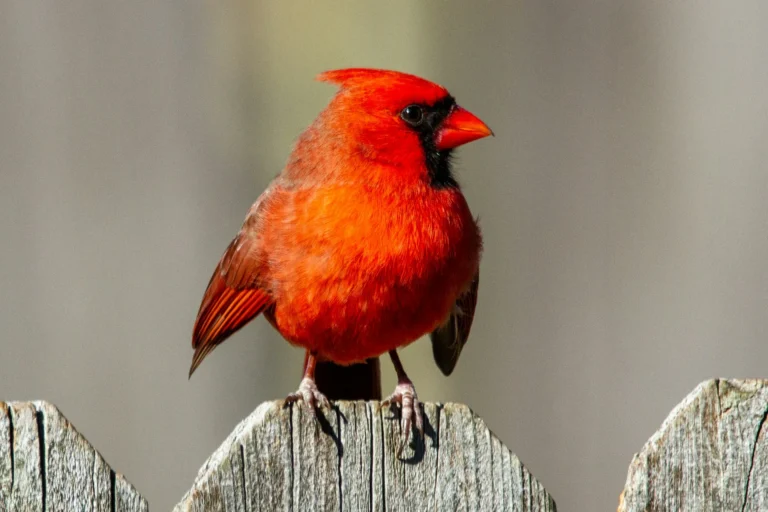
1. Northern Cardinal (Cardinalis cardinalis)

Red Birds in Florida Northern Cardinal

FlFlorida is a paradise for bird enthusiasts, home to the stunning Northern Cardinal (Cardinalis cardinalis). Known for its vivid beauty and distinctive red beak, this iconic bird is a year-round delight for birdwatchers.

Male Northern Cardinal: A Striking Presence

The male Northern Cardinal stands out with its striking crimson plumage and bold black mask, making it one of the most visually captivating birds in Florida.

Female Northern Cardinal: Understated Beauty

The female, with her warm tan feathers and red accents, exudes understated charm. While not as bright as the male, her elegance still adds to the bird’s appeal.

A Year-Round Resident

Non-migratory by nature, the Northern Cardinal thrives in Florida’s diverse habitats, from forest edges to backyard feeders.

Melodic and Spirited Behavior

Their melodious whistling and spirited behavior make them a joy to observe, embodying the vibrant diversity of Florida’s birdlife and captivating all who spot them.

Which green bird in California mimics human speech but is often mistaken for a wild parakeet?

2. Scarlet Tanager (Piranga olivacea)

Red Birds in Florida Scarlet Tanager (Piranga olivacea)

he Scarlet Tanager (Piranga olivacea) is a stunning migratory bird that adds a vibrant splash of red to Florida’s avian landscape during its migratory season. These birds are a welcome sight for birdwatchers, known for their striking colors.

Male Scarlet Tanager: A Bold Vision

The males of the species are unmistakable, boasting vivid scarlet plumage with contrasting black wings and tails. Their bright red feathers make them one of the most visually captivating birds in Florida.

Female and Juvenile Scarlet Tanagers: Subdued Elegance

Females and juveniles, however, display a more subdued olive-yellow coloration with darker wings, offering a softer appearance compared to the males.

Habitat and Migration

Scarlet Tanagers primarily inhabit deciduous forests and woodland edges. During migration, they may also be spotted in parks and gardens, especially in areas with tall trees.

Diet and Feeding Habits

These birds feed on a varied diet of insects, including beetles, caterpillars, and ants, as well as fruits and berries, ensuring they thrive in diverse habitats.

Secretive and Elusive Behavior

Scarlet Tanagers are known for their secretive nature, often staying high in the canopy, making them a challenge to spot despite their bright coloration.

A Melodious Song

Their song is a melodious, robin-like tune with a slightly husky quality, adding charm to their elusive presence and enchanting birdwatchers with their unique calls.

3. Summer Tanager (Piranga rubra)

Red Birds in Florida Summer Tanager (Piranga rubra)
https://www.flickr.com/photos/andrej_chudy/52926050797

The Summer Tanager (Piranga rubra) is a striking red bird that graces Florida during its breeding and migratory seasons. Known as the only entirely red bird in North America, the male is a vivid crimson, making it a remarkable sight.

Male and Female Summer Tanagers: A Colorful Contrast

The male Summer Tanager is a vivid crimson, while females and juveniles sport golden-yellow plumage. This color contrast adds to the visual appeal of the species, making it a favorite among birdwatchers.

Habitat and Distribution

Summer Tanagers favor open woodlands, especially oak and pine forests, as well as riparian habitats. They are often spotted in Florida during migration.

Diet and Feeding Habits

Their diet consists mainly of insects, such as bees and wasps, which they catch mid-flight and skillfully remove stingers. They also eat fruits and berries, contributing to the ecosystem.

Solitary and Elusive Nature

These solitary, elusive birds are often perched high in the canopy, making them a challenge to spot despite their vibrant colors.

Sweet Melodious Song

Their sweet, robin-like song adds charm to their elusive nature, making them a delight for birdwatchers who are lucky enough to hear it.

4. Red-headed woodpecker (Melanerpes erythrocephalus)

Red Birds in Florida  Red-headed woodpecker

The Summer Tanager (Piranga rubra) is a vibrant bird that visits Florida during its breeding and migratory seasons. Renowned as North America’s only entirely red bird, the male displays striking crimson plumage, while females and juveniles exhibit a golden-yellow hue.

Habitat and Migration

These birds thrive in open woodlands, especially among oak and pine trees, and are frequently spotted in Florida’s parks, gardens, and forests during migration.

Diet and Feeding Habits

Their diet primarily consists of insects like bees and wasps, which they expertly catch and disarm, as well as fruits and berries.

Physical Appearance and Behavior

While not a bird with a distinctive red head with a black-and-white body, the male Summer Tanager’s vivid red coloration is equally captivating. Elusive and solitary, Summer Tanagers often perch high in the canopy.

Song and Appeal

Their melodious whistle-like song is reminiscent of a robin, making them a delight for bird enthusiasts.

5. Painted Bunting (Passerina ciris)

Red Birds in Florida painted Bunting

The Painted Bunting (Passerina ciris) is a striking bird, often referred to as a “living rainbow” due to the male’s vibrant plumage of red, blue, green, and yellow. Females and juveniles are less colorful, sporting a greenish-yellow hue that provides camouflage.

Habitat and Distribution

These shy birds thrive in scrubby areas, woodland edges, and overgrown fields, often found in Florida’s southern regions during winter.

Feeding Habits

They frequently visit backyard feeders stocked with millet. Their diet consists of seeds, fruits, and insects, aiding in seed dispersion.

Song and Appeal

The male’s melodic warbling song further enhances the Painted Bunting’s appeal among birdwatchers.

6. Vermilion Flycatcher (Pyrocephalus rubinus)

Red Birds in Florida Vermilion Flycatcher (Pyrocephalus rubinus)

The Vermilion Flycatcher (Pyrocephalus rubinus) is a striking bird that occasionally visits Florida, especially during migration. Male flycatchers are easily recognized by their vivid red bodies, contrasting sharply with their dark brownish-black head, back, and wings. In contrast, females display a more muted grayish-brown plumage with subtle hints of red or pink on their bellies.

Habitat and Distribution

These birds thrive in open areas near water, such as grasslands, scrublands, and wetland edges. In Florida, they are most often seen in the southern regions during winter, although sightings are rare.

Preferred Habitat

Vermilion Flycatchers favor habitats with low perches like fences or branches, ideal for spotting prey.

7. Roseate Spoonbill (Platalea ajaja)

Red Birds in Florida Roseate Spoonbill

The Roseate Spoonbill (Platalea ajaja) is a captivating wading bird that adds a vibrant splash of pink to Florida’s wetlands. Often mistaken for flamingos, they are easily identified by their rosy plumage and unique spoon-shaped bill, which is pale gray and flattened at the tip. Their pink hue comes from carotenoid pigments in their diet of crustaceans and aquatic organisms.

Habitat and Distribution

These birds frequent coastal marshes, mangroves, and shallow freshwater or brackish wetlands. Commonly seen in the Everglades and wildlife refuges, Roseate Spoonbills are social creatures often found in small flocks.

Feeding Behavior

Their feeding involves sweeping their bill through water to sense prey, such as fish and shrimp.

Flight and Appeal

Graceful in flight, they embody Florida’s rich avian diversity.

8. House Finch (Haemorhous mexicanus)

Red Birds in Florida House Finch (Haemorhous mexicanus)

The House Finch (Haemorhous mexicanus) is a delightful songbird that brightens Florida’s urban and suburban landscapes with its vibrant red hues. As one of the small birds with red heads in Florida, males stand out with their rosy-pink foreheads, chests, and rumps, beautifully contrasted against their streaked brown bodies, while females feature a subtler streaked brown plumage.

Habitat and Distribution

These adaptable birds thrive in varied habitats such as parks, residential areas, and open woodlands. Frequent visitors to Florida bird feeders, they enjoy sunflower seeds, millet, and other grains.

Social Behavior and Song

Social and vocal, House Finches gather in flocks, with males singing cheerful warbling tunes to attract mates.

Nesting and Appeal

They nest in trees, shrubs, or man-made structures, charming birdwatchers and backyard enthusiasts across Florida.

9. Purple Finch (Haemorhous purpureus)

Red Birds in Florida Purple Finch

The Purple Finch (Haemorhous purpureus) is a vibrant winter visitor occasionally seen in Florida. Males boast a raspberry-red wash over their heads, backs, and chests, blending beautifully with streaked brown wings and tails, while females are more subdued with brown streaks and a distinctive white eyebrow stripe.

Habitat and Migration

During the breeding season, these birds favor coniferous and mixed forests but migrate to Florida’s wooded areas, parks, and suburban backyards in winter.

Feeding Habits

They frequently visit bird feeders, enjoying seeds like sunflower and millet.

Social Behavior and Song

Social and lively, Purple Finches often gather in small flocks, showcasing their melodious, warbling songs.

10. American Redstart (Setophaga ruticilla)

Red Birds in Florida  American Redstart

The American Redstart (Setophaga ruticilla) is a stunning migratory warbler that visits Florida during its breeding and migration seasons. Males captivate birdwatchers with bold orange-red patches on their wings, tail, and sides, contrasting sharply with sleek black bodies. Females and juveniles, while less vivid, charm with grayish plumage accented by yellow-orange highlights.

Habitat and Distribution

These active birds thrive in diverse habitats, from deciduous forests and mangroves to parks and gardens during migration.

Feeding Habits

Skilled insectivores, they use their colorful tails to flush out prey.

Song and Behavior

Males serenade with sweet, high-pitched songs, adding melody to their surroundings.

Appeal to Birdwatchers

Their energetic behavior and striking appearance make American Redstarts a lively highlight of Florida’s birding scene.

11. Pileated Woodpecker (Dryocopus pileatus)

Red Birds in Florida Pileated Woodpecker

The Pileated Woodpecker (Dryocopus pileatus) is one of North America’s largest and most striking woodpeckers, identifiable by its vibrant red crest, black body, and bold white stripes on its face and neck. Males are further distinguished by a red cheek stripe.

Habitat and Distribution

These impressive birds thrive in mature forests, wooded swamps, and areas with large, decaying trees, which they use for nesting and foraging. In Florida, they are year-round residents, occasionally venturing into suburban areas with ample tree cover.

Feeding Behavior

Known for their loud drumming and rectangular tree holes, Pileated Woodpeckers feed on carpenter ants and beetle larvae.

Appeal and Behavior

Their resonant calls and dynamic behavior make them a captivating presence in Florida’s forests.

12. Red-Winged Blackbird (Agelaius phoeniceus)

Red Birds in Florida Red-Winged Blackbird

The Red-Winged Blackbird (Agelaius phoeniceus) is a striking and common sight in Florida’s wetlands, easily recognized by the males’ glossy black feathers and bright red-and-yellow shoulder patches. These bold markings are used for territorial displays and attracting mates. In contrast, females are streaked brown, offering effective camouflage.

Habitat and Distribution

These adaptable birds inhabit marshes, meadows, and pond edges, thriving year-round in Florida. Often perched on cattails or fence posts, they also frequent farmland and grasslands.

Social Behavior

Known for their social nature, they gather in large flocks outside the breeding season.

Diet and Ecological Role

Their diet of insects, seeds, and grains makes them vital for pest control and seed dispersal, enriching Florida’s ecosystems.

13. Western Tanager (Piranga ludoviciana)

Red Birds in Florida  Western Tanager

The Western Tanager (Piranga ludoviciana) is a rare but stunning migrant in Florida, most often seen during spring and fall migrations. Males are easily identified by their bright yellow bodies, black wings, and fiery red-orange heads, while females sport more muted greenish-yellow plumage.

Habitat and Migration

These tanagers typically breed in coniferous forests of the western U.S. but occasionally visit Florida’s woodlands, parks, and tree-filled gardens during migration.

Diet

Their diet consists mainly of insects like beetles and wasps, though they also enjoy fruits and berries while traveling.

Behavior and Appeal

Relatively quiet, they occasionally sing short, melodic whistles. Spotting a Western Tanager in Florida is a rare delight for bird lovers.

14. Painted Redstart (Myioborus pictus)

Red Birds in Florida  Painted Redstart

The Painted Redstart (Myioborus pictus) is a rare and dazzling visitor to Florida, typically seen in the southwestern U.S. and Mexico. Its striking black head, back, and wings contrast beautifully with bold white wing patches and a vibrant red belly, making it a standout species for birdwatchers. This red-breasted bird in Florida is an exceptional sight for those lucky enough to encounter it.

Habitat and Migration

While they primarily inhabit pine-oak forests and mountainous regions, they occasionally appear in Florida’s wooded parks or tree-covered areas during migration.

Feeding Behavior

These acrobatic birds forage actively, flashing their white tail patches to flush out insects. Their diet consists mainly of insects and small arthropods.

Appeal to Birdwatchers

A Painted Redstart sighting in Florida is a true treasure for bird enthusiasts.

Best Places for Birdwatching in Florida

For those eager to spot these red birds, Florida offers some prime birdwatching locations:

  1. Everglades National Park: A haven for wading birds and migratory species.
  2. Merritt Island National Wildlife Refuge: Known for its diversity of birdlife.
  3. Corkscrew Swamp Sanctuary: Ideal for spotting woodpeckers and songbirds.
  4. Dry Tortugas National Park: A hotspot for migratory birds.
  5. Paynes Prairie Preserve State Park: Offers opportunities to see marsh-dwelling species.

Conclusion

The red birds of Florida captivate birdwatchers with their vivid hues and diverse behaviors. From common residents like the Northern Cardinal to elusive visitors like the Painted Redstart, these birds add vibrant beauty to Florida’s landscapes. By appreciating and protecting their habitats, we ensure these stunning species continue to thrive in the Sunshine State. So, pack your binoculars, grab a field guide, and head out to explore the colorful world of red birds in Florida. You’ll be rewarded with sights and sounds that connect you to nature in the most extraordinary ways.

Discover 15 Types of Brown Birds in Florida

Florida’s diverse habitats—spanning wetlands, forests, grasslands, and coastal regions—make it a haven for birdwatchers. Among the vibrant feathered residents and visitors are an impressive variety of brown birds, often overlooked for their more colorful counterparts. These birds, however, hold their own charm with intricate plumage patterns, unique behaviors, and significant ecological roles.

From small sparrows flitting through thickets to majestic brown raptors soaring above, Florida offers an array of brown birds that captivate nature enthusiasts. Whether you’re a seasoned birder or a curious observer, this guide will introduce you to 15 fascinating types of brown birds you can encounter across the Sunshine State.

Each bird tells its own story of adaptation and survival in Florida’s rich ecosystems, offering a deeper appreciation of the subtleties of nature. So grab your binoculars and prepare to meet these understated avian wonders.

1. Northern Mockingbird

Brown birds in Florida Northern Mockingbird

The Northern Mockingbird (Mimus polyglottos) is a versatile and highly adaptive songbird found throughout North America, particularly in the southern and central regions of the United States.

Known for its remarkable ability to mimic a wide variety of sounds, including other birds, animals, and even mechanical noises, the Northern Mockingbird is a master of vocal mimicry.

Which green bird in California mimics human speech but is often mistaken for a wild parakeet?

2. Mourning Dove

Brown birds in Florida  Mourning Dove

The Mourning Dove (Zenaida macroura) is a gentle and graceful bird commonly found across North America. Recognizable by its slender, grayish-brown body, small head, and long, tapered tail with white edges, the Mourning Dove measures about 9 to 13 inches in length with a wingspan of 17 to 18 inches. Its soft, mournful cooing sound, reminiscent of a melancholy flute, gives the species its name.

Mourning Doves inhabit open woodlands, suburban areas, and agricultural fields, often foraging on the ground for seeds, which make up the majority of their diet.

They are also frequent visitors to backyard feeders. These birds are known for their swift, straight flight, characterized by rapid wingbeats and a distinctive whistling sound created by their wings.

Highly adaptable, Mourning Doves mate for life and build flimsy nests in trees, shrubs, or even on building ledges. They symbolize peace and are cherished for their calm presence.

3. Brown Pelican

Brown birds in Florida Brown Pelican

The Brown Pelican (Pelecanus occidentalis) is a distinctive and iconic seabird, often recognized as one of the large brown birds in Florida and other coastal areas of North, Central, and South America. Recognized by its large size, long bill with a spacious throat pouch, and striking plumage, adult Brown Pelicans have a grayish-brown body, white neck, and yellow head, with black flight feathers.

They measure about 4 feet in length, boast a wingspan of 6 to 7 feet, and weigh 6 to 12 pounds.

Unlike other pelicans, the Brown Pelican is known for its dramatic feeding technique: it dives from considerable heights into the water to catch fish, its primary food source. Its expandable throat pouch aids in scooping up prey and draining water before swallowing.

These social birds are often seen resting in flocks on beaches, docks, or mangroves. Once endangered due to pesticide pollution, conservation efforts have successfully restored their populations, making them a symbol of environmental recovery.

4. Carolina Wren

Brown birds in Florida Carolina Wren

The Carolina Wren (Thryothorus ludovicianus) is a small yet spirited songbird commonly found in the eastern United States. It is characterized by its warm reddish-brown upperparts, buff-colored underparts, and a distinct white stripe above its eye.

Measuring about 5 to 5.5 inches long with a wingspan of 7 to 8 inches, it is a compact and active bird with a slightly curved bill.

This wren is best known for its loud and clear song, often rendered as “tea-kettle, tea-kettle, tea-kettle,” which males sing year-round to establish territory and attract mates.

Carolina Wrens are highly adaptable and can thrive in a variety of habitats, including forests, swamps, gardens, and suburban areas.

They are cavity nesters, building dome-shaped nests in natural crevices or unconventional spots like mailboxes and flowerpots.

Their diet consists primarily of insects, spiders, and small fruits, and their curious nature and cheerful presence make them a favorite among bird enthusiasts.

5. Boat-tailed Grackle

Brown birds in Florida Boat-tailed Grackle

The Boat-tailed Grackle (Quiscalus major) is a striking and vocal bird found along coastal areas of the southeastern United States and parts of the Gulf Coast.

This large blackbird measures about 10 to 15 inches in length, with males being significantly larger than females.

Males have glossy, iridescent plumage that shines purple, green, or blue in sunlight, while females are smaller and sport a rich brown coloration.

One of the most distinctive features of the Boat-tailed Grackle is its long, keel-shaped tail, which fans out in flight and adds to its graceful appearance.

These birds are often found in marshes, estuaries, and urban environments near water. They are highly social, forming large flocks that can be quite noisy with their array of sharp calls, whistles, and squawks.

Their diet is omnivorous, including insects, small aquatic creatures, grains, and human scraps. Bold and adaptable, they are a common sight in coastal habitats and urban areas alike.

6. Eastern Phoebe

Brown birds in Florida Eastern Phoebe

The Eastern Phoebe (Sayornis phoebe) is a charming and adaptable brown bird with a yellow belly, often seen in Florida,, especially during the winter months. This small flycatcher is about 5.5 to 6.7 inches long, with a wingspan of 10 to 11 inches.

Its plumage is a soft grayish-brown above, fading to a pale whitish-yellow on the underparts, and it has a slight crest that it frequently flattens or raises.

Eastern Phoebes are known for their habit of wagging their tails up and down while perched. They are primarily insectivorous, catching their prey in mid-air with acrobatic skill, though they also eat small fruits and berries during colder seasons.

Commonly found in open woodlands, gardens, and near water sources, the Eastern Phoebe often nests on human-made structures like bridges and eaves. Its call, a clear “fee-bee,” is a familiar sound in its range. Their adaptability and calm demeanor make them a favorite among bird watchers in Florida.

7. Limpkin

Brown birds in Florida Limpkin

The Limpkin (Aramus guarauna) is a distinctive wading bird commonly found in Florida’s wetlands, known for its unique appearance and haunting calls.

Measuring about 25 to 29 inches in length with a wingspan of 40 to 42 inches, it has a slender body, long legs, and a slightly curved bill.

Its brown plumage is mottled with white streaks, providing excellent camouflage in marshy habitats.

Limpkins thrive in freshwater environments such as swamps, marshes, and along the edges of rivers and lakes, where they are often spotted walking slowly in search of food.

Their diet primarily consists of apple snails, which they skillfully extract from their shells using their specialized bill, along with other small aquatic creatures.

This bird’s eerie, wailing call is a signature sound of Florida’s wetlands, especially at night. As an emblem of the state’s rich biodiversity, the Limpkin is a favorite among bird watchers and nature enthusiasts.

8. Brown Thrasher

Brown birds in Florida Brown Thrasher

The Brown Thrasher (Toxostoma rufum) is a striking and melodious bird commonly found in Florida, known for its vibrant songs and secretive nature.

Measuring about 9 to 12 inches in length with a wingspan of approximately 13 inches, this bird has a slender body, long tail, and slightly curved bill.

Its reddish-brown plumage on the upperparts contrasts beautifully with its pale underparts streaked with dark brown markings.

Brown Thrashers are skilled vocalists, capable of mimicking other bird calls and producing a repertoire of over 1,000 song variations. They are most often heard during spring, singing from dense shrubs or tree branches to establish their territory.

These birds thrive in thickets, forest edges, and residential areas with plenty of cover.

Their diet includes insects, fruits, and seeds, which they forage by vigorously flipping leaves on the ground. Elusive yet enchanting, the Brown Thrasher adds beauty and melody to Florida’s natural landscapes.

9. Palm Warbler

Brown birds in Florida Palm Warbler

The Palm Warbler (Setophaga palmarum) is a small and charming songbird commonly found in Florida during its winter migration. Measuring about 5 to 5.5 inches in length with a wingspan of 7.5 to 8 inches, this bird is easily recognized by its warm brown upperparts, yellowish underparts, and distinctive chestnut cap. One of its signature traits is its habit of constantly bobbing its tail as it forages.

Palm Warblers are versatile and thrive in a variety of habitats, including open fields, marshes, and coastal scrublands. They are ground foragers, often seen hopping along the ground or low vegetation, searching for insects, spiders, and seeds.

This warbler is a lively presence in Florida’s landscapes, often traveling in mixed flocks with other small birds. Its soft, musical chirps and active behavior make it a delightful sight for birdwatchers and nature enthusiasts exploring the Sunshine State.

10. Sedge Wren

Brown birds in Florida Sedge Wren

The Sedge Wren (Cistothorus stellaris) is a small, elusive bird that adds charm to Florida’s marshy landscapes.

Measuring about 4.5 to 5 inches in length with a wingspan of 5.5 to 6 inches, this wren has a compact body, a short tail, and a slender bill. Its plumage is a mix of brown and buff with intricate streaking on its back, helping it blend seamlessly into grassy habitats.

Found in marshes, wet meadows, and grassy fields, the Sedge Wren is a shy bird that prefers dense vegetation, where it forages for insects and spiders. Its quick, jerky movements and low-profile behavior make it a challenge to spot, but its distinctive song—a series of rapid, chattering notes—often gives away its presence.

Sedge Wrens are seasonal residents in Florida, primarily during the winter months. Their preference for undisturbed wetland habitats underscores the importance of conservation efforts to preserve these ecosystems.

11. Eastern Towhee

Brown birds in Florida Eastern Towhee

The Eastern Towhee (Pipilo erythrophthalmus) is a striking and melodic bird often found in Florida’s woodlands and brushy habitats. Measuring about 6.8 to 8.2 inches in length with a wingspan of 7.9 to 11 inches, this species is a notable example of common brown birds in Florida. Males have a rich black upper body, while females display warm brown tones, both complemented by a white belly and reddish-orange sides.

Eastern Towhees are ground foragers, using their feet to scratch through leaf litter in search of seeds, insects, and berries. Their distinctive “drink-your-tea” song is a common sound in Florida’s forests, especially during the breeding season.

These birds prefer thickets, forest edges, and overgrown fields, where they can remain hidden while foraging or nesting. Their vibrant appearance, paired with their rich, musical calls, makes the Eastern Towhee a favorite among birdwatchers in Florida.

12. Great Horned Owl

Brown birds in Florida Great Horned Owl

The Great Horned Owl (Bubo virginianus) is one of Florida’s most iconic brown birds, known for its striking appearance and haunting hoots. Measuring 18 to 25 inches in length with a wingspan of 3.5 to 4.8 feet, this large owl is instantly recognizable by its mottled brown plumage, piercing yellow eyes, and prominent ear tufts, which resemble “horns.”

These nocturnal predators are highly adaptable, thriving in a wide range of habitats, including forests, wetlands, and even urban areas. Their plumage provides excellent camouflage, allowing them to blend seamlessly into tree bark during the day. At night, they are powerful hunters, preying on mammals, birds, reptiles, and insects.

The Great Horned Owl’s deep, resonant hoots are a signature sound of Florida’s nights, especially during the breeding season.

Known as fierce protectors of their nests, these owls are symbols of wisdom and strength, captivating birdwatchers and nature enthusiasts alike.

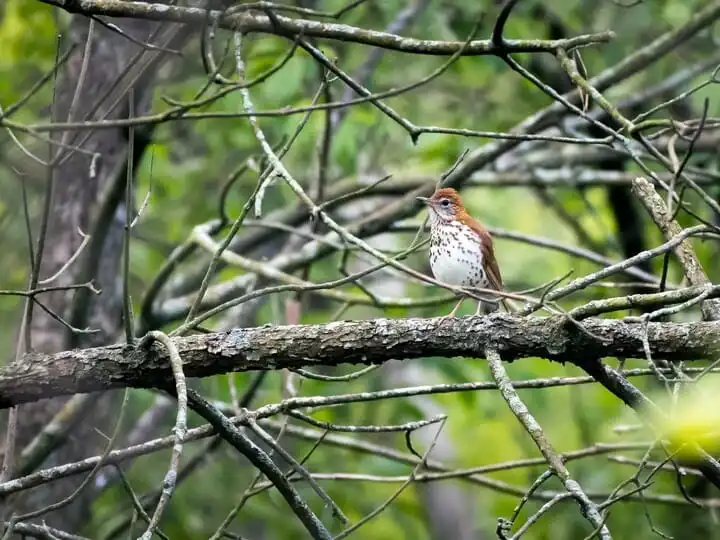
13. Hermit Thrush

Brown birds in Florida Hermit Thrush

The Hermit Thrush (Catharus guttatus) is a modest yet enchanting brown bird often seen in Florida during the winter months.

Measuring about 6 to 7 inches in length with a wingspan of 9 to 11 inches, this small thrush is known for its warm brown back, reddish tail, and pale underparts with distinct dark spots on its chest. Its quiet demeanor often belies its extraordinary singing abilities.

This bird thrives in woodlands, forests, and shrubby areas, where it forages on the ground for insects, spiders, and berries.

The Hermit Thrush is recognized for its ethereal, flute-like song, characterized by clear, ascending notes and complex harmonies, often delivered at dusk or dawn.

Unlike many migratory thrushes, the Hermit Thrush prefers to overwinter in Florida’s milder climate. Its combination of understated beauty and exquisite vocalizations makes it a favorite among birdwatchers exploring the state’s natural habitats.

14. Rose-breasted Grosbeak

Brown birds in Florida Rose-breasted Grosbeak

The Rose-breasted Grosbeak (Pheucticus ludovicianus) is a captivating songbird occasionally seen in Florida during migration. While males are celebrated for their black and white plumage with a vivid rose-colored chest patch, females and juveniles are more subdued, displaying warm brown plumage with streaked underparts and a white eyebrow stripe.

Measuring about 7 to 8 inches in length with a wingspan of 11 to 13 inches, this bird is known for its sturdy, seed-cracking bill. Rose-breasted Grosbeaks prefer wooded areas, forest edges, and gardens, where they forage for seeds, fruits, and insects.

Their sweet, melodic song is often compared to that of a robin, but richer and more complex. In Florida, these birds are primarily observed during spring and fall migrations.

Their presence adds a splash of beauty and melody to the state’s landscapes, delighting birdwatchers fortunate enough to spot them during their journeys.

15. Louisiana Waterthrush

Brown birds in Florida Louisiana Waterthrush

Have you ever spotted a bird confidently strutting along a stream, tail bobbing with flair? Say hello to the Louisiana Waterthrush!

This delightful brown bird is a winter visitor in Florida, adding charm to the state’s wetlands and wooded streams. Unlike many warblers that stick to the treetops, this one prefers a life on the ground, foraging along the water’s edge for insects, spiders, and other tasty morsels.

With its warm brown plumage, creamy streaked underparts, and bold white eyebrow, the Louisiana Waterthrush stands out despite its subtle tones. But what really makes this bird special is its song—a melodious cascade of notes that mimics flowing water, bringing a touch of nature’s music to its surroundings.

As one of the earliest migrating warblers, the Louisiana Waterthrush is a herald of spring for bird enthusiasts in Florida. Spotting one feels like uncovering a hidden gem in the wild!

Conclusion:

Florida’s diverse ecosystems provide a haven for a wide variety of brown birds, each playing a unique role in the state’s rich natural tapestry. From the haunting hoots of the Great Horned Owl to the melodic songs of the Hermit Thrush and the vibrant presence of the Rose-breasted Grosbeak, these birds captivate with their beauty and behaviors. The Limpkin’s wetlands wanderings and the Louisiana Waterthrush’s streamside foraging highlight the importance of Florida’s water-rich habitats, while species like the Eastern Towhee and Brown Thrasher thrive in wooded and brushy areas.

These brown birds not only add visual charm but also contribute to the ecological balance by controlling insect populations, dispersing seeds, and pollinating plants. Observing and protecting these birds reminds us of the vital role conservation plays in preserving Florida’s biodiversity. Whether you’re a seasoned birdwatcher or a casual observer, Florida’s brown birds offer endless opportunities for discovery and connection with nature

26 Purple Birds with Pictures and Identification

0

Purple-colored birds are some of the most striking and visually captivating species in the avian world. Their dazzling plumage ranges from deep, velvety purples to shimmering violets and lighter lilacs. These vibrant hues not only add beauty to the ecosystems where these birds live but also serve as a means of species identification and communication.

Whether you’re a birdwatcher, nature enthusiast, or simply someone intrigued by the wonders of wildlife, understanding these birds’ unique traits and habitats can enrich your appreciation for their presence. This article explorfeaes 26 of the most notable purple birds, offering insights into their identification, habitats, and distinctive behaviors.

Birds with purple plumage are a breathtaking sight, showcasing hues ranging from deep, rich violets to lighter lilacs. Their unique color not only sets them apart visually but also aids in species identification. Here’s a guide to some well-known purple birds and their characteristics.

1. Purple Martin (Progne subis)

1. Purple Martin (Progne subis)

Length: 7.5–7.9 inches (19–20 cm)
Weight: 1.6–2.1 oz (45–60 g)

Identification: The Purple Martin is North America’s largest swallow. Males are a striking deep blue-purple with a glossy sheen, while females and juveniles are grayish-brown with lighter underparts. Their long, tapered wings and forked tail help them glide gracefully through the sky. Their distinctive chattering call is a common sound near nesting sites.

Habitat: Purple Martins are commonly found in open areas near water, such as lakes, marshes, and coastal regions. They often nest in man-made birdhouses placed in open fields or residential areas. Historically, they used natural cavities like woodpecker holes.

Diet: They primarily eat flying insects, including dragonflies, flies, and beetles.

Behavior: Purple Martins are social birds that form colonies during the breeding season. They are known for their acrobatic flight and communal roosting in large numbers post-breeding.

Conservation Status: The Purple Martin is not currently threatened but faces habitat challenges due to competition with invasive species.

Which green bird in California mimics human speech but is often mistaken for a wild parakeet?

2. Violet-backed Starling (Cinnyricinclus leucogaster)

2. Violet-backed Starling (Cinnyricinclus leucogaster)

Length: 7–7.9 inches (18–20 cm)
Weight: 1.4–1.9 oz (40–55 g)

Identification: Males have a stunning iridescent violet back and crown, contrasting with their white underparts. Females are brown with streaked underparts, lacking the vibrant color of the males. Both sexes have sharp, pointed beaks ideal for foraging.

Habitat: Found in sub-Saharan Africa, this starling prefers open woodlands, savannas, and forest edges. It often stays in areas with scattered trees and access to fruit-bearing vegetation.

Diet: Feeds mainly on fruits and insects.

Behavior: This species is known for its social and often noisy nature, commonly seen in pairs or small flocks. Males perform impressive displays during courtship.

Conservation Status: Considered of Least Concern, with stable population trends.

3. Purple Grenadier (Uraeginthus ianthinogaster)

3. Purple Grenadier (Uraeginthus ianthinogaster)

Length: 5.1–5.5 inches (13–14 cm)
Weight: 0.4–0.6 oz (11–17 g)

Identification: Males display a striking combination of bright purple-blue plumage with a vivid orange mask and tail, while females are more muted with brownish and purplish hues. Both sexes have small, conical bills.

Habitat: This species inhabits dry savannas, bushlands, and acacia thickets in East Africa. They prefer open, dry areas with scattered shrubbery and tall grasses for cover.

Diet: Primarily seeds, supplemented with insects.

Behavior: Purple Grenadiers are typically seen in pairs or small family groups. They have a sweet, warbling song and engage in elaborate courtship rituals involving singing and feather displays.

Conservation Status: Not currently threatened, with a stable population.

4. Reddish-purple Sunbird Species

Length: 4–5 inches (10–13 cm)
Weight: 0.2–0.4 oz (5–11 g)

Identification: Males are notable for their metallic reddish-purple throat and chest, contrasting with darker wings and tail. Females are often duller, with olive or brownish plumage. Both have curved bills adapted for nectar feeding.

Habitat: Found in tropical and subtropical regions with flowering trees and dense vegetation, such as forests, gardens, and scrublands.

Diet: Feeds on nectar, insects, and small arthropods.

Behavior: These sunbirds are active and fast, flitting from flower to flower with rapid wingbeats. Males often display their bright plumage during courtship.

Conservation Status: Most species under this category are not currently under threat.

5. Asian Fairy-bluebird (Irena puella)

Length: 9–10.6 inches (23–27 cm)
Weight: 1.6–2.3 oz (45–65 g)

Identification: Males exhibit deep cobalt-blue feathers with black wings and tail, while females are a lighter blue. Both sexes have striking red eyes and strong, pointed bills.

Habitat: Found in the dense forests and tropical woodlands of South and Southeast Asia, these birds prefer canopy layers where they can forage for food.

Diet: Consists mainly of fruits, especially figs, and some insects.

Behavior: The Asian Fairy-bluebird is typically solitary or seen in pairs. Males produce loud, melodic calls, especially during the breeding season.

Conservation Status: Classified as Least Concern, though habitat loss poses a risk in some regions.

6. Purple Sunbird (Cinnyris asiaticus)

6. Purple Sunbird (Cinnyris asiaticus)

Length: 3.9–4.7 inches (10–12 cm)
Weight: 0.2–0.4 oz (5–10 g)

Identification: Males exhibit deep, metallic blue-purple plumage during the breeding season, while non-breeding males and females have olive-yellow underparts and a darker back. Both sexes possess slender, curved bills for nectar feeding. Their small, agile bodies are built for quick movements and hovering.

Habitat: Found across South Asia, including India, Sri Lanka, and nearby areas, in gardens, forests, and open woodlands.

Diet: Nectar, supplemented by small insects.

Behavior: Highly active, frequently darting from flower to flower and known for their buzzing wingbeats. Males sing and perform visual displays during courtship.

Conservation Status: Listed as Least Concern with stable populations and a wide range.

7. Purple Honeycreeper (Cyanerpes caeruleus)

7. Purple Honeycreeper (Cyanerpes caeruleus)

Length: 4.3–4.7 inches (11–12 cm)
Weight: 0.3–0.4 oz (9–12 g)

Identification: Males are a vivid violet-blue with a black mask and wings, and bright yellow legs. Females are greenish with subtle blue tints. Their slender, down-curved bills are adapted for sipping nectar. Both sexes have a compact body with agile wings for rapid movement.

Habitat: Inhabits tropical forests, woodlands, and secondary growth in Central and South America, particularly in the canopy.

Diet: Nectar, fruits, and insects.

Behavior: Active and social, often seen in small flocks. Known for rapid, acrobatic flight and their high-pitched calls.

Conservation Status: Listed as Least Concern, although deforestation could impact local populations.

8. Splendid Sunbird (Cinnyris coccinigaster)

Length: 5–5.5 inches (13–14 cm)
Weight: 0.3–0.5 oz (8–14 g)

Identification: Males have metallic green plumage with a deep violet throat and chest, highlighted by a striking red band. Females are olive with lighter underparts. Both sexes have slender, curved bills adapted for extracting nectar. Their eyes are dark, complementing their bright body colors.

Habitat: Found in West Africa, especially in open woodlands, savannas, and coastal forests rich with flowers.

Diet: Feeds primarily on nectar, with insects as a protein source.

Behavior: Agile and fast, capable of hovering at flowers. Males often display their colors while singing to attract mates.

Conservation Status: Listed as Least Concern, with populations stable due to adaptation to a variety of habitats.

9. Purple-crowned Lorikeet (Glossopsitta porphyrocephala)

Length: 6–7 inches (15–18 cm)
Weight: 1.1–1.4 oz (30–40 g)

Identification: A small parrot with bright green plumage, a distinctive purple crown, red forehead, and yellow streaks on the cheeks. Its underparts are yellowish-green, and its strong bill and long tail are adapted for maneuvering in trees.

Habitat: Inhabits open forests and woodlands of southern Australia, particularly where eucalyptus trees are common.

Diet: Primarily nectar and pollen, supplemented with fruits and seeds.

Behavior: Highly social, often seen in noisy flocks. Its flight is fast and direct, and it roosts communally at night.

Conservation Status: Listed as Least Concern, but habitat loss may impact regional populations.

10. Varied Bunting (Passerina versicolor)

Length: 4.7–5.5 inches (12–14 cm)
Weight: 0.3–0.5 oz (9–14 g)

Identification: Males display a beautiful mix of purples, reds, and blues, creating a vibrant plumage, while females are brownish with subtle purple tinges. Both sexes have a conical bill for eating seeds and a compact body structure suited for their arid environment.

Habitat: Found in arid regions, scrublands, and thorny forests of the southwestern U.S. and Mexico. Prefers dry, open areas with dense shrubs.

Diet: Seeds, with occasional insects and berries.

Behavior: Shy and often hidden in thick vegetation. Males sing melodious songs during the breeding season to attract mates.

Conservation Status: Listed as Least Concern, though habitat loss poses a potential threat in some regions.

11. Purple Roller (Coracias naevius)

11. Purple Roller (Coracias naevius)

Length: 14–15 inches (35–38 cm)
Weight: 5.6–7.7 oz (160–220 g)

Identification: The Purple Roller is recognized for its robust body, brownish-purple plumage, and white streaks on the breast and underparts. Its wings display vivid blue patches that are especially noticeable in flight, and its tail has white-edged feathers. A strong, hooked bill and striking orange or yellow eyes complement its bold look.

Habitat: Prefers dry savannas, thorny scrublands, and open woodlands in sub-Saharan Africa. Often seen perched on trees or posts, scanning for prey.

Diet: Feeds on insects, small reptiles, and small mammals.

Behavior: Typically solitary or found in pairs, this bird perches in open areas to hunt, diving swiftly to catch prey. It emits harsh croaking calls.

Conservation Status: Listed as Least Concern, though habitat destruction could pose future risks to some populations.

12. Purple-throated Fruitcrow (Querula purpura)

Purple-throated Fruitcrow
cc: https://www.flickr.com/photos/151817352@N04/32218888317

Length: 11–12 inches (28–30 cm)
Weight: 3.5–4.6 oz (100–130 g)

Identification: Males of this species have a striking black body with an iridescent purple throat patch, while females are matte black. Their stout body, short tail, and large wings aid in their maneuverability through the forest. Their large bill is well-adapted for fruit consumption.

Habitat: Inhabits tropical and subtropical forests of Central and South America, preferring the dense canopies and forest edges.

Diet: Primarily frugivorous, with occasional insects.

Behavior: Known for their loud calls, Purple-throated Fruitcrows are social and often seen in small groups, emitting simple, repetitive vocalizations.

Conservation Status: Classified as Least Concern, though habitat loss could affect specific populations.

13. Violet-crowned Hummingbird (Amazilia violiceps)

VJAnderson, CC BY-SA 4.0, via Wikimedia Commons

Length: 4–4.3 inches (10–11 cm)
Weight: 0.1–0.2 oz (3–5 g)

Identification: The Violet-crowned Hummingbird is characterized by a vibrant violet crown, white underparts, and metallic green upperparts. The tail is rufous-copper, and the bill is red with a black tip. Its sleek, small body is designed for rapid, agile movement, allowing it to hover expertly at flowers.

Habitat: Found in arid and semi-arid regions of the southwestern U.S. and Mexico, often near water sources, gardens, and open woodlands.

Diet: Nectar and small insects for protein.

Behavior: Solitary and territorial, these hummingbirds fiercely defend their feeding grounds and use high-pitched vocalizations to mark their territory.

Conservation Status: Listed as Least Concern with stable populations.

14. Purple Gallinule (Porphyrio martinicus)

Length: 13–14.6 inches (33–37 cm)
Weight: 7.3–10.2 oz (208–290 g)

Identification: The Purple Gallinule has a striking mix of purple-blue feathers and a green back. It features a bright red bill tipped with yellow, yellow legs, and a blue frontal shield. Its long toes allow it to walk gracefully on floating vegetation. The bird’s eyes are red, adding to its vivid appearance.

Habitat: Found in freshwater marshes, swamps, and wetlands across the southeastern U.S., Central America, and parts of South America.

Diet: Eats aquatic plants, seeds, and small invertebrates.

Behavior: Often seen striding on lily pads or reeds, it exhibits a confident, deliberate movement. The bird’s call is a series of clucks and whinnies.

Conservation Status: Listed as Least Concern, but habitat loss may impact regional populations.

15. Superb Fruit-Dove (Ptilinopus superbus)

Length: 8–9 inches (20–23 cm)
Weight: 1.5–2.5 oz (40–70 g)

Identification: Males are noted for their colorful purple crown, bright orange chest band, and green body. Females are mostly green with paler underparts. Both sexes have white-tipped tails and strong, compact bodies adapted for forest life. Their bright eyes and short, sturdy bills make them well-suited for fruit consumption.

Habitat: Found in the rainforests and dense woodlands of Australia and Southeast Asia, particularly in areas with abundant fruit-bearing trees.

Diet: Primarily consumes fruits and berries.

Behavior: Shy and often concealed in dense canopy, it is usually spotted alone or in pairs. Their cooing calls are soft and low.

Conservation Status: Listed as Least Concern, but deforestation poses threats to specific populations.

16. Purple Swamphen (Porphyrio porphyrio)

Length: 15–19 inches (38–49 cm)
Weight: 25–30 oz (700–850 g)

Identification: The Purple Swamphen is a large, water-loving bird with vivid blue-purple plumage and a distinctive red frontal shield and beak. Its long, red legs have large toes adapted for walking on marsh vegetation. It has a robust body, a long neck, and bright eyes that give it a bold appearance.

Habitat: Prefers wetlands, marshes, and swamps with dense vegetation across southern Europe, Asia, Africa, and Australasia.

Diet: Consists mainly of reeds, shoots, leaves, and small invertebrates.

Behavior: Known for its loud, clucking calls and social nature, it often lives in groups. It forages by using its strong beak to pull up plants and catch prey.

Conservation Status: Listed as Least Concern, but habitat loss and water pollution pose threats to certain populations.

17. Purple Finch (Haemorhous purpureus)

Length: 4.7–6.3 inches (12–16 cm)
Weight: 0.6–1 oz (18–28 g)

Identification: Males have a raspberry-red head, breast, and back with brown streaks on the wings and tail, while females are streaked brown with a distinctive facial pattern. The thick, conical bill is adapted for seed eating, and their bodies are compact with a notched tail.

Habitat: Found in coniferous and mixed forests, often in northern North America. During winter, they migrate to areas with more abundant food sources.

Diet: Seeds, berries, and small insects.

Behavior: Typically seen in small flocks, Purple Finches are social and emit cheerful, warbling songs. Males use their vibrant color and songs for courtship.

Conservation Status: Classified as Least Concern, though competition with the House Finch has impacted its range.

18. Purple-breasted Cotinga (Cotinga cotinga)

Length: 7.5–8.3 inches (19–21 cm)
Weight: 1.6–2.3 oz (45–65 g)

Identification: The male displays striking deep purple plumage on the breast and underparts, contrasted by a bright blue back and wings. Females are brownish with less distinctive markings. Both have stout bills adapted for fruit consumption and dark eyes that accentuate their colorful appearance.

Habitat: Found in the tropical rainforests of northern South America, particularly in the canopy and middle forest levels.

Diet: Primarily fruits and berries.

Behavior: Males are known for their solitary displays on perches to attract females, while both sexes emit low, simple calls. Often found in pairs or alone.

Conservation Status: Listed as Least Concern, but deforestation poses potential habitat threats.

19. Violet-crowned Woodnymph (Thalurania colombica)

Length: 3.5–4 inches (9–10 cm)
Weight: 0.1–0.2 oz (3–6 g)

Identification: Males have a shimmering violet crown and a metallic green body with a dark, forked tail. Females are primarily green with lighter underparts. Both sexes have slender, slightly curved bills and rapid wing movements suited for hovering at flowers.

Habitat: Common in tropical and subtropical forests of Central and northern South America, typically found in humid understory and at forest edges.

Diet: Nectar, supplemented by small insects.

Behavior: Highly territorial, they chase away intruders from their feeding areas. Males perform aerial displays during courtship.

Conservation Status: Listed as Least Concern, with stable populations, though habitat loss could pose localized issues.

20. Purple-naped Lory (Lorius domicella)

Length: 10–11 inches (25–28 cm)
Weight: 5.6–7.8 oz (160–220 g)

Identification: This parrot has striking green plumage with a bright purple patch on the nape and vivid red underparts. The face is red with a blue or purple crown, and it has a strong, hooked orange beak and dark eyes. Its long, graduated tail adds to its elegant appearance.

Habitat: Native to the tropical rainforests of Indonesia, primarily on the islands of Seram and nearby areas.

Diet: Feeds on fruits, nectar, and flowers.

Behavior: Social and often seen in small flocks, it’s known for its loud, chattering calls. It uses its strong beak for climbing and foraging.

Conservation Status: Classified as Vulnerable due to habitat destruction and capture for the pet trade.

21. Purple-collared Woodstar (Myrtis fanny)

Length: 3–3.5 inches (8–9 cm)
Weight: 0.07–0.1 oz (2–3 g)

Identification: This tiny hummingbird features a brilliant purple collar around its neck, contrasting with its green back and white underparts. Males are more vivid, with a metallic sheen, while females are more subdued with greenish-gray plumage and a smaller collar. Both have slender, slightly curved bills ideal for nectar feeding.

Habitat: Found in arid and semi-arid areas of Peru and Ecuador, typically in open woodlands, gardens, and scrublands.

Diet: Primarily nectar, with occasional small insects.

Behavior: They are agile, hovering at flowers and engaging in rapid, darting flights. Males perform aerial displays during the breeding season to attract mates.

Conservation Status: Listed as Least Concern, but habitat changes due to deforestation could impact specific populations.

22. Purple-bellied Lory (Lorius hypoinochrous)

Length: 10–11 inches (25–28 cm)
Weight: 5.6–7.8 oz (160–220 g)

Identification: The Purple-bellied Lory showcases a vibrant green body with a distinctive purple belly and a red face. The head often has splashes of blue or purple. Its beak is strong and orange, suited for feeding on fruit, while its eyes are dark and expressive. Its wings are broad, aiding in strong, fast flight.

Habitat: Inhabits tropical rainforests of the Bismarck Archipelago and nearby regions, thriving in forest canopies and edges.

Diet: Primarily fruits, nectar, and some seeds.

Behavior: These lories are social and often travel in flocks, producing loud, chattering calls. They use their strong beaks for climbing and foraging.

Conservation Status: Considered Near Threatened, with habitat loss and capture for the pet trade posing risks.

23. Purple Sunbird (Cinnyris asiaticus)

Length: 3.9–4.7 inches (10–12 cm)
Weight: 0.2–0.4 oz (5–10 g)

Identification: Males display striking metallic blue-purple plumage during the breeding season, while females are olive-yellow with paler underparts. Both have slender, curved bills perfectly suited for extracting nectar. Males have a blackish underpart outside of the breeding season. Their eyes are dark, complementing their vibrant appearance.

Habitat: Found throughout South Asia in gardens, forests, and scrublands. They are adaptable to urban and rural areas with flowering plants.

Diet: Primarily nectar, with insects for protein.

Behavior: Purple Sunbirds are agile and active, flitting from flower to flower with rapid wingbeats. Males perform singing and visual displays during courtship.

Conservation Status: Listed as Least Concern, with a stable and widespread population.

24. Purple-winged Ground Dove (Paraclaravis geoffroyi)

Length: 7.5–8.3 inches (19–21 cm)
Weight: 2.5–3.5 oz (70–100 g)

Identification: The Purple-winged Ground Dove has soft, violet wings that stand out against its grayish-blue body. The head and breast are a soft blue-gray, with darker wing markings. Males have more vibrant purple patches, while females are more subdued. The bird has a slender body and short, pink legs.

Habitat: Found in subtropical and tropical moist lowland forests of South America, particularly in Brazil and Argentina.

Diet: Seeds, fruits, and small invertebrates.

Behavior: Typically elusive, it forages on the forest floor and emits soft cooing calls. It’s often seen alone or in pairs, blending into dense vegetation.

Conservation Status: Critically Endangered due to extensive habitat loss and deforestation.

25. Purple-rumped Sunbird (Leptocoma zeylonica)

Length: 3.9–4.3 inches (10–11 cm)
Weight: 0.2–0.4 oz (5–10 g)

Identification: Males feature a metallic purple crown and back with yellow underparts and a maroon back patch. Females are olive above and yellowish below, with subtle plumage. Both have long, curved bills for nectar feeding. The small, compact body and shimmering feathers make this sunbird visually captivating.

Habitat: Commonly found in gardens, forests, and open woodlands of South India and Sri Lanka, thriving near flowering plants.

Diet: Nectar, supplemented with small insects.

Behavior: Fast and active, often seen hovering at flowers or perching on thin branches. Males engage in song displays during breeding season.

Conservation Status: Classified as Least Concern, with populations well-adapted to various environments.

26. Lilac-breasted roller (Coracias caudatus) 

Length: 14.5–15 inches (37–38 cm)
Weight: 3.4–4.9 oz (96–140 g)

Identification: The Lilac-breasted Roller is one of the most colorful birds in Africa, displaying a mix of vibrant colors: a lilac breast, turquoise belly, and green and blue wings. The tail is adorned with long, pointed outer feathers. Its robust bill and dark eyes complete its distinctive look. The roller’s striking plumage is unmistakable during flight.

Habitat: Found in sub-Saharan Africa and the southern Arabian Peninsula, inhabiting open savannas, woodlands, and grasslands with scattered trees for perching.

Diet: Primarily feeds on insects, small reptiles, and amphibians.

Behavior: Often seen perched high on trees or poles, scanning for prey. It performs impressive aerial displays, including rolling dives during courtship and territorial displays.

Conservation Status: Listed as Least Concern, with a stable population across its range, although habitat loss could pose future threats.

Identification Tips:

– Plumage Shine: The iridescence in some birds (like Purple Martins) can make their color vary based on light conditions.

– Habitat and Behavior: Knowing a bird’s natural habitat and distinctive behaviors, such as flight patterns and calls, can aid in proper identification.

– Size and Shape: Note the bird’s silhouette, including beak shape and tail length.

With their vivid and eye-catching feathers, these purple birds are truly spectacular members of the avian world. Observing them in their natural habitats or through birdwatching expeditions can be both a rewarding and educational experience.

Conclusion

The world of purple birds is as diverse as it is beautiful, showcasing an array of species that thrive in varied habitats, from tropical rainforests to suburban gardens. Their stunning plumage serves not just as an aesthetic wonder but also plays essential roles in their survival and mating rituals. By recognizing and appreciating these birds, we not only become more attuned to the wonders of nature but also remind ourselves of the importance of preserving the habitats that sustain such unique species. Whether observed in the wild or studied from afar, these purple birds offer a glimpse into the splendor of avian biodiversity.

15 Birds That Lay Blue Eggs: Facts and Species

0

Birds are incredibly diverse and fascinating creatures, boasting vibrant plumage, melodic songs, and intricate behaviors. Among their many wonders, one particularly enchanting feature is the existence of birds that lay blue eggs. These eggs, with hues ranging from pale sky blue to deep turquoise, capture the imagination of both bird enthusiasts and casual observers.

The beauty of blue eggs goes beyond their visual appeal, representing remarkable evolutionary adaptations. Their rarity adds to their allure, as only a select group of bird species, from the familiar American Robin to the exotic Emu, possess this unique trait.

In this article, we’ll delve into the science behind blue egg coloration, explore the lives of common and exotic birds producing these beautiful eggs, and emphasize the importance of conserving their habitats.


What is The Science Behind Blue Eggs? 

Have you ever wondered why some bird eggs are blue? It’s pretty cool! The blue color comes from a special pigment called biliverdin. Think of it like the natural paint that birds use to make their eggs. When a mama bird is forming an egg, biliverdin mixes with the shell to give it that beautiful blue color.

But why would a bird want blue eggs? There are a couple of neat reasons. First, camouflage! In nature, it’s all about hiding from predators. Blue eggs can blend in with their surroundings, like the sky or the leaves, making it harder for predators to spot them.

Another reason is temperature control. The blue pigment can help regulate the temperature inside the egg. This means the baby bird inside can stay at the right temperature, which is super important for its development.

So, blue eggs aren’t just pretty; they’re a clever way for birds to keep their babies safe and comfy!

Which green bird in California mimics human speech but is often mistaken for a wild parakeet?

Birds That Lay Blue Eggs

Here’s a look at some amazing bird species that lay blue eggs, along with detailed descriptions and their habitats.

1. American Robin

American Robin
  • Habitat: They prefer open areas, such as lawns, fields, and forests.

The American Robin is a well-known and beloved bird in North America, easily recognizable by its bright red chest and cheerful song. These birds are often seen hopping around lawns and gardens, searching for earthworms and insects. 

They build their nests in trees and shrubs, using mud to reinforce the structure. Robins are adaptable and thrive in a variety of habitats, including forests, parks, and suburban areas. Their striking blue eggs are a common sign of spring, signaling new life and warmer days ahead.

2. Starlings

Starlings
  • Habitat: They thrive in urban areas, farmlands, and open woodlands.

Starlings are small to medium-sized birds with dark, glossy feathers that shimmer with iridescent colors in the sunlight. Known for their incredible mimicking abilities, they can imitate the sounds of other birds and

human noises. 

These social birds are often seen in large flocks, performing mesmerizing aerial displays called murmurations. Starlings thrive in a variety of habitats, including urban areas, farmlands, and open woodlands. Their adaptability and intelligence make them a fascinating species to observe.

3. Blue-footed Booby

Blue-footed Booby
  • Habitat: They are found along the coasts of the eastern Pacific Ocean, especially around the Galápagos Islands.

The Blue-footed Booby is a unique seabird, famous for its bright blue feet, which it uses in elaborate mating dances. These birds are excellent divers, plunging into the ocean to catch fish with remarkable precision.

Found along the coasts of the eastern Pacific Ocean, particularly around the Galápagos Islands, they prefer rocky shores and islands for nesting. Their blue eggs are laid in simple ground nests. 

The Blue-footed Booby’s distinctive appearance and fascinating behaviors make it a standout species among seabirds.

4. Common Myna

Common Myna
  • Habitat: They are native to Asia but have spread to many urban areas worldwide.

The Common Myna is a bold and adaptable bird, easily recognized by its brown body, black head, and bright yellow eye patches. Known for its loud and varied calls, the Myna is a highly social bird that often forms large, noisy flocks. 

Originally from Asia, it has spread to many parts of the world, thriving in urban environments. Mynas are opportunistic feeders, consuming a wide range of food from insects to scraps in city streets. Their adaptability and resilience have made them successful in diverse habitats.

5. Blackbird

Blackbird
  • Habitat: They are commonly found in forests, gardens, and parks across Europe and Asia.

Blackbirds are medium-sized birds with glossy black feathers and a melodious song that is a common sound in European gardens and woodlands. Male Blackbirds have striking yellow beaks and eye-rings, while females are generally brown with speckled breasts. 

These birds are often seen foraging on the ground for insects and worms. They build their nests in dense shrubs and trees, laying beautiful blue-green eggs. Blackbirds are a familiar and beloved sight in many parts of Europe and Asia, symbolizing the charm of the countryside.

6. Snowy Egret

Snowy Egret
  • Habitat: They inhabit wetlands, marshes, and shorelines across the Americas.

The Snowy Egret is an elegant white bird, distinguished by its slender black legs and bright yellow feet, which it uses to stir up prey in shallow waters. Found in wetlands, marshes, and coastal areas across the Americas, these birds are expert fishers, often seen gracefully wading through the water. 

During the breeding season, Snowy Egrets display beautiful plumes that were once highly sought after for fashion, leading to their near extinction. Conservation efforts have helped their populations recover, and they now thrive in protected wetland habitats.

7. Eastern Bluebird

Eastern Bluebird
  • Habitat: They prefer open fields and meadows with scattered trees and nest boxes.

The Eastern Bluebird is a small, vibrant bird with bright blue plumage and a rusty-red chest, known for its gentle demeanor and sweet, warbling song. These birds prefer open fields and meadows with scattered trees, often using nest boxes provided by humans. 

They primarily feed on insects and berries, making them beneficial for pest control in gardens and orchards. Eastern Bluebirds are a symbol of happiness and hope, their presence often heralding the arrival of spring. Their blue eggs add to their charm and appeal.

8. Red-winged Blackbird

Red-winged Blackbird
  • Habitat: They are found in wetlands and marshes across North America.

The Red-winged Blackbird is easily identifiable by the male’s glossy black feathers and distinctive red and yellow shoulder patches. These birds are commonly found in wetlands and marshes across North America, where they build their nests among cattails and reeds. They are known for their aggressive territorial behavior, often seen chasing away intruders. 

Red-winged Blackbirds have a varied diet, including insects, seeds, and grains. Their loud, conk-la-ree calls are a characteristic sound of their wetland habitats, adding to the vibrant ecosystem.

9. Dunnock

Dunnock
  • Habitat: They live in hedgerows, gardens, and woodlands in Europe.

The Dunnock, also known as the Hedge Sparrow, is a small, brownish bird with a discreet appearance but fascinating behaviors. They are often seen skulking in hedgerows, gardens, and woodlands in Europe, searching for insects and seeds. 

Dunnocks have complex mating systems, including polyandry and polygamy, which are rare among birds. Their nests, hidden in dense foliage, contain beautiful blue eggs. Despite their drab plumage, Dunnocks play a vital role in the ecosystem, controlling insect populations and dispersing seeds.

10. Blue-gray Gnatcatcher

Blue-gray Gnatcatcher
  • Habitat: They inhabit deciduous forests and woodland edges across North America.

The Blue-gray Gnatcatcher is a tiny, active bird with blue-gray feathers and a long, black-and-white tail. These birds are often seen flitting about in deciduous forests and woodland edges across North America, catching insects in mid-air. 

Their high-pitched calls and energetic behavior make them a delight to observe. Blue-gray Gnatcatchers build intricate, cup-shaped nests in trees, using spider silk and lichens for construction. Their presence indicates healthy forest ecosystems, as they are sensitive to habitat changes.

11. Goldfinch

Goldfinch
  • Habitat: They are found in weedy fields, meadows, and gardens.

Goldfinches are small, brightly colored birds with vibrant yellow feathers and cheerful songs, making them a favorite among bird watchers. Found in weedy fields, meadows, and gardens, they feed primarily on seeds, especially from thistles and sunflowers. During the breeding season, Goldfinches build compact nests in shrubs and trees, laying pale blue eggs. Their social and acrobatic nature, along with their striking plumage, make them a delightful addition to any landscape. Goldfinches symbolize joy and positivity in many cultures.

12. Magpies

Magpies
  • Habitat: They are common in open countryside, farmlands, and urban areas.

Magpies are large, striking birds with black and white plumage and long tails, known for their intelligence and complex social structures. They are often seen in open countryside, farmlands, and urban areas, where they forage for a variety of foods, including insects, small animals, and seeds. 

Magpies are also known for their ability to mimic sounds and their fascination with shiny objects. Their nests, built high in trees, are large and sturdy, containing blue-green eggs. Magpies are often associated with folklore and mythology due to their distinctive appearance and behaviors.13. Gray Catbird

13.Gray Catbird

Gray Catbird
  • Habitat: They prefer dense shrubs and thickets in North America.

The Gray Catbird is a medium-sized bird with slate-gray feathers and a distinctive cat-like mewing call. They are found in dense shrubs and thickets across North America, often near water sources. 

Catbirds are skilled mimics, incorporating the songs of other birds and environmental sounds into their melodies. Their nests are hidden in thick vegetation, and they lay beautiful blue-green eggs. Gray Catbirds play a crucial role in seed dispersal and insect control, contributing to the health of their habitats.

14. Great Tinamou

Great Tinamou

Patrick Coin (Patrick Coin), CC BY-SA 2.5, via Wikimedia Commons

The Great Tinamou is a ground-dwelling bird with a plump body and excellent camouflage, blending seamlessly into the tropical forests of Central and South America. They have a distinctive, haunting call that echoes through the forest. Tinamous are shy and elusive, making them difficult to spot in the wild. They forage on the forest floor for fruits, seeds, and small animals. Their nests are simple scrapes in the ground, where they lay large, shiny blue-green eggs. The Great Tinamou’s presence indicates a healthy and undisturbed forest ecosystem.

15. Blue Jay

Blue Jay
  • Habitat: They are found in forests, woodlands, and suburban areas across eastern and central North America.

Blue Jays are striking birds with vibrant blue and white plumage and a loud, jay-jay call. They are highly intelligent and known for their complex social behaviors and ability to mimic other birds and sounds. 

Blue Jays are found in forests, woodlands, and suburban areas across eastern and central North America. They are omnivorous, eating a varied diet that includes insects, nuts, seeds, and small animals. Their nests, built high in trees, contain pale blue or greenish eggs. Blue Jays are essential to forest regeneration, as they help disperse seeds, particularly acorns.

Fun Facts About Birds That Lay Blue Eggs

  1. The blue color of bird eggs comes from a special color called biliverdin. It’s like the greenish color you see in bruises on your skin.
  2. American Robins are famous for their bright blue eggs. The color is so special that people use the name “Robin’s egg blue” as a color in art and fashion.
  3. Blue and green eggs can hide well in nature. They blend in with leaves and the sky, making it hard for predators to see them and keep the baby birds safe.
  4. The blue color might also help keep the eggs at the right temperature, making sure the baby birds inside grow strong and healthy.
  5. For birds like the Blue-footed Booby, the daddy bird’s bright blue feet are super important. The bluer the feet, the more the mommy bird likes him!
  6. A long time ago, the Snowy Egret was in trouble because people wanted their pretty feathers for hats. Luckily, people helped protect them, and now there are lots of Snowy Egrets again.

Wrap It Up: Each of these bird species not only adds to the diversity of the avian world but also contributes to the beauty and wonder of nature with their unique blue eggs.

What is a small greyish male bird with red breast?

Male American Robin

5 Birds Similar to Cormorants

0

When it comes to the mesmerizing world of wildlife, cormorants often steal the spotlight with their striking appearance and fascinating behavior. But did you know that many other birds share remarkable similarities with cormorants?

Whether you’re a seasoned birdwatcher or a curious nature enthusiast, exploring birds similar to cormorants can open up a whole new dimension of understanding and appreciation for these incredible creatures. From their sleek bodies and expert diving skills to their distinctive hunting techniques, these birds offer a captivating glimpse into the diverse and interconnected world of aquatic avifauna.

In this article, we’ll dive deep into the traits, habitats, and lifestyles of birds that closely resemble cormorants, shedding light on the unique characteristics that make each species a marvel of nature. 

Characteristics of Cormorants

With around 26 to 30 species, cormorants are found across the globe, each contributing significantly to their ecosystems. Understanding and appreciating the characteristics of these fascinating birds underscores the importance of their conservation and the protection of their natural habitats. 

Here are some popular characteristics of Cormorants: 

  • Cormorants are distinctive water birds known for their sleek, glossy black feathers and remarkable underwater swimming abilities. 
  • Their most notable physical features include a long, hook-tipped bill, bare skin patches on the face, and a small throat pouch known as a gular sac. 
  • These adaptations make them excellent divers and hunters, primarily feeding on fish.
  • Cormorants inhabit a wide range of environments, from seacoasts and lakes to some rivers. 
  • They are skilled nest builders, using materials like seaweed and guano to create nests on cliffs or sticks to build nests in bushes or trees. 
  • Typically, cormorants lay two to four chalky eggs that are pale blue when fresh. These eggs hatch in three to five weeks, and the young birds reach maturity in about three years.
  • One of the most widespread species is the Great Cormorant (Phalacrocorax carbo), which can be found across eastern Canada, Iceland, Eurasia, Australia, New Zealand, and parts of Africa.

Birds Similar to Cormorants – 5 Birds That Resemble Cormorants!

Let’s Explore birds similar to cormorants. Understanding these similarities and differences not only enhances our appreciation of these remarkable birds but also underscores the importance of protecting their varied habitats to ensure their survival for future generations.

1. Anhingas

Anhingas

Anhingas, are often called “snakebirds” due to their long, slender necks. They are skilled divers found in warm, shallow waters across the Americas. They possess striking black and white plumage, with males displaying a glossy, dark appearance and females featuring a more brownish tone. 

Anhingas are known for their distinctive swimming style, with only their neck and head visible above water, giving the impression of a snake slithering through the water. They have a straight, sharp bill used for spearing fish, and their long tail feathers are often fanned out like a fan when perched.

Comparison with Cormorants: – 

  • Like cormorants, anhingas are expert fish hunters, using their sharp bills to catch prey.
  • Both birds are adept at diving and swimming underwater. However, while cormorants typically have a hook-tipped bill, anhingas possess a straight bill. 
  • Additionally, anhingas tend to spread their wings to dry in the sun, similar to cormorants, showcasing their shared behavior and adaptability to aquatic environments.
  •  Despite these similarities, anhingas prefer freshwater habitats, whereas cormorants are more commonly found in both fresh and saltwater environments.
Which green bird in California mimics human speech but is often mistaken for a wild parakeet?

2. Boobies

Boobies

Boobies are captivating seabirds known for their striking plumage and remarkable diving prowess. Found mainly in tropical and subtropical oceans, these birds have long, pointed wings and a streamlined body perfect for high-speed dives. Boobies are famous for their colorful feet, which can be blue, red, or yellow, depending on the species. 

This vibrant feature plays a crucial role in their mating rituals, where males display their brightly colored feet to attract females. Boobies also have sharp, pointed bills ideal for catching fish, their primary diet.

Comparison with Cormorants:

  • Both boobies and cormorants are skilled fish hunters, but their hunting techniques differ.
  • Cormorants typically dive from the water’s surface, using their webbed feet to propel themselves underwater in search of fish. 
  • In contrast, boobies perform dramatic plunge dives from the air, hitting the water at high speeds to snatch fish.
  • While cormorants have a more uniform, dark plumage, boobies are often more colorful and visually striking.
  • Both birds have elongated bodies and sharp bills suited for fishing, but boobies are generally found in marine environments, whereas cormorants inhabit both freshwater and saltwater areas. 
  • Both species are known for their social nesting habits, often forming large colonies during breeding seasons, making them fascinating subjects for birdwatchers and researchers alike.

3. Grebes

Grebes

Grebes are elegant water birds known for their striking plumage and elaborate courtship dances. These birds are excellent swimmers and divers found in freshwater lakes and marshes around the world. Grebes have slender necks, sharp, pointed bills, and lobed toes that help them easily navigate through water. Their plumage varies by species but often includes a mix of white, black, and brown feathers.

Comparison with Cormorants:

  • Both grebes and cormorants are adept divers, relying on their underwater agility to catch fish and other aquatic prey. 
  • While cormorants have webbed feet, grebes possess lobed toes, which provide similar propulsion in the water.
  • Grebes tend to be smaller and more compact than larger, elongated cormorants.
  • grebes are primarily freshwater birds, while cormorants are found in fresh and saltwater environments. Both species exhibit intriguing nesting behaviors, with grebes building floating nests and cormorants often nesting in colonies on cliffs or trees.

4. Loons

Loons

Loons are iconic water birds known for their haunting calls and striking appearance. They inhabit freshwater lakes across North America and parts of Europe and Asia. Loons have sleek bodies, dagger-like bills, and distinctive black-and-white plumage. During the breeding season, their plumage becomes even more striking, with intricate patterns and bold colors.

Comparison with Cormorants:

  • Loons and cormorants share many similarities, including their exceptional diving abilities and fish-based diets. 
  • Both birds have webbed feet positioned towards the rear of their bodies, aiding in powerful underwater propulsion.
  • Loons are generally larger and have a more robust build compared to the slimmer cormorants. 
  • Cormorants are found in a variety of aquatic habitats, loons are typically associated with deep, freshwater lakes. 
  • Loons are known for their eerie, melodic calls, quite different from the more guttural sounds of cormorants. 
  • Both species are highly adapted to life in the water, making them fascinating to observe in their natural habitats.

5. Finfoots

Finfoots

Finfoots are unique and elusive water birds found in tropical and subtropical regions across Africa, Asia, and the Americas. They have long necks, pointed bills, and distinctive lobed feet, similar to those of grebes. 

Finfoots are often shy and secretive, preferring to inhabit dense vegetation along rivers and wetlands. Their plumage is generally subdued, featuring shades of brown and gray, which provide excellent camouflage.

Comparison with Cormorants:

  • Finfoots and cormorants both exhibit strong swimming abilities and rely on aquatic habitats for survival. 
  • While cormorants are known for their glossy black feathers and more conspicuous presence, finfoots blend seamlessly into their surroundings with their muted colors and reclusive nature. 
  • Both birds have adapted to life in the water, but finfoots are more often associated with densely vegetated areas, whereas cormorants are commonly seen in open-water environments.
  • Additionally, while cormorants are social birds often found in large colonies, finfoots are typically solitary or found in small family groups. 
  • Despite these differences, both species are fascinating examples of avian adaptation to aquatic ecosystems.

So, these were the 5 birds similar to cormorants! we hope all the bird lovers enjoy it!

12 Beautiful Birds With Mohawks 

0

Ever noticed how some birds have the coolest hairdos? Birds with mohawks are like the rock stars of the avian world, flaunting their unique crests and vibrant personalities. From the striking colors of the Cockatiel to the elegant crests of the Victoria Crowned Pigeon, these birds never fail to impress. 

In this article, we’re diving into the world of birds with mohawks, exploring their stunning looks, fascinating behaviors, and the reasons why they stand out in the wild. Get ready to meet 10 of the most beautiful birds with mohawks and discover what makes each one so special!

1. Northern Cardinal: A Beautiful Bird with a Mohawk

Northern Cardinal

The Northern Cardinal is a stunning bird with a distinctive look. This mid-sized songbird, measuring about 21–23 cm (8.3–9.1 inches) in length, is easily recognizable by the crest, or “mohawk,” on top of its head. 

In Native American lore, the Northern Cardinal is much more than a pretty bird. It symbolizes devotion, loving relationships, and monogamy. Some tribes believed cardinals were signs of rain, while others, like those in the southeastern regions, saw them as symbols of good fortune and sunshine. 

The bright red color of the cardinal is often associated with positivity and hope, especially during tough times. 

There’s even a popular saying, “Cardinals appear when angels are near,” which suggests that seeing a cardinal could be a sign of a departed loved one watching over you.

Diet and Feeding Habits: The Northern Cardinal has a varied diet that includes many insects such as beetles, grasshoppers, caterpillars, ants, flies, and more. They also eat spiders, centipedes, and snails. But their diet isn’t all about insects; they consume a lot of vegetable matter too. This includes seeds from weeds and grasses, waste grain, leaf buds, flowers, and a variety of berries and wild fruits. 

Which green bird in California mimics human speech but is often mistaken for a wild parakeet?

2. Eurasian hoopoe – brown bird with mohawk

Eurasian hoopoe

The Eurasian Hoopoe is one of the most eye-catching birds, known for its distinct appearance. 

This brown bird with a mohawk has a beautiful cinnamon-colored body, striking black and white wings, and a broad white band across its black tail. Its long, narrow, down-curved bill and tall, erect crest, or “mohawk,” make it easily recognizable. When excited, the hoopoe raises this pinkish-brown crest, adding to its unique look.

The Eurasian Hoopoe stands out with its exotic appearance, comparable in size to a Mistle Thrush. Its soft call, “oop-oop-oop,” is distinctive and adds to its charm. The hoopoe’s crest, black and white wings, and unique bill make it one of the most fascinating birds.

Diet and Feeding Habits: Hoopoes mainly eat insects, focusing on large insects, their larvae, and pupae. They are skilled foragers, often searching animal droppings and dung heaps for beetles. Their long beak is perfect for probing the ground and finding food.

In summary, the Eurasian Hoopoe is a striking bird with a beautiful mohawk and unique feeding habits, making it a fascinating subject for bird watchers and nature enthusiasts alike.

Also read: Birds That Look Like a Brown Thrasher

3. Steller’s jay

Steller's jay

The Steller’s Jay is a stunning bird native to western North America and the mountains of Central America. It’s closely related to the Blue Jay but stands out as the only crested jay west of the Rocky Mountains. With its striking blue, white, and black plumage and its perky crest, or “mohawk,” the Steller’s Jay is hard to miss.

In mythology, the Steller’s Jay symbolizes hope and resilience. It’s believed to teach fearlessness, adaptability, and survival. These birds are often found in forests but are also common in campgrounds, parks, and backyards. They are known for their intelligence and complex social systems, often spotted around bird feeders and picnic spots.

Diet: The Steller’s Jay has a varied diet, consisting of about two-thirds vegetable matter and one-third animal matter. They feed heavily on pine seeds, acorns, nuts, berries, and wild fruits. In summer, they also eat many insects like beetles and wasps.

4. Tufted Titmouse

Tufted Titmouse

The Tufted Titmouse is a charming small songbird found in North America, belonging to the tit and Chickadee family. 

This bird is easy to recognize with its cute crest, or “mohawk,” on top of its head. The black-crested titmouse, a relative found in Texas and beyond, used to be considered a subspecies but is now a separate species.

Tufted Titmice are known for their friendly nature and imaginative singing. They often visit feeders and birdhouses in backyards, sometimes even plucking hair for nest building! Interestingly, these birds never fly over water. 

Their song is a clear, fast-repeated whistle: “peter-peter-peter,” which they can repeat up to 35 times per minute. Female titmice sometimes sing a quieter version.

Diet: The Tufted Titmouse has a diet that includes mostly insects and seeds. Insects make up about two-thirds of their diet, with caterpillars being a favorite in the summer. They also eat wasps, bees, beetles, bugs, and many other insects, as well as spiders and snails.

5. Victoria Crowned Pigeon

Victoria Crowned Pigeon

The Victoria Crowned Pigeon is a stunning bird that looks like royalty. It’s a large pigeon with a beautiful bluish-grey color, a maroon chest, and striking red eyes. What makes it stand out is its elegant blue lace-like crest, which looks like a fancy mohawk.

This pigeon is native to the New Guinea region and is one of four unique, very large, ground-dwelling pigeons. Sadly, the Victoria Crowned Pigeon is classified as Near Threatened by the IUCN. While hunting has decreased, their population is still shrinking due to habitat loss from logging and palm oil plantations.

Diet: In the wild, these pigeons enjoy eating fallen fruits, seeds, berries, insects, and other small creatures. In zoos, their diet includes papaya, special bird pellets, mealworms, corn grubs, and Bird of Paradise pellets.

In summary, the Victoria Crowned Pigeon is a remarkable bird with a fancy mohawk, making it a standout in the avian world. Its beauty and uniqueness are truly captivating.

6. Sulphur-crested cockatoo – white bird with yellow mohawk

Sulphur-crested cockatoo

The Sulphur-Crested Cockatoo is a large, white bird known for its striking yellow crest, or “mohawk,” that stands out against its bright white feathers. This eye-catching bird is native to the wooded habitats of Australia, New Guinea, and some Indonesian islands. These birds are so numerous in some areas that they are sometimes considered pests.

These birds are not just known for their beautiful appearance but also their social nature. They are often seen in large flocks and are very vocal, making them a lively and entertaining presence in their habitats.

Diet: In the wild, Sulphur-Crested Cockatoos have a varied diet. They eat a mix of seeds, fruits, nuts, berries, flowers, and other vegetation, depending on what is available during different seasons. Some cockatoos even snack on insects and their larvae.

7. Great curassow

Great curassow

The Great Curassow is a large, impressive bird found in the rainforests of the Neotropics, from eastern Mexico through Central America to parts of Colombia and Ecuador. These birds resemble pheasants and are known for their unique, curly crests, or “mohawks.” Males are black with yellow beaks and curly crests, while females can be barred, rufous, or black.

Standing about 36 inches tall, the Great Curassow is a robust bird with long tails and a distinctive yellow bulge at the base of their bills. These birds are primarily ground dwellers, living in the undergrowth of lowland forests, plantations, and riverside thickets.

Diet and Predators: Great Curassows mainly eat fruit, but their diet also includes buds, shoots, leaves, flowers, fungi, and invertebrates. They have natural predators such as ocelots and ornate hawk-eagles. When protecting their young, curassows may perform distraction displays, pretending to be injured to divert the predator’s attention.

8. Western crowned pigeon

Western crowned pigeon

The Western Crowned Pigeon, also known as the Common Crowned Pigeon or Blue Crowned Pigeon, is a large and beautiful bird. It has a striking blue-grey body, blue lacy crests on its head, and dark blue mask-like feathers around its eyes. Males are usually bigger than females, and these birds can grow up to 70 cm long and weigh around 2.1 kg.

In the wild, Western Crowned Pigeons eat fallen fruits, seeds, berries, insects, and other small creatures. In zoos, their diet includes papaya, special bird pellets, mealworms, corn grubs, and Bird of Paradise pellets.

Hunted for their meat and beautiful feathers, these pigeons are now mostly found in remote areas. Despite this, they continue to thrive in places far from human activity.

Habitat and Diet: This pigeon is native to the lowland rainforests of northwestern New Guinea. Unlike other pigeons, crowned pigeons have sixteen tail feathers instead of twelve, and they lack an oil gland and gall bladder. They also have a large, fan-shaped crest of lacy feathers that gives them their unique “mohawk” look.

9. Pileated woodpecker

Pileated woodpecker

The Pileated Woodpecker is a large and impressive bird native to North America. Known for its striking black feathers and bold red crest, or “mohawk,” this woodpecker stands out in any forest.

This woodpecker can be found in deciduous forests across eastern North America, around the Great Lakes, in the boreal forests of Canada, and along parts of the Pacific Coast and northern Rockies. Its main requirement is large trees, especially dead or dying ones, which provide both food and nesting sites.

The Pileated Woodpecker’s striking appearance and size, along with its unique red crest, make it one of the most recognizable woodpeckers in North America. Its presence is a good indicator of a healthy forest ecosystem.

Diet and Behavior: As an insectivore, the Pileated Woodpecker primarily feeds on insects. It uses its strong beak to drill into trees in search of ants, beetles, and other insects, often leaving behind distinctive rectangular holes. This bird’s loud, rhythmic drumming can often be heard echoing through the forest.

10. Grey Go-Away-Bird – small bird with mohawk and long tail

Grey Go-Away-Bird

The Grey Go-Away-Bird is a striking bird native to southern Africa. It has a long tail and is covered in beautiful grey feathers. The most eye-catching feature is its impressive mohawk, making it a standout in the bird world.

These birds are often seen perched on tree tops, where they make their famous alarm call that sounds like “go-away.” This call is how the bird got its unique name. The Grey Go-Away-Bird thrives in savannahs, nearby woodlands, and even suburban areas like parks and gardens.

Diet: The Grey Go-Away-Bird loves to eat fruit, but its diet doesn’t stop there. They also munch on leaves, buds, flowers, nectar, snails, and insects. In suburban areas, they might visit feeders for fruit and vegetables.

11. Crested tit

Crested tit

The Crested Tit, also known as the European Crested Tit, is a small, eye-catching bird from the tit family Paridae. This bird is famous for its striking crest, or “mohawk,” which adds a touch of flair to its appearance.

The Crested Tit is commonly found in coniferous forests across central and northern Europe. It also inhabits deciduous woodlands in France and the Iberian Peninsula. This bird is a resident breeder, meaning it stays in the same area year-round.

The Crested Tit has a distinctive look with its prominent crest and a mix of grey, black, and white feathers. This bird is active and lively, often seen flitting about trees in search of food.

Diet: Its diet mainly consists of insects, spiders, and seeds. During winter, it stores food to ensure it has enough to eat when resources are scarce.

12. Cockatiel (Nymphicus hollandicus)

Cockatiel (Nymphicus hollandicus)

The Cockatiel, also known as Nymphicus hollandicus, is a small parrot famous for its striking mohawk. These birds have a grey body with large white wing patches. Males are particularly eye-catching with their yellow-grey mohawk, orange cheek patches, and whitish-yellow faces.

Female cockatiels are less colorful, with a greyer overall look. They have light grey and yellow barring on their rump, lower back, and central tail. Their underwings and undertail also show yellow spots and barring.

Habitat and Diet: Cockatiels are native to Australia and thrive in arid and semi-arid habitats. You can find them in savannahs, farmlands, grasslands, open woodlands, parks, and yards. They enjoy a diet of seed pods, fruits, nuts, flowers, and seeds.

So these were the 12 Stunning Birds With Mohawks!

10 Black Birds With a White Belly  

0

In the world of avian wonders, few sights are as captivating as the elegant contrast of black birds with a white belly. These striking creatures, with their dark plumage and snowy undersides, present a beautiful paradox that captures the imagination of bird enthusiasts and casual observers alike. 

Whether darting through dense forests, gracing suburban gardens, or soaring across open fields, these birds never fail to leave a lasting impression. 

From their unique habitats and varied diets to fascinating facts that highlight their distinctive behaviors, these birds offer a glimpse into the diverse and intricate world of our feathered friends. 

Prepare to be enchanted by their beauty, intrigued by their habits, and inspired by the stories they have to tell. 

1. Black-and-White Warbler (Mniotilta varia)

Black-and-White Warbler (Mniotilta varia)

Meet the Black-and-White Warbler, a favorite among beginner bird watchers for its striking appearance and easy-to-recognize behavior. This charming bird, once called the ‘Black-and-white Creeper,’ loves to climb tree trunks and branches like a nuthatch, making it a joy to observe as it hunts for insects in bark crevices.

Unlike other warblers, the Black-and-White Warbler often feeds low and nests even lower, usually right on the ground. This unique habit makes it an intriguing sight in northern and eastern North America during the breeding season. When winter arrives, you can find these birds in Florida, Central America, and even the West Indies.

Despite its broad range, the Black-and-White Warbler remains a delightful discovery for bird enthusiasts. 

Its bold black-and-white stripes and distinctive foraging style make it a standout in any bird-watching adventure. So, keep an eye out for this fascinating little warbler the next time you’re exploring the great outdoors!

Which green bird in California mimics human speech but is often mistaken for a wild parakeet?

2. Black Phoebe (Sayornis Nigricans)

 Black Phoebe (Sayornis nigricans)

Say hello to the Black Phoebe, a charming bird with a sleek, dark charcoal gray body and a crisp white belly. This petite bird, easily recognizable by its slim shape and upright posture, often perches near water, dipping its tail up and down as if in a cheerful nod.

One of the endearing habits of the Black Phoebe is its frequent short flights to catch insects mid-air, making it a lively and entertaining bird to watch. Juvenile Black Phoebes sport rusty edges on their wing and back feathers, adding a touch of color to their otherwise monochromatic appearance.

The Black Phoebe’s life cycle is quite fascinating. Females lay 3-6 eggs, which they incubate for about 15-17 days. Both parents diligently feed the nestlings until they are ready to leave the nest, usually after 2-3 weeks. 

These resilient birds can live up to 8 years, bringing joy to bird watchers with their energetic antics and striking look. Keep an eye out for these delightful birds on your next nature walk.

Also read: Types of Yellow Birds in Michigan

3. White-collared Blackbird (Turdus albocinctus)

White-collared Blackbird (Turdus albocinctus)

Dibyendu Ash, CC BY-SA 3.0, via Wikimedia Commons

Meet the White-collared Blackbird, a captivating bird native to the Indian subcontinent. You’ll find these striking birds in the lush, subtropical montane forests and high-altitude shrublands of Bangladesh, Bhutan, India, Myanmar, Nepal, and Pakistan. 

With their distinctive white collar and dark plumage, they are a delight to spot.

One fascinating aspect of the White-collared Blackbird is its unique breeding behavior, especially on the Tibetan Plateau. Here, these birds can breed twice a year. The first breeding cycle usually results in smaller clutches with fewer, but healthier, chicks. 

The second attempt, often larger, produces more chicks, although they tend to be in lower body condition. 

This variation is thought to be influenced by changes in food availability and parental feeding behaviors throughout the seasons.

Interestingly, field studies have shown that female White-collared Blackbirds display different nest defense behaviors, classified into bold and shy personalities. 

Bold females tend to have higher nest success rates compared to their shy counterparts. These birds feed their chicks a diet rich in plant material, especially berries, along with invertebrates like arthropods and annelids.

4. Pied Wagtail

Pied Wagtail

Pied Wagtail, is a small and charming bird that is a delight to watch with its distinctive behavior and striking appearance. Known for its characteristic tail-wagging, this little bird belongs to the family Motacillidae, which also includes pipits and long claws.

The Pied Wagtail, a subspecies of the White Wagtail, is predominantly found in Ireland and Great Britain. These birds are often seen in a variety of habitats, including beaches, meadows, and stream sides, where they forage for insects and other small invertebrates. Their bold black and white plumage makes them easy to spot as they flit about, wagging their tails up and down incessantly.

One of the charming habits of the Pied Wagtail is its preference for nesting on the ground while choosing trees for roosting. This dual habitat use makes them quite adaptable and interesting to observe. Despite their small size, Pied Wagtails are lively and active, adding a touch of cheerfulness to any landscape.

With their playful tail movements and striking looks, Pied Wagtails are sure to bring a smile to your face. So, next time you’re near a beach, meadow, or stream, keep an eye out for these delightful birds and enjoy their lively antics!

5. Eastern Kingbird (Tyrannus tyrannus)

Eastern Kingbird (Tyrannus tyrannus)

Eastern Kingbird, is a striking and bold bird that is a delight to observe. This large tyrant flycatcher is native to the Americas and is easily recognizable by its dark gray upperparts and contrasting white underbelly.

Eastern Kingbirds are commonly found in open areas with scattered trees and bushes, where they perch conspicuously while foraging for insects. These birds are not shy; their scientific name, Tyrannus, means “tyrant” or “king,” a nod to their aggressive behavior. Eastern Kingbirds are known to fiercely defend their nests, even taking on much larger predators like hawks, crows, and squirrels.

During the breeding season, these birds are highly territorial and primarily feed on flying insects. However, their diet shifts in the winter when they migrate to South America, where they travel in flocks and feast on fruits. The Eastern Kingbird’s adaptability and boldness make it a fascinating subject for bird watchers.

With a lifespan of up to 10 years in the wild, the Eastern Kingbird continues to captivate with its striking appearance and fearless nature. Next time you’re in an open field or near a grove of trees, keep an eye out for this regal bird and enjoy its commanding presence!

6. Magpie-lark (Grallina cyanoleuca)

Magpie-lark (Grallina cyanoleuca)

Nigel Jacques (Kris)., CC BY-SA 2.5, via Wikimedia Commons

Magpie-lark is a delightful and highly intelligent bird native to Australia and New Guinea. Known for its striking black-and-white plumage, the Magpie-lark is a member of the monarch flycatcher family and brings a touch of elegance to any landscape it graces.

These birds are not only beautiful but also fascinating in their behavior. Magpie larks are renowned for their intelligence and strong family bonds. They are often seen singing cheerful songs, which are a joy to hear and add a lively soundtrack to their surroundings. Their uplifting birdsongs and friendly demeanor make them a favorite among bird watchers and nature lovers.

Magpie larks are known for their unique behaviors related to reflection and mirroring, often seen engaging in acts of self-preoccupation and complimenting others. 

They have a remarkable ability to recognize themselves in mirrors, a trait shared with very few animals. Their social nature involves a balance of give and take, making them a symbol of cooperation and community.

These birds are also fiercely protective of their territory and family, demonstrating a blend of aggression and caring that ensures their space and resources are well-guarded. 

7. Willy Wagtail (Rhipidura leucophrys)

Willy Wagtail (Rhipidura leucophrys)

Willy Wagtail is a lively and charming bird native to Australia. Known for its energetic behavior and distinctive black-and-white plumage, the Willy Wagtail is a favorite among bird enthusiasts.

In Indigenous Australian culture, the Willy Wagtail is a bird with a personality. It’s believed to be a gossiper, eavesdropping around camps and even telling the spirits if anyone spoke ill of the deceased. This fascinating folklore adds a layer of mystique to this already captivating bird.

Willy Wagtails are active feeders and can often be seen darting around lawns, wagging their tails from side to side as they hunt for insects on the ground. They are adept hunters, catching beetles, larvae, flies, spiders, wasps, bees, ants, and grasshoppers both from perches and in mid-air chases. Their constant movement and cheerful tail-wagging make them a delight to watch.

These birds are not just about looks and lore; they play a crucial role in controlling insect populations, making them beneficial for gardens and parks. Their friendly and approachable nature, coupled with their tireless hunting, makes the Willy Wagtail a bird worth admiring.

8. Black-and-White Flycatcher (Ficedula hypoleuca)

Black-and-White Flycatcher (Ficedula hypoleuca)

Aviceda, CC BY-SA 3.0, via Wikimedia Commons

The Black-and-White Flycatcher is a delightful bird that adds a touch of elegance to the forests and woodlands of Europe and Western Asia. With its striking black and white plumage, this small passerine is a joy to observe. Males sport a sleek black upper body with a contrasting white belly, while females are more subdued with brownish-gray upperparts and a paler underside.

Black-and-White Flycatchers are skilled hunters, catching insects in mid-air with acrobatic precision. They are often seen flitting about the forest canopy or perched on branches, scanning for their next meal. During the breeding season, they become highly territorial, fiercely defending their nesting sites from intruders.

These birds have a fascinating migration pattern. They breed in Europe and Western Asia, then migrate to sub-Saharan Africa for the winter. This long journey showcases their incredible endurance and adaptability. Whether you’re a seasoned bird watcher or a casual nature lover, spotting a Black-and-White Flycatcher is always a delightful experience.

9. Common Blackbird (Turdus merula)

 Common Blackbird (Turdus merula)

The Common Blackbird is a familiar sight across Europe, Asia, and North Africa, known for its melodious song and striking appearance. Males are easily recognizable with their glossy black feathers and bright orange-yellow beak, while females are more subdued with brownish plumage and a slightly speckled breast.

These adaptable birds thrive in a variety of habitats, from dense forests to urban gardens. They are often seen hopping along the ground, foraging for insects, worms, and berries. Their diet changes with the seasons, reflecting their ability to make the most of their environment.

Common Blackbirds are also known for their enchanting song, which can be heard at dawn and dusk, adding a lovely soundtrack to the start and end of the day. During the breeding season, these birds become quite territorial, using their song to defend their area and attract mates. 

10. Ring Ouzel (Turdus torquatus)

 Ring Ouzel (Turdus torquatus)

The Ring Ouzel is a striking bird, easily recognized by its black plumage and distinctive white crescent on its chest.

Predominantly an upland bird, the Ring Ouzel breeds in steep-sided valleys, crags, and gullies across the UK, from sea level in northern Scotland to the high Cairngorms.

In the UK, between 6,200 and 7,500 pairs of Ring Ouzels breed annually. However, their population is on a worrying decline, having decreased by 43% over the last 40 years, placing them on the Red List of high conservation concern.

The Ring Ouzel’s song is hauntingly beautiful, reminiscent of a melancholic telephone ringing out over the moorlands. This evocative sound adds to the bird’s mysterious allure, making it a special sighting for bird watchers. Despite their current struggles, the Ring Ouzel remains a symbol of the wild, rugged landscapes they inhabit.

So wrapping it up with These top 10 blackbirds with a white belly!

12 White Birds in Florida With Facts and Pictures 

Florida, with its sun-soaked beaches and lush wetlands, is a paradise for bird watchers. Among the myriad of avian wonders, white birds with long beaks stand out, gracing the skies and waters with their elegance and beauty. In this article, we delve into the fascinating world of these magnificent creatures. 

From their unique habitats to their diverse diets, and five intriguing fun facts about each, get ready to explore the enchanting lives of 12 white birds in Florida. With stunning pictures to accompany each fact, prepare to be captivated by the splendor of these feathered wonders.

1. Great Egret

Great Egret

The Great Egret is a large, stunning bird that you can spot all over the world! Known by many names like the common egret, large egret, great white egret, or great white heron, this elegant creature has four subspecies found in Asia, Africa, the Americas, and southern Europe. 

  • Habitat: Great Egrets love hanging out in freshwater and saltwater marshes, streams, ponds, lakes, and mudflats. In Connecticut, they prefer nesting on uninhabited offshore islands in Long Island Sound.
  • Diet: These birds are opportunistic foragers, which means they’ll eat what they can find. Their diet mainly includes fish, but they also snack on crustaceans, amphibians, and small mammals.

Fun Facts: 

  • The wings of the Great Egret are longer and broader compared to most other white herons, making them beautiful to watch in flight.
  • When flying, they hold their neck in a more open S-shape, unlike other white herons.
  • Their call is a loud, low-pitched, hoarse croak.
  • Males and females look quite similar, but the males are just a bit bigger.

Also read: Types of Yellow Birds in Michigan

2. Ibis

Ibis

The White Ibis is a striking bird with its reddish-pink legs and long, curved bill. These birds are social butterflies, often seen moving around in large flocks. They love to hang out in shallow wetlands or flooded fields, where they spend their time walking through the water in search of food. Unlike larger herons that prefer to stalk their prey, White Ibises are always on the move, making them easy to spot.

  • Habitat: The White Ibis thrives in a variety of coastal environments. You can find them in freshwater, saltwater, and brackish marshes, rice fields, mudflats, mangrove swamps, and lagoons.
  • Diet: White Ibises typically feast on invertebrates such as freshwater crayfish and crickets. However, due to the decline in the quality of their natural habitats and their growing population, many have adapted to urban areas, supplementing their diet with scraps from landfill sites, bins, and litter.

Fun Facts:

  • The name “Ibis” comes from Latin and Ancient Greek, reflecting the bird’s long history and cultural significance.
  • White Ibises are known for their long, slender legs, which make them excellent waders in shallow waters.
  • These birds have a unique foraging style, often seen probing the mud with their curved bills to catch their prey.
  • They are highly social and prefer to travel in flocks, making them easy to spot in large groups.
  • Despite their graceful appearance, White Ibises are quite adaptable and have learned to thrive in urban environments, often seen scavenging in cities and towns.
Which green bird in California mimics human speech but is often mistaken for a wild parakeet?

3. Herons

Herons

Herons are elegant, long-legged birds often seen standing still in the water, waiting patiently to catch their prey. They are a common sight in Florida and are known for their graceful movements and striking appearance.

  • Habitat:

Herons love wetlands! You can find them in marshes, swamps, rivers, lakes, and coastal areas. They are quite adaptable and can thrive in both freshwater and saltwater environments.

  • Diet:

Herons primarily eat fish, but they also enjoy a variety of other foods like amphibians, insects, and small mammals. They are skilled hunters, using their sharp beaks to catch their prey with precision.

Fun Facts:

  • Herons can stand still for long periods, waiting for the perfect moment to strike at their prey.
  • They have a unique S-shaped neck, which helps them quickly extend their beak to catch fish.
  •  During the breeding season, herons develop beautiful plumage to attract mates.
  • Herons nest in colonies called rookeries, often high up in trees to protect their young.
  • Despite their large size, herons are excellent fliers and can travel long distances to find food.

4. Snowy Egret

 Snowy Egret

The Snowy Egret is a stunning white bird with striking black legs and bright yellow feet, often called “golden slippers.” These small egrets are known for their graceful appearance and lively hunting techniques.

  • Habitat:

Snowy Egrets are commonly found in wetlands, marshes, and along coastal shorelines. They love shallow waters where they can easily hunt for food.

  • Diet:

Snowy Egrets primarily feed on fish and crustaceans but also enjoy insects and small amphibians. They use their yellow feet to stir up the water and flush out prey.

Fun Facts:

  • Snowy Egrets were once hunted for their beautiful feathers, which were used in fashion.
  • They are very active hunters, often seen running through the water to catch their prey.
  • Their yellow feet act as lures, attracting fish and other prey.
  • Snowy Egrets are social birds, often seen in groups with other wading birds.
  • They have a loud, raspy call that they use to communicate with each other.

5. American White Pelican

American White Pelican

The American White Pelican is a large, impressive bird with a striking orange bill and a massive wingspan. They are known for their cooperative hunting techniques and graceful flight.

  • Habitat:

You can find American White Pelicans in lakes, rivers, and coastal lagoons. They prefer calm waters where they can easily catch fish.

  • Diet:

These pelicans primarily eat fish, scooping them up with their large bills. They are also known to eat amphibians and crustaceans when fish are scarce.

Fun Facts

  • American White Pelicans are excellent team players, often working together to herd fish into shallow waters for easy catching.
  • They have a wingspan of up to 9 feet, making them one of the largest birds in North America.
  • Unlike brown pelicans, they do not dive for fish but catch their prey while swimming.
  • During the breeding season, the males develop a distinctive bump on their bills.
  • These pelicans migrate long distances, traveling from their breeding grounds in the interior of North America to coastal wintering sites.

6. Wood stork

Wood stork

The Wood Stork is a large, striking wading bird known for its distinctive appearance and fascinating behaviors. Despite its name, it’s not an ibis! This bird is the only member of its family that breeds in North America, making it a unique sight in Florida.

  • Habitat:

Wood Storks love subtropical and tropical environments. You can find them in wetlands, swamps, and marshes across Florida and the Caribbean. They prefer areas with shallow water where they can easily forage for food.

  • Diet:

Wood Storks primarily eat fish, but they also enjoy a variety of other foods like frogs, insects, and small crustaceans. They are expert foragers, often seen wading through shallow waters with their beaks open, waiting to snap up any unsuspecting prey that swims by.

 Fun Facts:

  • Wood Storks have a unique foraging technique called “tactile feeding,” where they keep their beaks open in the water and snap them shut when they feel something touch them.
  • They are social birds and often nest in large colonies, which can include hundreds of pairs.
  • During the breeding season, Wood Storks build large, stick nests high in trees, often over water to protect their young from predators.
  •  They are known for their bald heads, which help keep them clean while feeding in muddy waters.
  •  Wood Storks can travel great distances to find food, sometimes flying over 50 miles a day to their feeding grounds.

7. Bubulcus

Bubulcus

The Cattle Egret, also known by its scientific name Bubulcus ibis, is a small, stocky heron with a short neck. These charming birds are pure white, except during the breeding season when they sport beautiful orange buff plumes on their crown, back, and foredeck. Cattle Egrets are found in the tropics, subtropics, and warm-temperate zones across the globe.

  • Habitat:

Cattle Egrets are unique among herons because they prefer drier, open habitats. You can find them in seasonally flooded grasslands, pastures, farmlands, wetlands, and rice paddies. They are often seen accompanying cattle or other large mammals, making them a common sight in agricultural areas.

  • Diet:

These adaptable birds primarily feed on insects and small vertebrates, such as frogs and lizards. They take advantage of large mammals that disturb insects and other prey as they move through fields, making it easy for the egrets to catch their meals.

Fun Facts:

  • The name “Cattle Egret” comes from their habit of following cattle and other large animals to catch insects that are stirred up.
  • During the breeding season, Cattle Egrets develop stunning orange buff plumes, adding a splash of color to their otherwise white feathers.
  • Originally native to Africa and Asia, Cattle Egrets have successfully spread to every continent except Antarctica, thanks to their adaptability.
  • While they primarily eat insects, Cattle Egrets are opportunistic feeders and will also eat small birds, reptiles, and even small mammals when available.
  • Cattle Egrets build their nests in colonies, often with other wading birds. They use sticks and other plant materials to create sturdy nests in trees or shrubs.

8. Stork 

Stork 

Storks are large, long-legged, and long-necked wading birds with long, stout bills. These majestic birds belong to the family Ciconiidae and are well-known for their graceful presence and impressive size. They are often seen wading through wetlands and are a delight to spot in Florida’s natural habitats.

  • Habitat:

Storks breed in fresh and brackish forested wetlands. They forage in wetlands, swamps, ponds, and marshes with shallow water depths of around 4–12 inches. They prefer open wetlands for foraging and roost in trees along the water’s edge.

  • Diet:

Storks are carnivorous and have a varied diet. They eat small mammals, large insects, amphibians, snakes, lizards, earthworms, fish, eggs, and hatchlings of ground-nesting birds, mollusks, and crustaceans. Their diet can change depending on the season and availability of food.

Fun Facts:

  •  According to European folklore, the white stork is famously known for bringing babies to new parents, a legend popularized by Hans Christian Andersen’s story “The Storks.”
  • Storks have an incredibly diverse diet and will eat almost anything they can catch, from insects and fish to small mammals and reptiles.
  • Storks are quite tall, usually standing between 2 to 5 feet (0.6 to 1.5 meters) tall. The largest stork, the marabou, can be found in Africa.
  • The white stork is known for nesting on rooftops and chimneys in towns, making them a common sight in some urban areas.
  • During droughts, storks primarily eat insects and mice, while in wetter years, they feast on aquatic animals, showcasing their adaptability.

9. Willet

 Willet

The Willet is a large shorebird often seen along Florida’s coastlines, estuaries, and marshes. Distinguished by its long, straight beak and striking white wing patches visible in flight, the Willet is a captivating sight. These birds typically forage in shallow waters, using their beaks to probe the sand and mud for small invertebrates. They are known for their distinctive, piercing calls, often heard before the birds are seen. During the breeding season, Willets migrate to the northern interior regions of North America but return to Florida’s shores in the winter.

  • Habitat:

Willets are typically found in coastal habitats such as beaches, mudflats, and marshes. They are often seen foraging along the shoreline and in shallow waters.

  • Diet:

Willets have a varied diet that includes insects, crustaceans, small fish, and mollusks. They forage by probing the sand and mud with their long bills.

Fun Facts:

  • The most distinguishing feature of Willets is the bold white wing patches that become visible when they fly.
  • There are two subspecies of Willets, one that breeds inland and another that breeds along the coast.
  • Willets are known for their loud, piercing calls, especially during the breeding season.
  • Coastal Willets migrate to South America for the winter, while inland Willets stay in North America but move to coastal areas.
  • Their nests are well-camouflaged among grasses, making them difficult to spot.

10. Royal Tern

Royal Tern

The Royal Tern is a striking bird with a sleek, white body, a black cap on its head, and a long, orange beak. These elegant birds are commonly found along Florida’s sandy beaches and coastal waters, often seen diving gracefully into the water to catch fish. Their social nature leads them to gather in large colonies, where their loud, raucous calls are a common sound. Royal Terns are masterful fliers, capable of impressive aerial acrobatics.

Habitat: 

Royal Terns prefer coastal habitats such as sandy beaches, islands, and estuaries. They are commonly seen near the shore, either resting or foraging.

Diet: 

Royal Terns primarily eat fish, which they catch by diving into the water from flight. They also eat crustaceans and other small marine creatures.

Fun Facts:

  • Royal Terns are excellent divers, plunging into the water to catch fish with their sharp bills.
  • Their bright orange bills are not only striking but also a key identifying feature.
  • These birds nest in large colonies, often alongside other seabirds, providing safety in numbers.
  • Males perform elaborate courtship displays, offering fish to females as a gift.
  • Royal Terns migrate along the coasts of North and South America, following the warm weather.

11. White-tailed Tropicbird

White-tailed Tropicbird

kansasphoto, CC BY 2.0, via Wikimedia Commons

The White-Tailed Tropicbird is a rare and exotic visitor to Florida, known for its graceful flight and striking appearance. With a predominantly white body, long tail feathers, and a distinctive black eye mask, this bird is a marvel to behold. These birds are pelagic, spending most of their lives over the open ocean and only coming to land to breed. They are known for their elegant, soaring flight patterns and their ability to navigate vast distances across the ocean.

Habitat: 

White-tailed Tropicbirds are typically found in tropical and subtropical oceans. They nest on remote islands and cliffs but can sometimes be seen near the coast.

Diet: 

Their diet consists mainly of fish and squid, which they catch by diving into the water from flight.

Fun Facts:

  • The long, white tail feathers are a distinctive feature, making them easy to identify.
  • These birds are skilled divers, plunging from heights to catch fish and squid.
  • Unlike many seabirds, White-tailed Tropicbirds often nest alone or in small groups.
  • They are known for their graceful flight, often gliding effortlessly over the ocean.
  • Spotting a White-tailed Tropicbird in Florida is a special treat due to its rarity in the region.

12. Mute Swan

Mute Swan

The Mute Swan is an iconic and graceful bird, often associated with beauty and elegance. These large, white birds are easily recognizable by their long necks, orange bills with black basal knobs, and their habit of holding their wings slightly raised in a display of grandeur. Mute Swans are commonly found in Florida’s lakes, ponds, and slow-moving rivers. Despite their name, they are not entirely mute but are less vocal than other swan species.

Habitat: 

Mute Swans are often found in ponds, lakes, and slow-moving rivers. They are also common in park settings and urban water bodies.

Diet:

 Mute Swans primarily feed on aquatic vegetation, but they also eat small fish, insects, and other invertebrates.

Fun Facts:

  • Mute Swans are known for their graceful movements on water, often gliding smoothly across the surface.
  • They often hold their necks in an elegant S-shape, a classic pose associated with swans.
  • Mute Swans are highly protective of their nests and young, often chasing away potential threats.
  • These swans can live for many years, with some reaching up to 20 years old in the wild.
  • Despite their name, Mute Swans do make sounds, including hissing and grunting, especially when threatened.

So these were the top 12 White Birds you can find in Florida!

Discover 11 Types of Green Birds in Florida

Florida is a great place for bird lovers, with many different kinds of birds living in its various environments. Among these birds, green ones are especially interesting because of their bright feathers and unique actions. 

Their vivid green color stands out beautifully against Florida’s greenery, making bird watching even more magical. In this article, we will look at and learn about 11 types of green birds in florida. Whether you’re an experienced bird watcher or just starting, get ready to discover the amazing green birds of Florida!

Florida is home to a vibrant array of bird species, and among them, the green-feathered varieties truly stand out. Their striking colors and unique behaviors make them a joy to observe. Here are the top 10 green birds you can find in Florida:

1.Green Heron (Butorides virescens)

Green Heron (Butorides virescens)

The Green Heron is a small, stocky wading bird with a striking appearance. It features a dark, glossy green back, a rich chestnut chest, and a sharp, pointed bill. These herons have a unique hunched posture, making them look even more compact.

Green Herons prefer wetland habitats such as marshes, ponds, and streams. They are often seen alone or in pairs, patiently stalking their prey at the water’s edge. Their diet mainly consists of fish, insects, and small crustaceans.

  • Tips for Spotting Them in Florida

To spot a Green Heron in Florida, visit wetlands or shallow bodies of water, especially early in the morning or late in the afternoon. Look for their distinctive silhouette and listen for their sharp, barking call. Bring binoculars for a closer look at their beautiful plumage.

Also read: Birds With Long Legs With Pictures

2. Monk Parakeet (Myiopsitta monachus)

Monk Parakeet (Myiopsitta monachus)

The Monk Parakeet, also known as the Quaker Parrot, is a small, bright green parrot with a grayish face and chest. They are social birds known for their loud, chattering calls and playful behavior.

Monk Parakeets are unique among parrots for their large, communal nests, which they build in trees and man-made structures. They thrive in urban and suburban areas, often found in parks and gardens. These birds primarily feed on seeds, fruits, and nuts, displaying their adaptability to various environments.

  • Tips for Spotting Them in Florida

To find Monk Parakeets in Florida, keep an eye on large nests built on utility poles or tall trees. Visit parks and green spaces where they are known to forage. Their loud, social behavior makes them easier to spot and hear.

Which green bird in California mimics human speech but is often mistaken for a wild parakeet?

3. Painted Bunting (Passerina ciris)

Painted Bunting (Passerina ciris)

The female Painted Bunting is less colorful than her male counterpart but equally enchanting with her soft green plumage. She has a slender build and a delicate appearance, making her a subtle beauty.

Painted Buntings prefer brushy areas, woodland edges, and gardens. They are often seen foraging on the ground for seeds and insects. These birds are shy and elusive, typically staying within dense vegetation.

  • Tips for Spotting Them in Florida

To see a female Painted Bunting in Florida, visit areas with thick brush or overgrown fields. Provide a bird feeder with seeds to attract them to your garden. Early mornings and late afternoons are the best times to catch a glimpse of these lovely birds.

4. Budgerigar (Escapee Populations)

Budgerigar (Escapee Populations)

Budgerigars, commonly known as budgies or parakeets, are small, brightly colored parrots with a mix of green, yellow, and blue feathers. Although native to Australia, escapee populations have established themselves in parts of Florida.

These adaptable birds are often found in urban areas, parks, and gardens. Budgerigars are social and active, often seen in flocks. They feed on seeds, fruits, and vegetation, and their cheerful, chirping calls are a common sound in their habitats.

  • Tips for Spotting Them in Florida

Look for Budgerigars in city parks and suburban areas where they may have escaped from captivity. Listen for their high-pitched calls and l

5. Nanday Parakeet

Nanday Parakeet

The Nanday Parakeet, also known as the Black-hooded Parakeet, is a medium-sized parrot with striking green feathers, a black face and throat, and blue-tipped wings and tail.

Nanday Parakeets are often found in open woodlands, savannas, and urban areas. They are social birds, usually seen in noisy flocks. These parakeets feed on seeds, fruits, and occasionally insects. They are known for their loud, raucous calls and playful behavior.

  • Tips for Spotting Them in Florida

To find Nanday Parakeets in Florida, visit areas with abundant trees and food sources. Look for their distinctive black heads and listen for their loud calls. Early mornings and late afternoons are ideal times for spotting these active birds.

7. Ruby-throated hummingbird (Archilochus colubris)

Ruby-throated hummingbird (Archilochus colubris)

The Ruby-throated Hummingbird is a tiny, vibrant bird known for its iridescent green feathers and the male’s striking ruby-red throat. Their rapid wing beats and hovering ability make them a joy to watch.

These hummingbirds are commonly found in gardens, forests, and meadows. They feed on nectar from flowers and are crucial pollinators. Ruby-throated Hummingbirds are highly territorial, often seen chasing away intruders from their feeding grounds. They also consume small insects and spiders for protein.

  • Tips for Spotting Them in Florida

To attract and spot Ruby-throated Hummingbirds in Florida, plant native flowering plants or hang hummingbird feeders filled with sugar water. Look for their fast, darting movements and listen for their high-pitched chirps, especially during the warmer months.

8. White-eyed Parakeet

White-eyed Parakeet

The White-eyed Parakeet, also known as the White-eyed Conure, is a colorful and sociable bird native to South America. These parakeets have established small populations in parts of Florida, adding a splash of color to the local avifauna.

White-eyed Parakeets are predominantly green with a yellow-green face and a distinctive white eye-ring. They have red patches on their shoulders and under their wings. Known for their vocal nature, these parakeets often emit loud, piercing calls.

In Florida, White-eyed Parakeets are typically found in urban areas, parks, and gardens. They are social birds, often seen in flocks. Their diet consists of seeds, fruits, and berries. These parakeets are known for their playful behavior and strong social bonds.

  • Tips for Spotting Them in Florida

To spot White-eyed Parakeets, visit parks and green spaces in urban areas. Listen for their loud, high-pitched calls and look for their bright green plumage and white eye-ring. Early mornings and late afternoons are the best times to observe these birds.

9. Red-masked Parakeet

Red-masked Parakeet

Richard Crossley, CC BY-SA 3.0, via Wikimedia Commons

The Red-masked Parakeet, also known as the Cherry-headed Conure, is a vibrant and social parrot known for its striking appearance and playful behavior. Native to southwestern Ecuador and northwestern Peru, they have established populations in Florida.

This parakeet features bright green plumage with a bold red mask covering its face and forehead. They have a distinctive red patch on their shoulders and blue-tipped wings and tail. These birds are known for their loud, chattering calls and social nature.

In Florida, Red-masked Parakeets are often found in urban areas, parks, and gardens. They are social and active, usually seen in flocks. Their diet includes seeds, fruits, and vegetables. These parakeets are playful and curious, often engaging in acrobatic antics.

  • Tips for Spotting Them in Florida 

Look for Red-masked Parakeets in urban parks and green spaces. Listen for their loud, chattering calls and look for their bright red and green plumage in the trees. Early mornings and late afternoons are ideal times for spotting these lively birds.

10. Ovenbird

Ovenbird

The Ovenbird is a small, charming songbird known for its distinctive call and unique nesting habits. Named for its oven-shaped nest, this bird is a delight for any birdwatcher in Florida.

The Ovenbird has olive-brown upperparts and a white underbelly with bold black streaks. It has a distinctive orange crown bordered by black stripes, giving it a striking appearance. Its most notable feature is its loud, ringing song that echoes through the forest.

Ovenbirds prefer deciduous and mixed forests with dense understory. They are ground foragers, searching for insects and spiders among the leaf litter. The bird builds a unique, dome-shaped nest on the forest floor, resembling a small oven.

  • Tips for Spotting Them in Florida 

To find an Ovenbird, explore forested areas with dense undergrowth. Listen to their distinctive “teacher-teacher-teacher” song, which is a clear indicator of their presence. Spotting them can be tricky due to their ground-dwelling habits, so patience and keen observation are key.

11. Red-crowned Amazon Parrot

Red-crowned Amazon Parrot

rachael fogarty, CC BY-SA 2.0, via Wikimedia Commons

The Red-crowned Amazon Parrot is a vibrant and intelligent bird, easily recognized by its bright green body and striking red crown. This parrot is native to northeastern Mexico but has established populations in parts of Florida.

The Red-crowned Amazon Parrot boasts a green body with a vivid red crown and a hint of blue on its wings. Its beak is robust and hooked, perfect for cracking seeds and nuts. These parrots are known for their playful nature and exceptional vocal abilities, often mimicking human speech and other sounds.

In Florida, these parrots are typically found in urban areas, parks, and gardens. They are social birds, often seen in pairs or small flocks. Their diet consists of seeds, fruits, and vegetables. Red-crowned Amazons are known for their loud calls and playful antics, making them a delight to observe.

  • Tips for Spotting Them in Florida

To spot a Red-crowned Amazon Parrot, visit parks and green spaces in urban areas where these birds are known to congregate. Listen for their distinctive, loud calls and look for their bright green and red plumage in the trees. Early mornings and late afternoons are the best times to see them.

So these were the top 10 green birds you can find in Florida!