
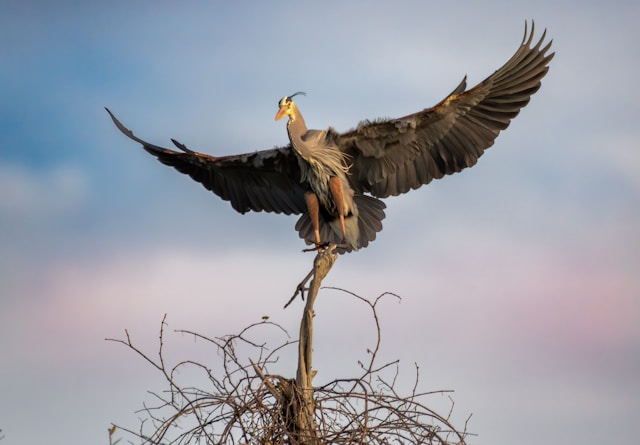
Great Blue Heron in Florida: Identification, Habitat, Nesting & Where to See One
Quick answer: Great Blue Herons (Ardea herodias) are year-round residents in Florida and occur in freshwater and saltwater wetlands across the state. Look for a very large blue-gray heron with a heavy yellowish bill, a pale face, a black stripe over the eye, long legs, and a slow, deliberate hunting style. In southern Florida—especially the Keys—you may also encounter the all-white form often called the Great White Heron.
| Feature | Great Blue Heron in Florida |
|---|---|
| Scientific name | Ardea herodias |
| Florida status | Year-round resident; widespread around suitable wetlands |
| Length | About 38–54 in (97–137 cm) |
| Wingspan | About 66–79 in (167–201 cm) |
| Best field marks | Blue-gray body, heavy yellowish bill, white face, black eye stripe, long legs |
| Main habitats | Marshes, ponds, lakes, canals, estuaries, mangroves, tidal flats and shorelines |
| Diet | Mostly fish, plus amphibians, reptiles, insects and small vertebrates |
| Florida specialty | All-white “Great White Heron” form in coastal southern Florida and the Keys |
How to Identify a Great Blue Heron in Florida
The Great Blue Heron is the largest heron in North America. Adults are tall and long-legged, with a blue-gray body, a long S-shaped neck, a strong yellowish bill and a broad black stripe that runs from above the eye toward the back of the head. The chest and shoulder feathers can look shaggy, especially on breeding adults.
In flight, the neck is pulled back into a tight S shape while the long legs trail behind the tail. That tucked-neck silhouette is one of the easiest ways to separate a heron from a crane, which flies with its neck stretched straight forward.
Are Great Blue Herons Common in Florida?
Yes. Great Blue Herons are regular year-round birds in Florida and can be seen throughout the state wherever shallow water and suitable feeding habitat occur. They use both freshwater and coastal habitats, including ponds, lakes, canals, marshes, mangrove edges, estuaries, mudflats and tidal shorelines.
They are not limited to remote preserves. In Florida they also turn up around retention ponds, golf-course water hazards, fishing piers and developed canals, provided there is enough shallow water and prey.
Great Blue Heron vs Great Egret in Florida
| Feature | Great Blue Heron | Great Egret |
|---|---|---|
| Body color | Blue-gray in the typical form | Entirely white |
| Bill | Large, heavy and yellowish | Long, yellow and more slender |
| Legs | Grayish to brownish/pale | Black |
| Size | Heavier and bulkier | Large but more slender |
| Florida complication | Great White Heron form can be all white | Always white |
The comparison becomes more important in the Florida Keys, where the white form of the Great Blue Heron occurs. A Great White Heron has the Great Blue Heron’s heavy structure and pale legs, while a Great Egret has black legs and a slimmer build.
Great White Heron: Florida’s White Great Blue Heron
Southern Florida is unusual because it supports an all-white form of the Great Blue Heron, commonly called the Great White Heron. Cornell notes that this white form is found mainly in coastal southern Florida, and intermediate birds with a gray body but mostly white head and neck are often called Würdemann’s Herons.
The Florida Keys are especially important for this white form. Do not identify every large white heron as a Great Egret: leg color, overall bulk, bill shape and local range are useful clues.
What Do Great Blue Herons Eat in Florida?
Fish make up much of the diet, but Great Blue Herons are opportunistic predators. They also take frogs, aquatic insects, crustaceans, reptiles and other small animals when available. They usually hunt by standing still or walking slowly through shallow water, then striking forward rapidly with the bill.
They sometimes forage away from water in fields and grassy areas. In suburban Florida, a bird may also investigate decorative fish ponds.
Where Do Great Blue Herons Live in Florida?
Almost any productive shallow-water habitat can attract them. Useful places to scan include freshwater marshes, lake margins, retention ponds, canals, mangrove lagoons, estuaries, tidal flats and quiet shorelines.
Florida’s extensive wetland network means Great Blue Herons can be encountered from the Panhandle to the Keys. Coastal southern Florida is especially interesting because blue, white and intermediate-plumaged birds may occur in the same broader region.
Where to See Great Blue Herons in Florida
You do not need one specific park to find this species, but large protected wetlands make observation easier. Good places to look include:
- Everglades National Park: the National Park Service lists both Great Blue Heron and Great White Heron among the park’s birds, and shallow marshes provide extensive feeding habitat.
- J.N. “Ding” Darling National Wildlife Refuge: the refuge’s official bird list includes Great Blue Heron, and its mangroves, bays and wetland habitats support many wading birds.
- Merritt Island National Wildlife Refuge: its salt marshes, impoundments and estuarine habitats are excellent places to scan for large wading birds.
- Florida Keys wetlands and backcountry: this is the key region for the white form known as the Great White Heron.
- Local ponds, canals and lake edges: Great Blue Herons commonly use developed freshwater habitats as long as prey and shallow feeding water are available.
When visiting nesting or roosting areas, observe from a distance. Florida wildlife agencies warn that repeated disturbance can cause colonial waterbirds to leave nests and expose eggs or young.
Great Blue Heron Nesting in Florida
Great Blue Herons usually build large stick nests in trees, often in colonies called heronries. Nesting sites are generally near productive feeding wetlands, although adults may commute several miles between a colony and feeding areas.
Florida’s long warm season makes nesting timing more flexible than in colder parts of North America. In southern Florida, nesting can begin during winter and continue through spring, and some colonies include several species of wading birds.
Great Blue Heron vs Sandhill Crane
These two tall Florida birds are frequently confused at a distance. A Great Blue Heron has a daggerlike bill and usually keeps its neck folded in flight. A Sandhill Crane has a straighter body profile, a red crown on adults and flies with its long neck fully extended. Cranes also spend much more time walking and feeding in open fields and grasslands.
Great Blue Heron vs Little Blue Heron
A Little Blue Heron is far smaller and slimmer. Adults are dark slate-blue with a purplish head and neck and have a much finer bill. Juvenile Little Blue Herons are white, which creates a different identification challenge, but they still lack the massive size and heavy bill of a Great Blue Heron.
Do Great Blue Herons Migrate in Florida?
Florida supports Great Blue Herons throughout the year. Northern populations elsewhere in North America can migrate south, so Florida may also receive seasonal birds in addition to its resident population. The species can therefore be seen in the state in every season.
Great Blue Heron FAQs
Are Great Blue Herons protected in Florida?
Yes. Great Blue Herons are native migratory birds and are protected under federal migratory-bird law. Give feeding and nesting birds space and avoid disturbing colonies.
Can a Great Blue Heron be completely white?
Yes. In coastal southern Florida, especially around the Keys, an all-white form of Great Blue Heron occurs. It is commonly called the Great White Heron.
What is the easiest way to identify a Great Blue Heron?
Start with size and structure: it is an exceptionally large heron with long legs, a heavy yellowish bill and a long neck. Typical adults are blue-gray with a white face and black eye stripe. In flight, look for the folded neck and trailing legs.
What is the best time of day to see one?
Great Blue Herons can feed throughout the day. Early morning and late afternoon are often comfortable times for birding because activity around wetlands can be high and the light is usually better for observing plumage and bill color.
Related Florida Heron Guide
For a comparison of the state’s other herons, egrets and bitterns, see our Herons in Florida identification guide.
Authoritative References
- Cornell Lab of Ornithology — Great Blue Heron identification
- Cornell Lab of Ornithology — Great Blue Heron overview
- U.S. Fish & Wildlife Service — Great Blue Heron
- Everglades National Park — bird species list
- U.S. Fish & Wildlife Service — J.N. “Ding” Darling refuge bird list

Lexi edits World Birds Life bird-identification and location guides using authoritative references such as the Cornell Lab of Ornithology, eBird, the U.S. Fish and Wildlife Service, and state wildlife agencies. Updated guides check species status, range, habitat, and look-alike differences where relevant.
One Comment