Penguins are some of the most recognisable birds in the world, with their upright posture, tuxedo-like plumage, and charming waddle. While true penguins are found mainly in the Southern Hemisphere, especially Antarctica, several other birds across the globe share a surprisingly similar look. These penguin-like species may not belong to the same family, but their colours, shapes, or behaviours can easily remind you of penguins at first glance.
From seabirds like auks and puffins to flightless oddities like the Great Auk (now extinct), these creatures showcase fascinating examples of convergent evolution—where different species evolve similar traits to adapt to similar environments. In this guide, we’ll explore a list of birds that look like penguins, covering their appearance, habitat, diet, behaviour, breeding habits, and conservation status.
Table of Contents
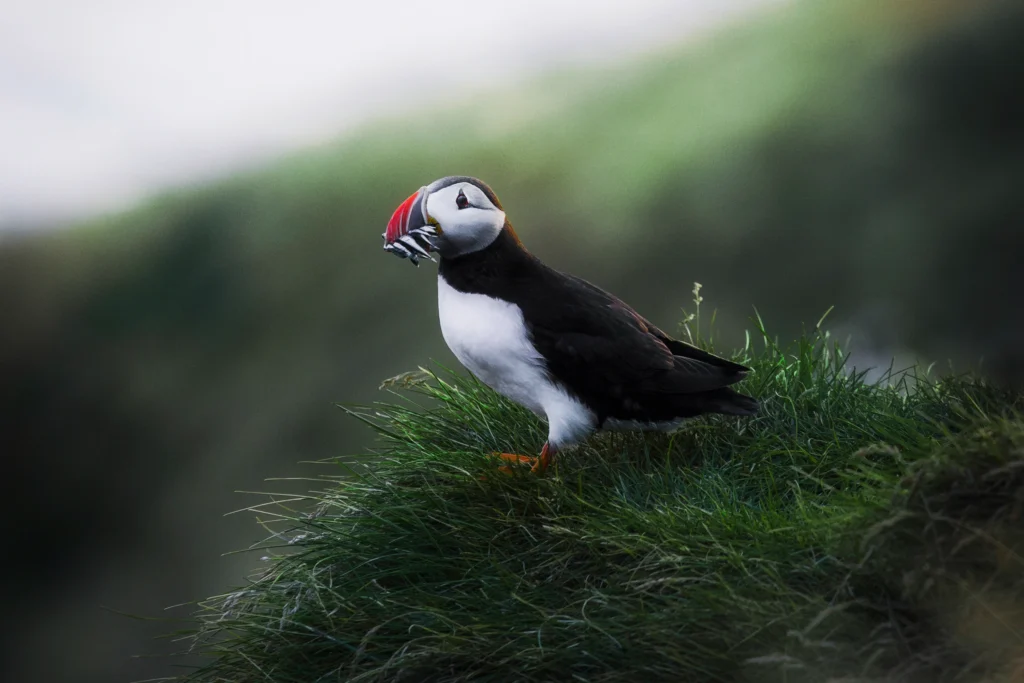
1. Atlantic Puffin
Appearance: The Atlantic Puffin is often dubbed the “clown of the sea” thanks to its colourful beak, but from a distance, its upright stance, black-and-white body, and waddling walk give it a strong resemblance to a miniature penguin.
Habitat: These birds nest along rocky cliffs and islands of the North Atlantic, from Maine to Iceland and the British Isles.
Diet: Puffins feed mostly on small fish such as herring and sand eels, which they catch by diving underwater using their wings to swim.
Behavior: Puffins are expert divers and swimmers but awkward on land, much like penguins. They live in large colonies and communicate with soft growls and bill-tapping.
Breeding: They dig burrows or nest in crevices. A single egg is laid per year, and both parents take turns incubating and feeding the chick.
Conservation: While still common in some regions, puffins face threats from overfishing, climate change, and pollution. Conservation efforts are underway in parts of the UK and US.
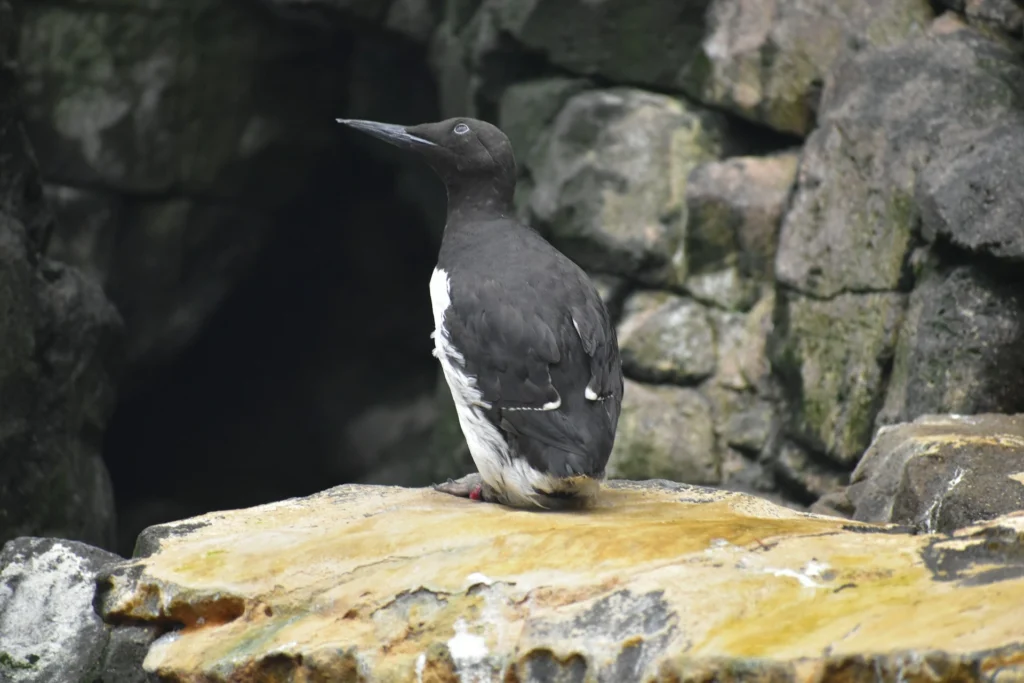
Appearance: The Common Murre stands upright like a penguin and has a sharply defined black-and-white plumage. When viewed from the front, it looks very penguin-like, especially in its breeding plumage with a slender, pointed beak.
Habitat: Murres nest on narrow cliff ledges along the coasts of the North Atlantic and North Pacific. They prefer cold, marine environments and are often seen in large colonies.
Diet: Their diet consists mainly of small schooling fish like capelin, herring, and sardines, which they dive for underwater. They may also eat squid and crustaceans.
Behavior: Murres are agile swimmers and divers, propelling themselves underwater with their wings. However, they’re clumsy on land and in flight. Their social colonies are noisy and tightly packed.
Breeding: They lay a single pear-shaped egg directly on bare rock, and both parents share incubation and feeding duties. Chicks jump off the cliff ledge before they can fly, guided by the calls of their parents.
Conservation: Although populations are generally stable, murres are vulnerable to oil spills, entanglement in fishing gear, and warming oceans that affect fish availability.
Appearance: The Razorbill is another black-and-white seabird with a penguin-like profile. It has a thick, laterally compressed black beak with a white stripe, adding to its unique yet penguin-resembling look. Its upright posture on land only enhances the resemblance.
Habitat: Razorbills breed on rocky cliffs and islands in the North Atlantic, particularly around Iceland, Scandinavia, the UK, and Canada. They spend much of the year at sea.
Diet: These birds primarily eat small fish such as sand eels, capelin, and sprats. They hunt by diving beneath the waves, using their wings to “fly” underwater.
Behavior: Razorbills are fast and agile swimmers, capable of reaching impressive depths. On land, they’re social and nest in crevices or under rocks to stay hidden from predators.
Breeding: They lay a single egg per season, typically in a hidden nook or ledge. Both parents incubate and care for the chick until it fledges and heads out to sea.
Conservation: While globally not endangered, Razorbills are threatened by habitat disturbance, oil spills, and overfishing. Conservationists closely monitor colonies in vulnerable regions.
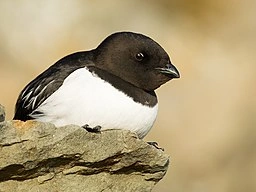
Appearance: The Little Auk, also known as the Dovekie, is a tiny seabird with a compact black-and-white body. Though much smaller than penguins, its short wings, upright posture, and striking contrast in colour give it a strong penguin-like vibe—especially when seen waddling on rocky shores.
Habitat: Little Auks breed in massive colonies on high Arctic islands like Svalbard and Greenland. During winter, they migrate south, often appearing along the North Atlantic coasts.
Diet: They feed mostly on zooplankton, including copepods and krill, which they catch underwater. Their diet can also include small fish and marine invertebrates.
Behavior: These birds are strong swimmers and fly low over the water. They often forage in large flocks and nest in crevices, rock piles, or scree slopes.
Breeding: One egg is laid per season, typically tucked into a rocky cavity. Both parents take part in incubation and chick-rearing duties.
Conservation: Currently listed as Least Concern, but Little Auks are highly vulnerable to shifts in ocean temperatures and prey availability due to climate change.
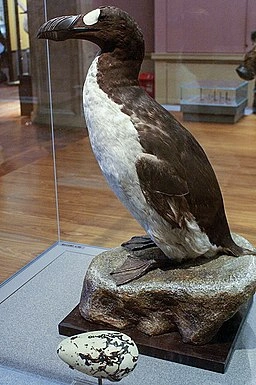
Mike Pennington / Great Auk (Pinguinis impennis) specimen, Kelvingrove, Glasgow
Appearance: The Great Auk was a large, flightless seabird that looked incredibly similar to modern-day penguins. It had a sleek black back, white belly, upright stance, and a heavy, hooked beak with grooves. Standing around 30 inches tall, it was the closest thing to a penguin in the Northern Hemisphere.
Habitat: Great Auks lived along rocky, remote islands in the North Atlantic, from Canada and Greenland to Iceland and northern Europe. They bred in dense colonies on isolated cliffs and coasts.
Diet: These birds fed on fish and crustaceans, which they caught by diving and swimming expertly through cold ocean waters.
Behavior: Much like penguins, Great Auks were excellent swimmers but completely flightless. On land, they moved awkwardly but formed massive breeding colonies with complex social interactions.
Breeding: They laid one large egg per year on bare rock. Both parents incubated the egg and raised the chick. The eggs were highly prized by collectors, contributing to their downfall.
Conservation: Sadly, the Great Auk was hunted to extinction by the mid-1800s for its meat, eggs, and feathers. Its story is often cited as one of the first major conservation tragedies caused by human exploitation.
6. Black Guillemot
Appearance: In winter, the Black Guillemot adopts a striking black-and-white plumage that can resemble a penguin from afar. Its upright stance, compact body, and white wing patches on a dark body enhance this illusion. During summer, it becomes all-black with vivid red legs.
Habitat: This bird is found along rocky coastlines and islands in the North Atlantic, especially around Arctic and sub-Arctic waters. It breeds on cliffs and rocky outcrops and winters near coastal waters.
Diet: Black Guillemots feed on fish, crustaceans, and marine invertebrates. They dive using their wings and can forage at considerable depths.
Behavior: They are solitary or found in small groups, often perched on rocks or ice. Their red feet are visible when flying or swimming. They’re known for their whistling calls and strong site fidelity, often returning to the same nesting spot.
Breeding: Nesting in rocky crevices or under boulders, they lay 1–2 eggs. Both parents take part in incubation and chick feeding.
Conservation: Populations are generally stable, though threats include oil spills, marine pollution, and warming seas affecting prey availability.
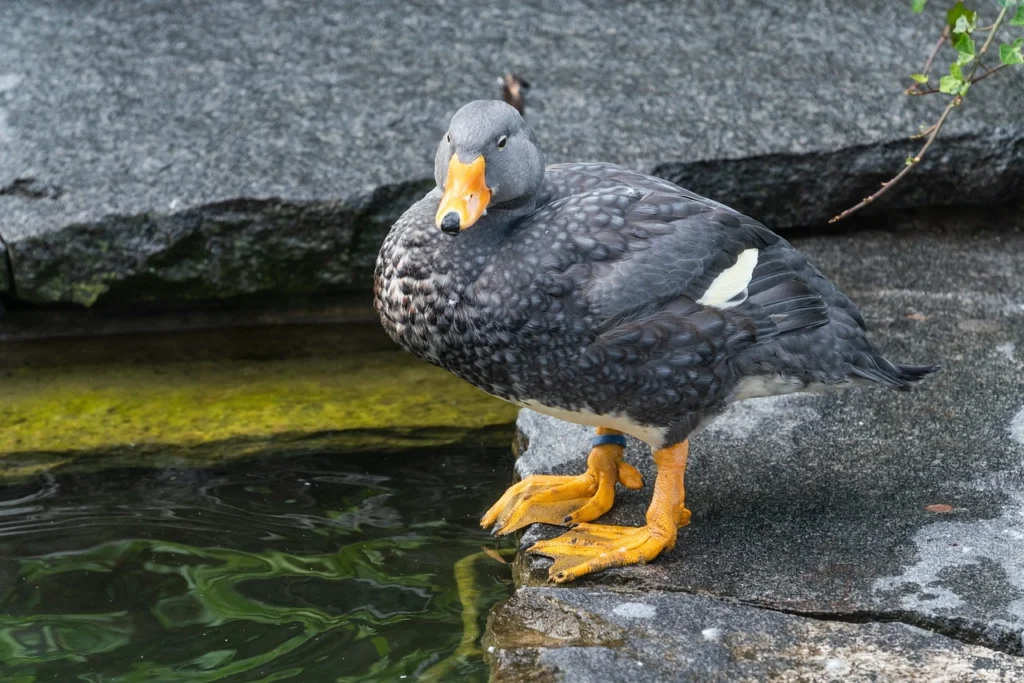
7. Magellanic Flightless Steamer Duck
Appearance: Stout-bodied and heavyset, the Magellanic Flightless Steamer Duck has greyish-brown plumage, a thick neck, and a low-slung build that gives it a penguin-like profile. While not black-and-white like penguins, its waddling gait and flipper-like wings add to the resemblance—especially on land.
Habitat: This duck is native to the southern tip of South America, especially around Tierra del Fuego, Patagonia, and the Falkland Islands. It lives along rocky coasts, bays, and estuaries.
Diet: Its diet includes crustaceans, mollusks, small fish, and aquatic insects. It dives and forages underwater, much like penguins, using powerful strokes of its wings.
Behavior: Unlike most ducks, it cannot fly. Instead, it uses its wings like paddles to “steam” across the water—hence the name. It’s territorial, aggressive, and often engages in splashy chases and fights to defend its area.
Breeding: Nesting occurs in thick vegetation near water. Females lay up to 10 eggs, and the male guards the nest aggressively.
Conservation: It is not currently threatened, but because it’s flightless, it is vulnerable to introduced predators and habitat changes.
Conclusion
Penguins may be icons of the Southern Hemisphere, but they’re not alone in their looks. From the dapper Atlantic Puffin to the extinct Great Auk, many birds across the globe share the penguin’s black-and-white charm, upright stance, or underwater prowess. Whether it’s the Little Auk diving in Arctic seas or the Magellanic Flightless Steamer Duck paddling like a pro, these birds offer an incredible glimpse into the power of evolution and adaptation.
Next time you spot one of these curious seabirds, take a second look—you just might think you’ve found a penguin in disguise.
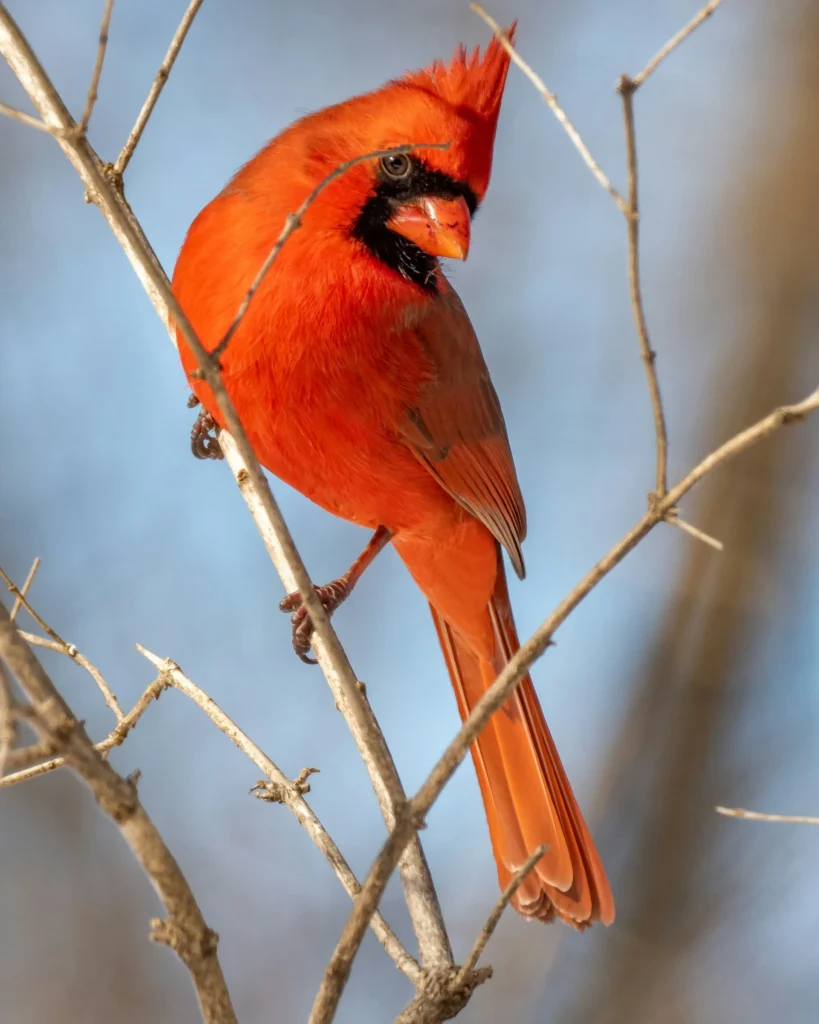
With their bright red plumage and striking crests, Northern Cardinals are among the most recognizable backyard birds in North America. But if you’ve ever spotted a bird that looks like a cardinal but isn’t quite right—maybe it’s missing the red, has a different beak shape, or behaves differently—you’re not alone. Many birds that look like cardinals share similar traits, from shape and size to coloration and song.
In this guide, we’ll explore fascinating bird species that resemble cardinals in one way or another—whether in appearance, behavior, or habitat. These cardinal look-alikes range from red-crested songbirds to muted-toned imitators. Some may even surprise you! Let’s dive into the feathered world of cardinal doppelgängers.
Table of Contents
Pyrrhuloxia (Desert Cardinal)
Appearance
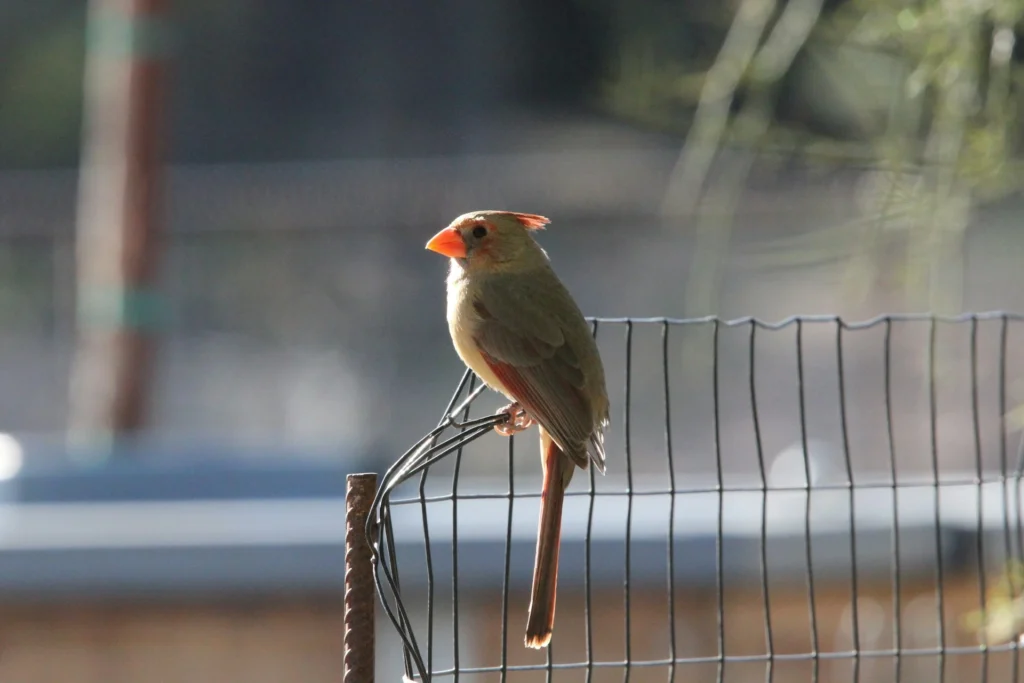
The Pyrrhuloxia is often called the “Desert Cardinal” for good reason—it looks like a Northern Cardinal in a dusty disguise. Males have a red face, crest, and breast, but their overall body is more grey than red. Females are mostly grayish with subtle red highlights on the wings and crest. Both sexes share the distinctive high crest and stout, parrot-like yellowish bill.
Habitat
Pyrrhuloxias are native to the arid regions of the American Southwest and northern Mexico. You’ll often find them in desert scrub, mesquite thickets, and dry woodlands, especially in Texas, Arizona, and New Mexico.
Diet
Their diet includes seeds, berries, and insects. Like their Northern cousins, they forage on the ground and in low shrubs. They’re particularly fond of sunflower seeds and cactus fruit in the wild.
Behavior
Pyrrhuloxias behave similarly to cardinals—perching high to sing, defending territory, and appearing at feeders. During the breeding season, males sing loudly and frequently. Outside of breeding, they often join mixed-species flocks for safety.
Song
Their call is a crisp, metallic “cheep” and their song is a series of whistled notes that resemble a more muted version of the Northern Cardinal’s song. It’s less melodic but still pleasant.
Nesting
They build small, cup-shaped nests in thorny shrubs or low trees. Females lay 2–4 eggs and do most of the incubating while the male keeps watch nearby.
Conservation
Pyrrhuloxias are stable in population and not currently under threat. They benefit from desert conservation efforts and adapt well to backyard feeders in desert-edge suburbs.
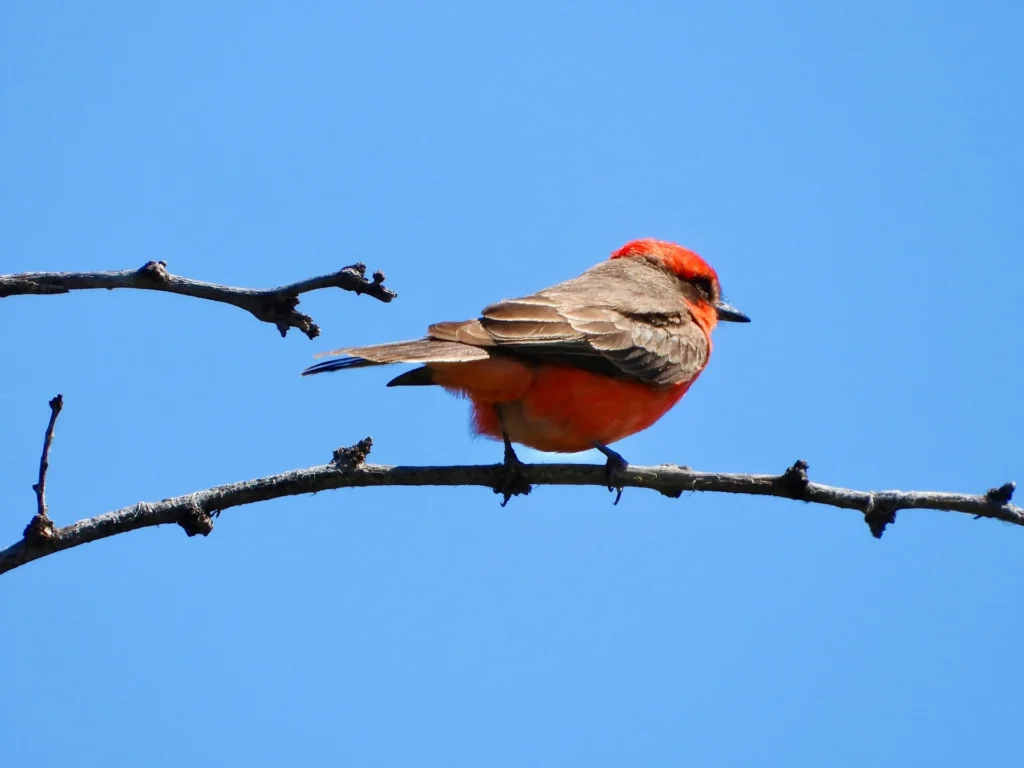
The male Vermilion Flycatcher is a fiery burst of color—his vibrant red crown, face, and underparts contrast sharply with a sooty brown back, wings, and tail. Though smaller and slimmer than a cardinal, his bright red plumage might cause a moment of confusion. Females look quite different, with peachy or buff bellies and grayish-brown upperparts, resembling a toned-down cardinal from a distance.
Habitat
These striking birds thrive in open woodlands, scrublands, desert edges, parks, and ranchlands across the southwestern United States, Mexico, and parts of Central and South America. They often perch visibly on fences or low branches.
Diet
Vermilion Flycatchers are insect specialists. They catch flies, beetles, and other flying insects on the wing using a classic “sallying” technique—darting out from a perch to snatch prey midair. Occasionally, they supplement their diet with berries or seeds.
Behavior
These flycatchers are animated and acrobatic. Males often perform courtship flights with fluttering wings and chirpy songs. They’re highly territorial during the breeding season and frequently return to the same perches day after day.
Song
Their song is a rapid, chattery series of chips and whistles, not as melodious as a cardinal’s but still cheerful and persistent. Males sing more during courtship and early morning hours.
Nesting
Females build a small, compact nest on horizontal branches or forks of trees. They lay 2–4 speckled eggs, and while the female incubates, the male often feeds her or stands guard nearby.
Conservation
Populations are generally stable, although habitat loss in parts of their range can pose localized threats. Their vivid color and insect-eating habits make them a welcome sight in natural and suburban areas alike.
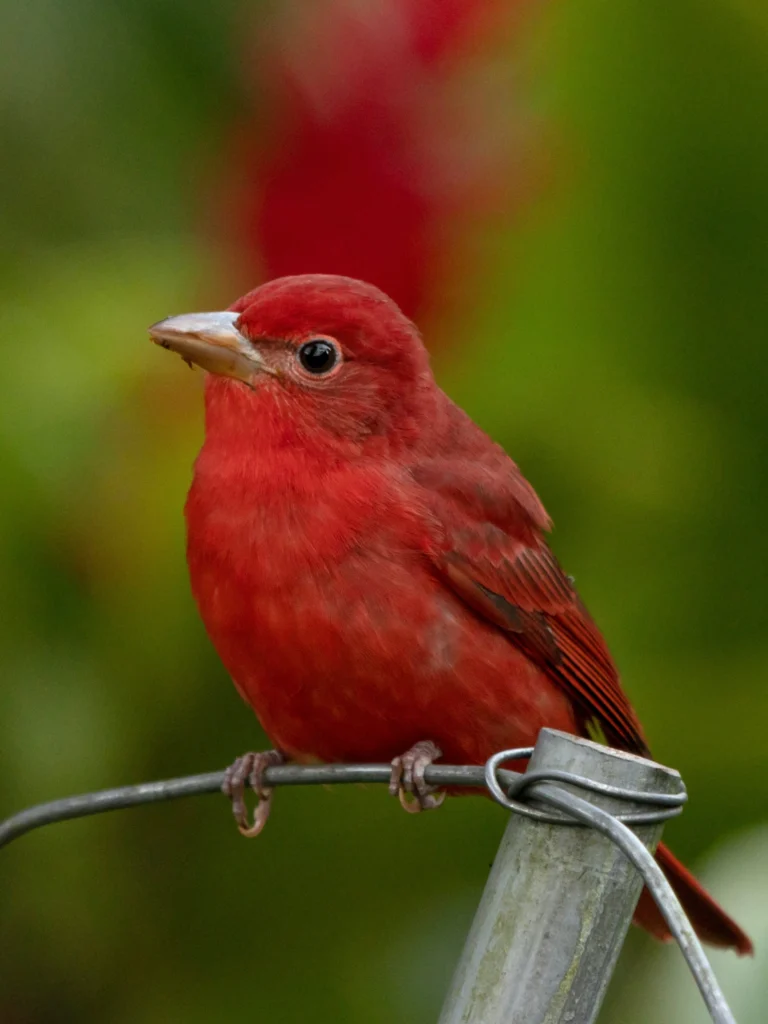
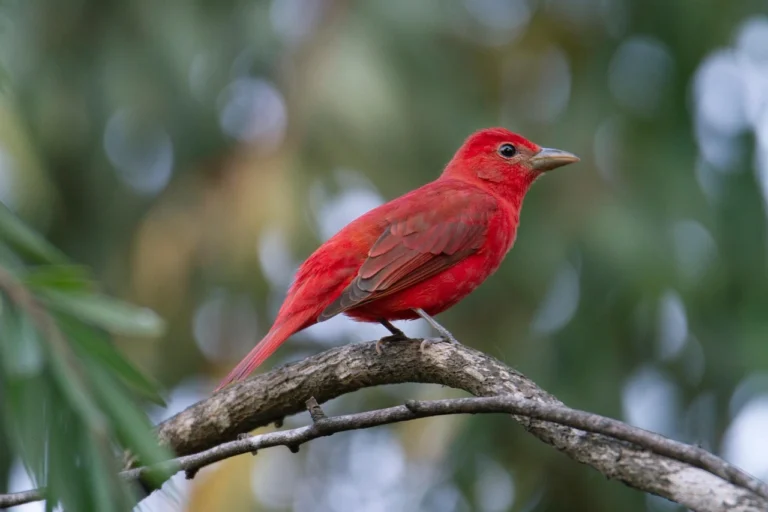
The male Summer Tanager is often mistaken for a cardinal due to his rich red color—but unlike the Northern Cardinal, he lacks a crest and has a slimmer, sleeker build. His red is more uniform and slightly rosier. The female Summer Tanager, on the other hand, is yellow to yellow-orange, which can cause her to be confused with juvenile cardinals or other songbirds.
Habitat
Summer Tanagers breed in deciduous and mixed woodlands, especially in the southeastern United States. They prefer areas with tall trees and open canopies, such as river edges, oak forests, and pine woodlands. During winter, they migrate to Central and South America.
Diet
They feed heavily on insects—especially bees and wasps. Summer Tanagers are known for catching wasps mid-air, removing their stingers by rubbing them on branches, and then eating them. They also eat berries and fruits, particularly during migration.
Behavior
These birds are quiet and stealthy compared to cardinals. They tend to stay in the treetops and may go unnoticed unless you’re looking carefully. Males sing to defend territories, and both sexes forage methodically among leaves and branches.
Song
The male’s song is a series of melodic whistles, very similar to an American Robin’s but more fluid and less sharp than a cardinal’s. Their call notes include a soft “pik-i-tuk” sound, often heard during foraging.
Nesting
The female builds a cup-shaped nest in a horizontal tree branch. She lays 3–4 pale blue or greenish eggs and incubates them while the male sings and forages nearby. After hatching, both parents feed the chicks.
Conservation
Summer Tanagers are doing well overall, although habitat loss in both breeding and wintering grounds can pose challenges. They’re welcome visitors in backyards with native trees and fruiting plants.
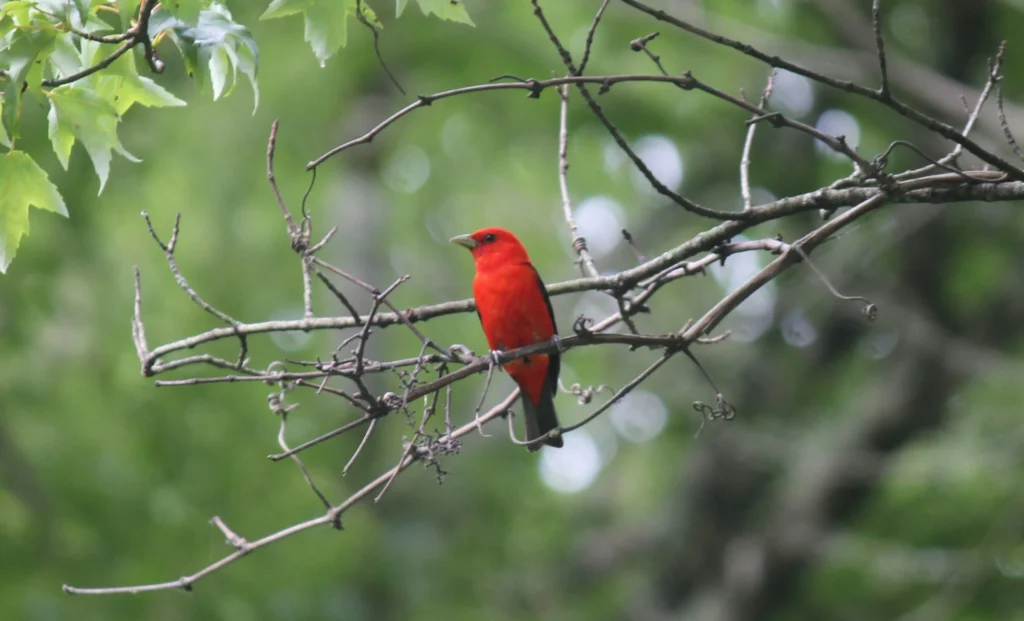
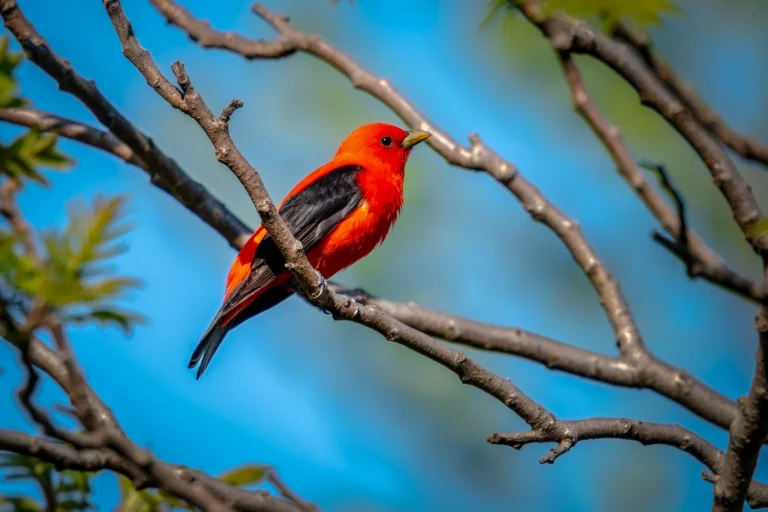
Male Scarlet Tanagers are breathtaking, with brilliant scarlet-red bodies and stark black wings and tails—a dramatic contrast to the uniform red of male Northern Cardinals. They lack the cardinal’s crest and have a more compact, rounded body. Females look entirely different, sporting olive-yellow plumage with darker wings, making them easy to confuse with other songbirds or even juvenile cardinals.
Habitat
Scarlet Tanagers prefer mature deciduous and mixed forests, especially in the northeastern and central United States. They spend most of their time high in the tree canopy and migrate to the Amazon Basin in South America during winter.
Diet
Their diet includes insects, spiders, and fruit. They forage actively in the treetops, snapping up flying insects or plucking berries from branches. They’re known to visit fruiting trees in summer and fall.
Behavior
Scarlet Tanagers are secretive and spend much of their time hidden in the leafy canopy. Males sing boldly during the breeding season to attract mates and defend territory, while females remain quieter and more camouflaged.
Song
The male’s song is a buzzy, robin-like series of phrases, often described as a “robin with a sore throat.” It’s less musical than a cardinal’s song but still easily identifiable with practice. Their sharp “chip-burr” call is often heard during flight or when alarmed.
Nesting
Females build loosely woven nests on horizontal branches of deciduous trees. They typically lay 3–5 pale eggs with dark speckling. Males often stay nearby while the female incubates.
Conservation
Scarlet Tanagers face threats from forest fragmentation and collisions during migration. However, their population remains stable. Planting native trees and preserving mature forests can support their breeding success.
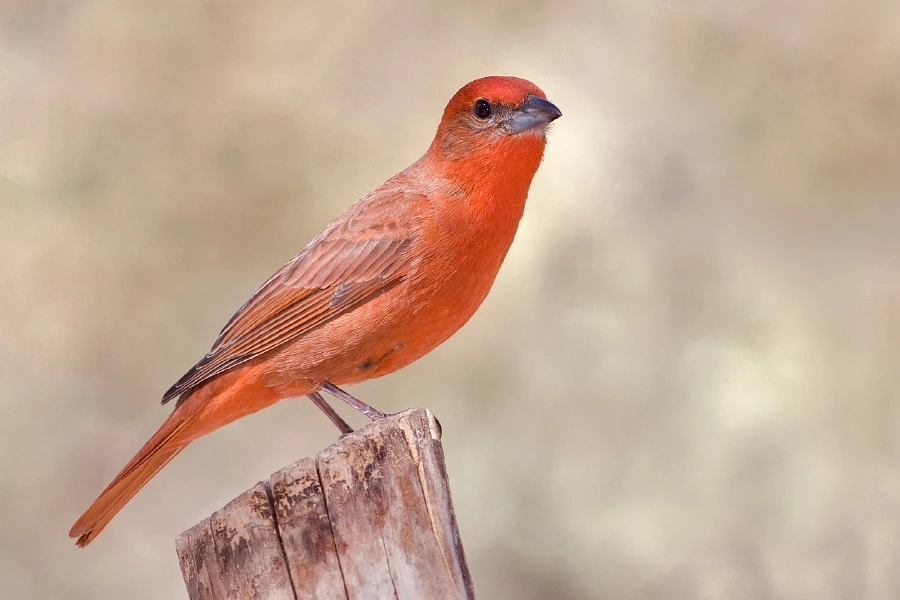
The male Hepatic Tanager has a dusky red or brick-red body, noticeably duller than the vivid red of a Northern Cardinal or Scarlet Tanager. His wings and back have a grayish or liver-colored tone (hence the name “hepatic”). Females and juveniles are yellowish-olive with rusty tinges, and may resemble female cardinals from a distance. Like other tanagers, they lack a crest and have a stout, slightly hooked bill.
Habitat
Hepatic Tanagers are found in montane pine-oak forests and woodlands of the southwestern U.S., Mexico, and Central America. They prefer higher elevations and are less common in suburban areas.
Diet
Their diet includes insects, spiders, berries, and small fruits. They forage slowly and methodically in trees and shrubs, often working in pairs or small family groups during the breeding season.
Behavior
These birds are deliberate and quiet, often foraging out of sight in the mid to upper canopy. They may join mixed flocks outside the breeding season and can be difficult to spot unless you’re actively scanning tree branches.
Song
Their song is a series of slow, slurred warbles, similar to the Summer Tanager but with a deeper, more nasal tone. Their calls include a low, dry “chup” sound, often heard while foraging.
Nesting
The female constructs a cup-shaped nest in trees or large shrubs. She lays 2–4 pale, speckled eggs and incubates them while the male stands guard. After hatching, both parents help feed the chicks.
Conservation
Hepatic Tanagers have a relatively stable population, though habitat loss in mountainous areas may affect their range. They’re rarely seen at feeders but can be attracted with native plants and berry-producing shrubs.
Phainopepla
Appearance
The Phainopepla (pronounced fay-no-PEP-la) is a sleek, glossy black songbird with a tall crest, often mistaken for a cardinal from afar due to its crest, slim silhouette, and upright posture. Males are iridescent black with bright red eyes and a tall feathered crest. Females are soft gray with the same crest and red eyes. Both sexes flash white wing patches in flight—something cardinals do not have.
Habitat
Phainopeplas inhabit desert washes, arid woodlands, and chaparral across the Southwestern U.S. and Mexico. They’re particularly drawn to areas with mistletoe, their favorite food source. You might spot them perching atop shrubs or trees, especially in places like Arizona, California, and New Mexico.
Diet
Their diet consists mainly of mistletoe berries, which they consume in large quantities, but they also eat other fruits and catch insects in flight. They are known for regurgitating mistletoe seeds and helping spread the plant across desert environments.
Behavior
Phainopeplas are often seen perching high with their crest raised, keeping watch over their territory. They’re fairly solitary, though pairs form strong seasonal bonds. Males often return to the same perch repeatedly and are very vocal during the breeding season.
Song
They have a wide variety of whistles, warbles, and imitations, sometimes mimicking other desert birds like scrub-jays or cardinals. Their song is often quiet but intricate, and they may call with a sharp “wurp” or “chew.”
Nesting
Unusually, they may nest twice a year in different habitats—deserts in early spring and oak woodlands in summer. Nests are small cups placed in tree forks or shrubs, with both parents sharing duties of incubation and chick-rearing.
Conservation
Phainopeplas are not considered threatened but may be sensitive to changes in desert plant communities and mistletoe availability. They are fascinating desert specialists that bring a cardinal-like flair to the arid southwest.
Cedar Waxwing
Appearance
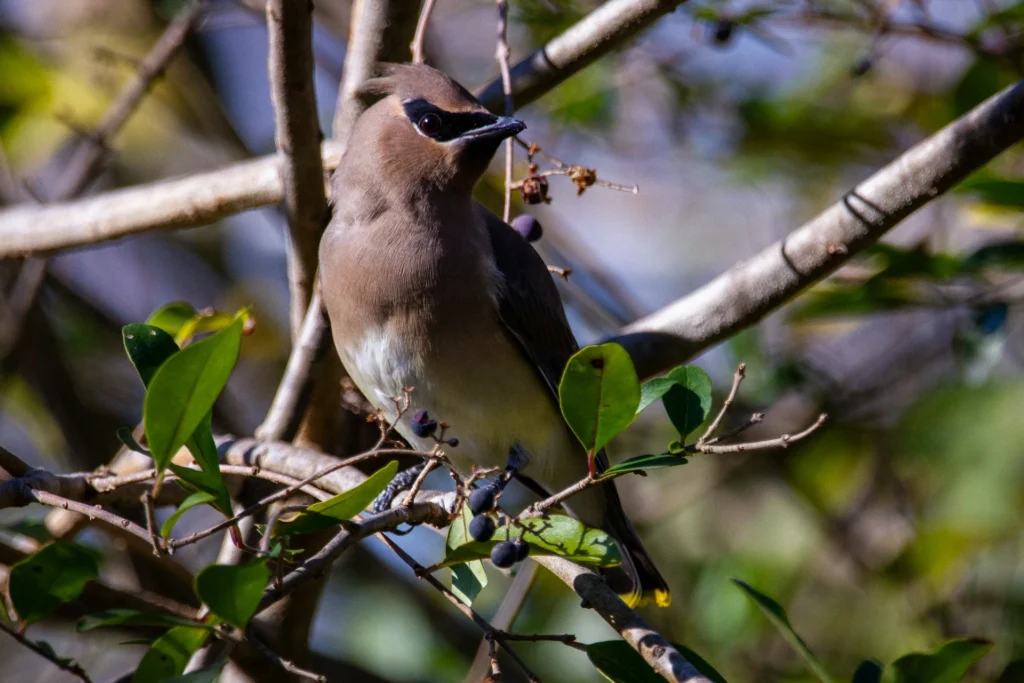
The Cedar Waxwing may not be red like a cardinal, but its elegant crest, silky feathers, and black facial mask can easily confuse casual observers. This bird has a smooth, pale brown head and chest, blending into soft gray wings and a lemon-yellow belly. The tail is tipped with a neat yellow band, and mature birds have waxy red tips on their wing feathers, giving them their name.
Habitat
Cedar Waxwings are found across North America, often in woodlands, orchards, parks, and residential areas with fruiting trees. They’re especially visible in fall and winter when they travel in large flocks to feast on berries.
Diet
Their diet is almost entirely fruit-based, making them unique among North American songbirds. They devour berries from trees like juniper, dogwood, serviceberry, and cedar. In summer, they’ll also eat insects, especially when feeding young.
Behavior
Cedar Waxwings are extremely social and gentle, often seen perching shoulder to shoulder in tight-knit groups. They even pass berries to one another during courtship. Despite their cardinal-like crest, they move in flocks rather than holding territories like cardinals.
Song
Their vocalizations are soft, high-pitched trills and whistles, often described as a “sreee” or “seee” sound. Unlike cardinals, they do not sing melodically and are more likely to be heard as a background chorus.
Nesting
Females build cup-shaped nests in tree branches using twigs, grasses, and moss. They lay 2–5 eggs, and both parents feed the chicks. These birds often nest later in the season to coincide with the ripening of summer berries.
Conservation
Cedar Waxwings are widespread and thriving. They benefit from urban and suburban plantings of fruiting trees and bushes. However, they are vulnerable to fermenting berries, which can cause temporary intoxication or collisions with windows.
House Finch (Male)
Appearance
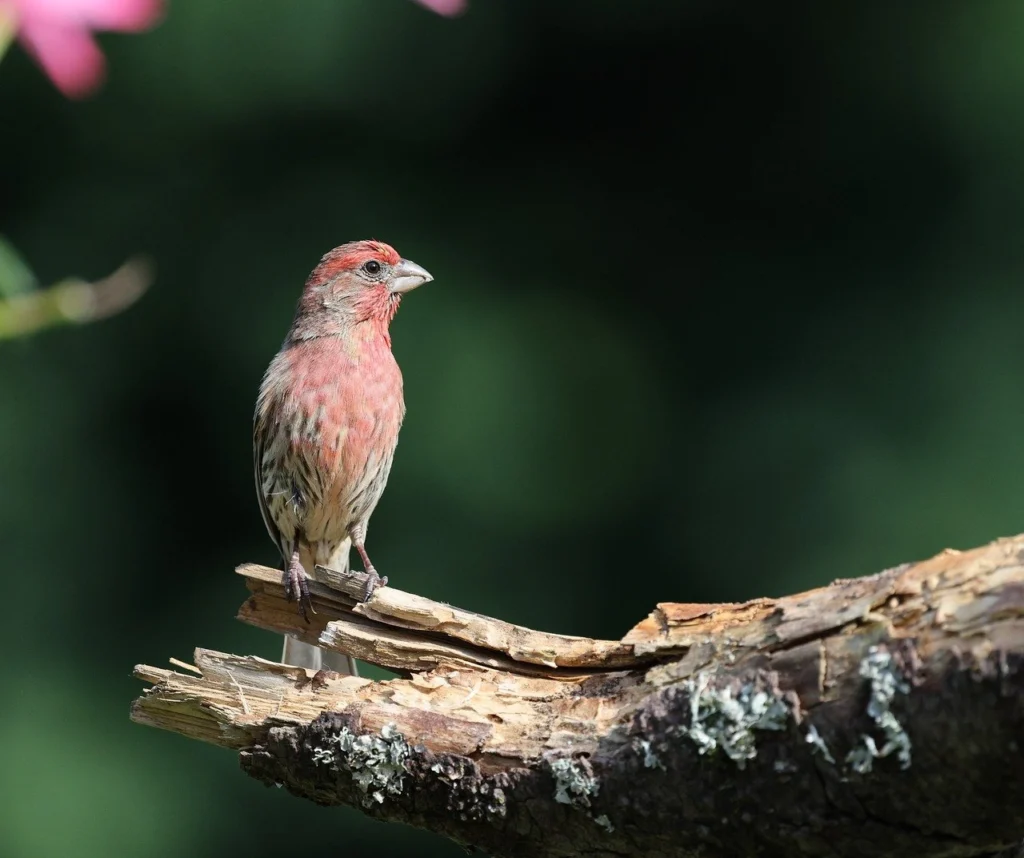
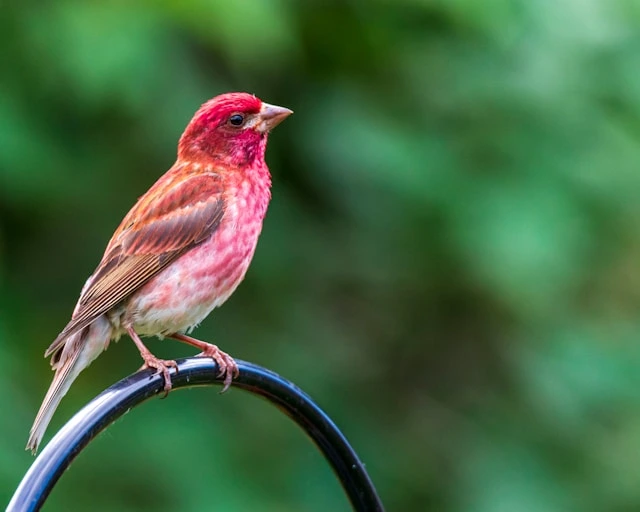
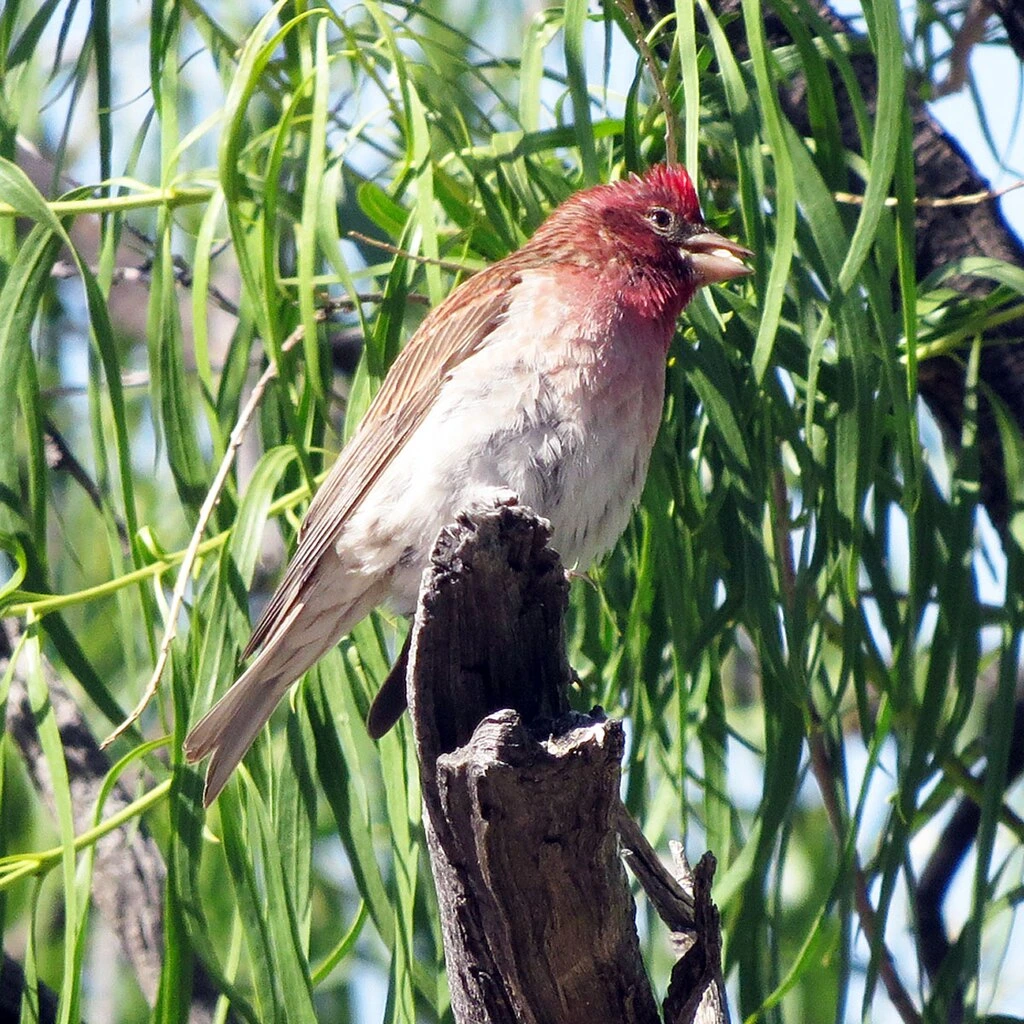
The male House Finch features a rosy-red head, chest, and rump, which can resemble a dull Northern Cardinal at a glance. However, he lacks the cardinal’s crest and has streaky brownish-gray wings and flanks. The red coloring varies by diet—some males appear more orange or even yellow. Females are entirely streaky brown and gray, without any red, often confused with juvenile cardinals or sparrows.
Habitat
House Finches are highly adaptable and common across urban, suburban, and rural environments throughout the United States and southern Canada. You’ll find them in backyards, parks, farms, deserts, and city centers alike.
Diet
They primarily eat seeds, grains, buds, and fruits. At feeders, they’re frequent visitors for sunflower seeds and millet. Unlike cardinals, they have a slightly more slender bill, suited for cracking smaller seeds.
Behavior
House Finches are gregarious and social, often found in flocks. Males sing from treetops or wires to defend small territories, but they are not as territorial as cardinals. They’re very accustomed to human presence and will readily nest near homes or on porches.
Song
The male’s song is a bright, warbling series of chirps and trills, often described as cheerful and jumbled. It differs from a cardinal’s whistled phrases but is quite musical in its own right.
Nesting
They build messy, cup-shaped nests in a variety of locations: tree branches, hanging planters, vents, ledges, and light fixtures. Females typically lay 2–6 pale blue eggs. House Finches often raise multiple broods in one season.
Conservation
Once native only to the western U.S., House Finches now thrive across the East Coast too. They’re one of North America’s most successful urban birds. However, they can suffer from eye disease (Mycoplasma), which spreads at feeders—clean feeders regularly to help prevent outbreaks.
Red Crossbill
Appearance
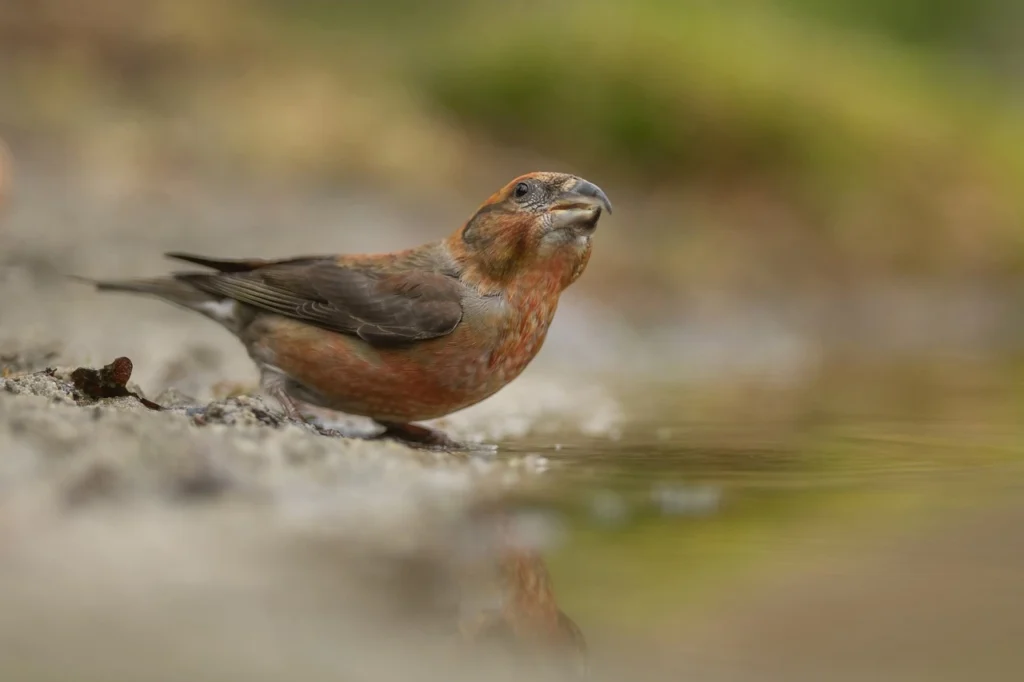
The male Red Crossbill sports a deep red to reddish-orange body with brownish wings and tail, often drawing comparisons to male cardinals. The most striking feature, though, is its unique crossed bill tips, specially adapted to pry open conifer cones. Males vary widely in color—from bright red to rusty or yellowish depending on age and diet. Females and juveniles are olive-gray to yellowish, with subtle streaking and the same distinctive bill.
Habitat
Red Crossbills inhabit coniferous forests across North America, especially where pine, spruce, or fir trees are abundant. Their range is nomadic, and they may show up unexpectedly in parks, cemeteries, or feeders during cone crop failures elsewhere.
Diet
These birds feed almost exclusively on conifer seeds. Their crossed bills are ideal for prying apart scales of pine cones to extract seeds. They also eat sunflower seeds, weed seeds, and occasionally insects during nesting.
Behavior
Red Crossbills are highly mobile and irregular in movement, traveling great distances in search of cone crops. They forage in flocks and may hang upside-down from branches to access cones. They are less territorial than cardinals and nest opportunistically when food is abundant—even in winter.
Song
Their song is a series of short, warbling notes and varied trills, less musical than a cardinal’s. They give frequent “jip-jip” or “kip-kip” flight calls that help keep flocks together.
Nesting
Unusual among songbirds, Red Crossbills may nest in mid-winter if cone crops are good. Nests are built in conifers, where females lay 2–5 bluish-white, spotted eggs. Both parents feed the chicks with regurgitated seeds.
Conservation
Red Crossbills are not considered threatened, but some subspecies have limited ranges and may face habitat-specific risks. Their nomadic lifestyle makes them hard to monitor, but they remain a fascinating, cone-loving cousin to cardinal fans.
Northern Flicker
Appearance
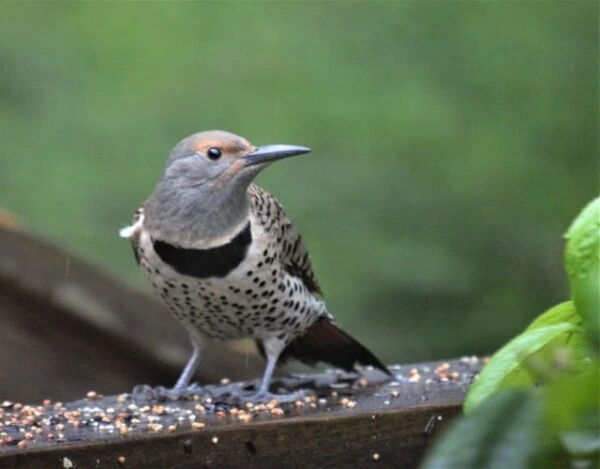
The Red-shafted Northern Flicker is a large woodpecker with a unique appearance that can occasionally be confused with a cardinal—especially in flight. While overall tan or grayish-brown, this flicker has bold red underwings and undertail feathers that flash brightly when flying. Males also have a red “mustache” mark on the face. Their spotted bellies, barred backs, and black crescent bib help distinguish them from cardinals on closer look.
Habitat
These birds thrive in a wide variety of open habitats, including woodlands, forest edges, parks, deserts, and suburban areas across western North America. They are often seen foraging on the ground, unlike most other woodpeckers.
Diet
Northern Flickers primarily eat ants and beetles, which they dig from the soil using their long, barbed tongues. They also enjoy berries, fruits, and seeds, especially in winter. You might spot them at suet feeders or probing lawns for insects.
Behavior
Unusual for a woodpecker, flickers often spend time on the ground. They perch on tree trunks, fences, and power lines but are just as likely to be seen hopping across your yard. They’re strong fliers with undulating flight patterns and distinctive red flashes under their wings.
Song
Flickers produce a loud, repeating “kleer” call and a series of rhythmic “wicka-wicka” notes. Their drumming on hollow trees, metal poles, or chimneys is often part of their territorial display.
Nesting
They excavate cavity nests in dead trees, wooden poles, or even buildings. Both sexes participate in nest-building and incubation, typically laying 5–8 white eggs. Flickers may reuse or expand old nesting sites year after year.
Conservation
Northern Flickers are widespread but face challenges from habitat loss and competition for nesting cavities. They’re still common backyard visitors and can be encouraged with dead trees, nest boxes, and ant-rich lawns.
Rose-breasted Grosbeak (Male)
Appearance
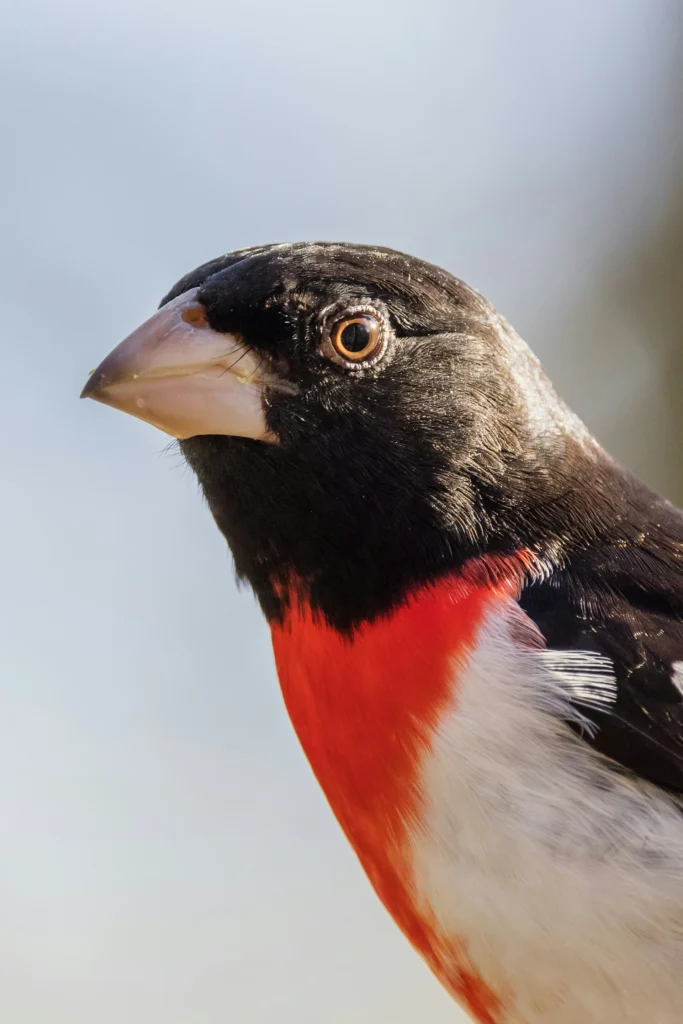
The male Rose-breasted Grosbeak is an eye-catching bird with a black head and back, white underparts, and a vivid triangular red patch on the chest. From a distance, this bold splash of red can remind birders of a cardinal. Both males and females have a large, conical, pale bill similar to a cardinal’s. Females, however, are streaky brown with white eyebrow stripes, resembling oversized sparrows rather than cardinals.
Habitat
These grosbeaks prefer deciduous and mixed forests, often near clearings, edges, and riversides. During migration, they’re frequent visitors to backyard feeders and gardens across much of the eastern and central United States.
Diet
Their diet is varied, consisting of insects, seeds, and fruits. In summer, they eat beetles, caterpillars, and grasshoppers, while in fall and spring, they switch to berries and seeds. At feeders, they enjoy sunflower seeds and occasionally suet.
Behavior
Rose-breasted Grosbeaks are relatively shy and deliberate in their movements, preferring leafy cover while foraging. Males sing persistently during breeding season, while females may respond with softer versions of the song.
Song
Their song is a sweet, melodious warble, often compared to a robin’s but more fluid and musical. The male’s song is one of the most beautiful in North American woodlands. Their sharp “chink” call note is also distinctive.
Nesting
Females build loosely constructed cup nests in trees or shrubs, typically 5–15 feet above ground. They lay 3–5 pale greenish-blue eggs with darker speckles. Interestingly, both parents share equally in incubation and chick-rearing duties.
Conservation
Rose-breasted Grosbeaks are fairly common but face pressures from habitat loss and collisions with windows during migration. They remain widespread and are considered a beloved backyard visitor for their beauty and song.
Blue Grosbeak (Female)
Appearance
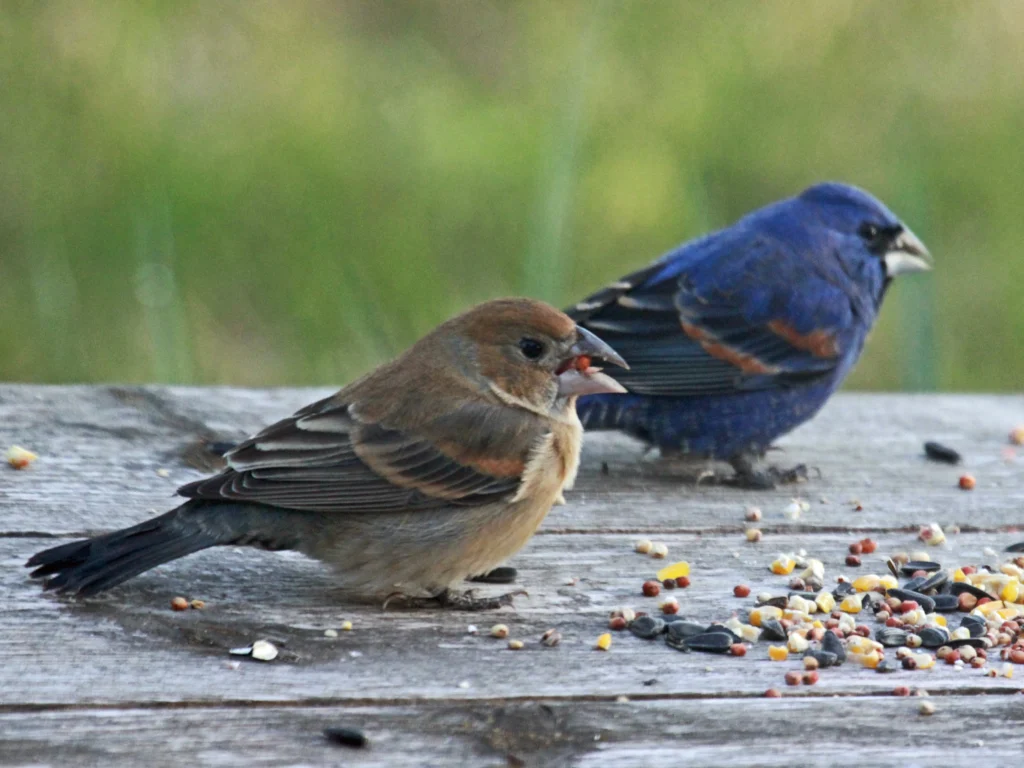
While the male Blue Grosbeak is a stunning deep blue with chestnut wing bars, it’s the female that often draws comparisons to cardinals. She has a warm brown or cinnamon-colored body with touches of blue on the wings and tail. Like the Northern Cardinal, she has a large, conical bill and similar body shape, though she lacks a crest. At a glance, her rich coloring and posture can easily lead to confusion with a female cardinal.
Habitat
Blue Grosbeaks prefer brushy fields, forest edges, overgrown pastures, and shrubby roadways across the southern and central United States. They often nest in dense vegetation near open areas and are most visible during the breeding season.
Diet
Their diet includes a mix of insects, seeds, and grains. They forage low in shrubs or on the ground and will occasionally visit feeders stocked with sunflower seeds or millet.
Behavior
Blue Grosbeaks are relatively secretive and shy, often staying hidden in thick shrubs. Males sing from exposed perches, while females stay closer to the nest. They are territorial during breeding but often migrate in mixed flocks.
Song
Males sing a rich, musical warble, similar to an Indigo Bunting but slower and more deliberate. Their call note is a soft “chink” or metallic “tink,” which can be heard as they move through cover.
Nesting
The female builds a nest low in dense vegetation, usually no more than 6 feet off the ground. She lays 3–5 pale blue eggs and incubates them alone. Males may feed the female during nesting and help raise the young once they hatch.
Conservation
Blue Grosbeaks are expanding their range northward and are not currently threatened. Providing brushy native plants and seed sources can help attract them to suitable habitats.
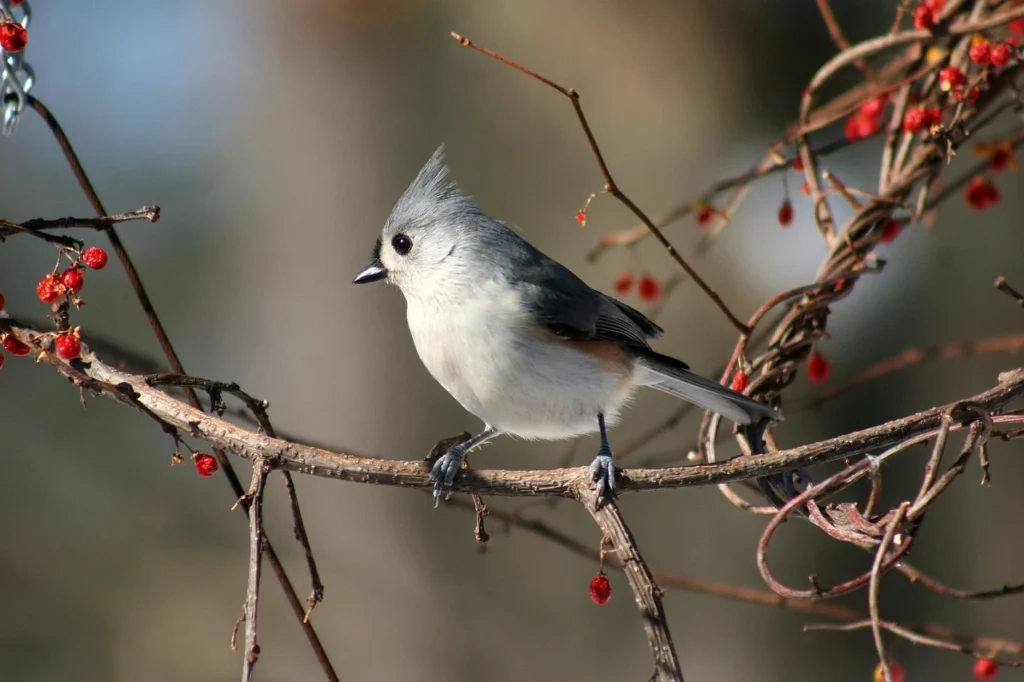
Black-crested Titmouse
Appearance
The Black-crested Titmouse is a petite, gray songbird with a bold black crest and white face, giving it a cardinal-like profile—especially from a distance. Unlike Northern Cardinals, it lacks red coloring entirely, but its crest and upright posture lead many to mistake it for a juvenile or female cardinal. Its underparts are pale gray, sometimes with a slight buff wash on the flanks.
Habitat
This species is primarily found in central and southern Texas and northeastern Mexico, especially in oak woodlands, mesquite brushlands, and suburban neighborhoods with plenty of trees.
Diet
Black-crested Titmice feed on a combination of insects, seeds, berries, and nuts. They’re agile foragers, often seen hanging upside-down to pluck food. At feeders, they readily eat sunflower seeds, suet, and peanuts.
Behavior
They are inquisitive, active, and often travel in mixed flocks with chickadees and woodpeckers. These titmice cache food in bark crevices and will readily explore bird feeders and even windowsills. Their fluttery, fast movements differ from the more deliberate posture of cardinals.
Song
Their vocalizations are sharp and whistled, usually a repeated “peter-peter-peter” or high-pitched “see-see-see.” While not musical like a cardinal, their song carries well through wooded areas.
Nesting
They are cavity nesters, using natural tree holes or nest boxes. Females lay 5–7 speckled eggs in a cozy, down-lined cup. Both parents feed the chicks, and the species readily adapts to nest boxes in urban areas.
Conservation
The Black-crested Titmouse has a stable and healthy population. It’s closely related to the Tufted Titmouse, with which it hybridizes in overlapping zones. Providing nest boxes and keeping feeders stocked helps support this friendly, crest-bearing bird.
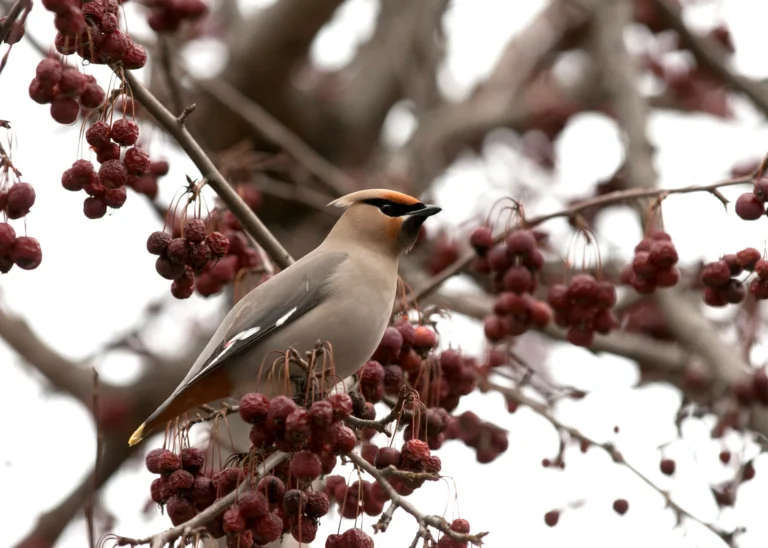
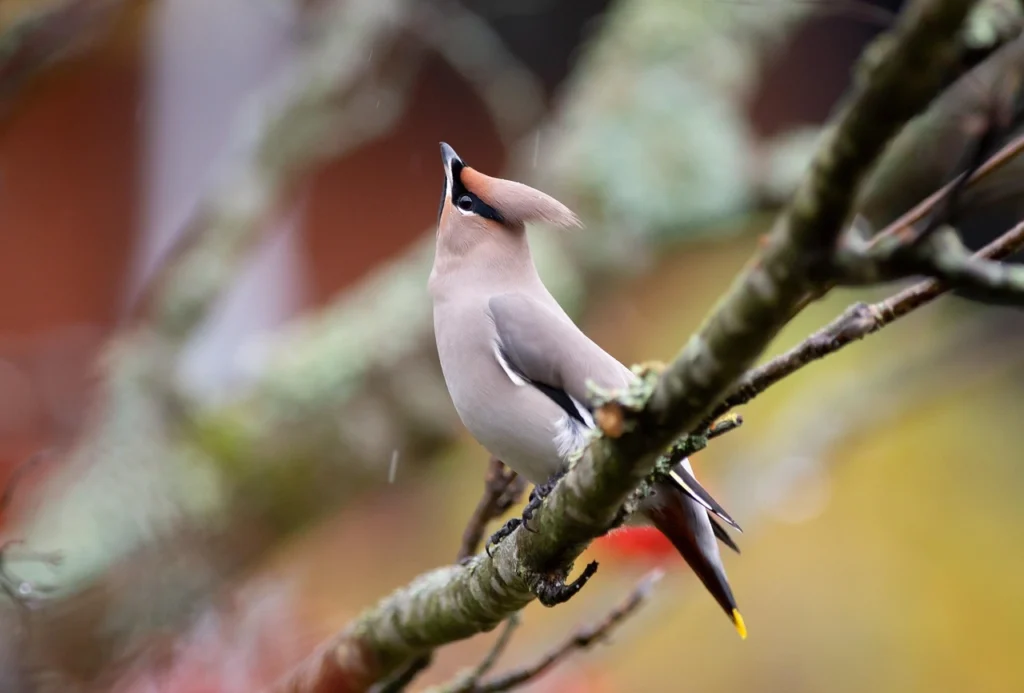
Bohemian Waxwing
Appearance
The Bohemian Waxwing is a sleek, silky bird with a soft gray-brown body, a pointed crest, and a striking black mask—all features that echo the Northern Cardinal’s silhouette. While it lacks the bright red coloration, its red-tipped wing feathers, yellow tail band, and rufous undertail give it a colorful, regal look. It’s slightly larger and more robust than the closely related Cedar Waxwing.
Habitat
Bohemian Waxwings breed in boreal forests across the far north of Canada, Alaska, and Eurasia, but in winter they move south into the northern U.S., especially the Northwest and Great Lakes regions, where they seek out fruiting trees and shrubs.
Diet
Their diet is heavily fruit-based. In winter, they form large flocks and feast on berries from mountain ash, juniper, crabapple, dogwood, and cedar trees. In summer, they’ll eat insects, especially during nesting.
Behavior
Bohemian Waxwings are highly gregarious, often forming tight flocks that move in unison from tree to tree. They are gentle and non-territorial, often mixing peacefully with other berry-loving species. Their graceful movements and clean plumage make them seem almost royal.
Song
Their call is a high-pitched, thin trill or “tseee” that sounds more like a hiss than a whistle. They are generally quiet birds, especially when compared to vocal songbirds like cardinals.
Nesting
Nesting occurs in remote northern conifer forests. The female builds a cup-shaped nest high in trees and lays 3–6 pale blue, speckled eggs. Both parents participate in feeding the young once hatched.
Conservation
Bohemian Waxwings have stable populations but are sensitive to berry crop failures and habitat changes. Because they move nomadically in winter, their presence can be unpredictable but thrilling for birders lucky enough to spot them.
Conclusion: More Than Just a Red Bird
The Northern Cardinal may be one of the most recognizable birds in North America, but it’s far from the only one with eye-catching colors, crested heads, or melodic songs. From the dusty-red Pyrrhuloxia of the Southwest to the raspberry-toned Purple Finch and the flashy Vermilion Flycatcher, many species share similar traits that can cause birdwatchers to take a second look.
Whether you’re spotting birds in your backyard or out on a woodland trail, these cardinal look-alikes add rich variety and surprises to the birding experience. Learning their subtle differences—in shape, behavior, song, and color tone—enhances your connection to nature and helps you appreciate just how wonderfully diverse our feathered world really is.
Birds That Look Like Blue Jays often catch the eye of curious birdwatchers with their vivid plumage, bold personalities, and clever behavior. While Blue Jays are among the most recognizable birds in North America—famed for their bright blue feathers, crest-topped heads, and loud, expressive calls—they aren’t the only species flaunting that signature blue charm. Across the U.S. and beyond, a variety of birds share similar traits in color, shape, and sass. This guide highlights those remarkable look-alikes to help birders spot, compare, and enjoy birds that resemble Blue Jays in both appearance and attitude.
Table of Contents
Steller’s Jay
Appearance
Steller’s Jays have a striking look that often causes them to be mistaken for Blue Jays. They feature deep blue bodies with black crests and heads. Unlike the Blue Jay’s white and blue face, the Steller’s Jay wears a darker, more dramatic mask.
Habitat
You’ll find Steller’s Jays in coniferous forests of the western U.S., especially in the Rocky Mountains, Pacific Northwest, and parts of Mexico. They thrive in higher elevations and wooded campgrounds.
Diet
These jays are omnivores. Their diet includes insects, seeds, nuts (especially acorns), berries, small animals, and even human scraps if you’re eating outdoors.
Behavior
Steller’s Jays are bold and noisy. Much like Blue Jays, they are highly intelligent and often mimic the calls of other birds, including hawks. They’re also known for their curiosity and fearless presence around people.
Breeding
During nesting season, the female constructs a bulky nest of twigs and mud, often in dense trees. She lays 2–6 eggs, which she incubates while the male feeds her.
Conservation
Steller’s Jays are common and adaptable, with populations currently stable. However, habitat destruction and wildfire damage can impact local numbers.
The Florida Scrub-Jay is a close cousin to the Blue Jay but lacks the crest. It has a soft blue head, wings, and tail with a pale grayish-white belly and back. Its face features a distinct blue “necklace” across the chest, giving it a sharp, clean look.
Habitat
This bird is endemic to Florida and found only in scrubby flatwoods and sandy pine barrens. It thrives in oak scrub habitats and is rarely seen outside its very specific ecosystem.
Diet
Florida Scrub-Jays eat insects, fruits, small reptiles, and acorns. They’re famous for caching acorns in the ground for later—a habit they share with Blue Jays.
Behavior
These jays are social and live in cooperative family groups. Young birds often help raise their siblings. Like Blue Jays, they’re bold, intelligent, and curious. They’re also quite vocal and will scold intruders with a sharp “shreep” call.
Breeding
They nest in low shrubs, laying 2–5 eggs per clutch. Both parents, along with helpers, assist in raising the young—a rare cooperative breeding behavior in North American songbirds.
Conservation
Sadly, the Florida Scrub-Jay is threatened, primarily due to habitat loss from development and fire suppression. Conservation efforts focus on preserving their unique scrubland environments.
The California Scrub-Jay shares the Blue Jay’s vivid blue coloring but has a sleeker profile and no crest. It features a bright blue head, wings, and tail, with a contrasting white throat and grayish back. A blue band outlines the neck, giving it a crisp, elegant look.
Habitat
This species is commonly found in the chaparral, oak woodlands, suburbs, and parks along the Pacific coast—from California to southern Washington. It adapts well to both wild and urban areas.
Diet
California Scrub-Jays enjoy a varied diet: insects, fruits, acorns, seeds, and even small animals or bird eggs. Like Blue Jays, they are known for hiding food to eat later—often remembering hundreds of hiding spots.
Behavior
Bold and noisy, they’re frequently seen perched on fences or hopping around backyards. These jays are highly intelligent problem-solvers and are known to watch other birds burying food—so they can dig it up later!
Breeding
Nests are built in shrubs or trees, usually hidden in dense foliage. A typical clutch includes 3–6 eggs, and both parents share feeding duties once the chicks hatch.
Conservation
Their population is stable, though habitat fragmentation in urbanized areas can affect breeding success. They remain one of the most visible and vocal jays in the western U.S.
The Green Jay may not be entirely blue, but its brilliant combination of colors—especially its blue head and black facial markings—often reminds birders of the Blue Jay. It has a lime-green back, bright blue crown and cheeks, and a striking black bib. The wings and tail flash vivid greens and yellows.
Habitat
Green Jays are primarily found in southern Texas, Mexico, and Central America. They prefer subtropical forests, thorn scrub, and dense thickets, often near water or agricultural fields.
Diet
These birds are opportunistic feeders. Their diet includes insects, spiders, seeds, fruits, small reptiles, and even eggs of other birds. Like Blue Jays, they’re known to forage boldly and aren’t picky eaters.
Behavior
Green Jays are social, loud, and clever—traits they share with Blue Jays. They often travel in small family groups and communicate through a range of chatters and squawks. Their calls are harsh and mechanical, often described as “shreeh-shreeh.”
Breeding
They nest in dense shrubs or trees, typically laying 3–5 eggs. Both parents take part in raising the young, and sometimes older siblings help as well—a behavior similar to the Florida Scrub-Jay.
Conservation
Green Jays are not currently threatened. In fact, their range has expanded slightly in south Texas due to favorable climate and habitat changes.
The Pinyon Jay shares the Blue Jay’s overall blue coloring but lacks any crest or patterning. It has a more uniform dusty-blue body, with slightly paler underparts and a darker face and crown. Its bill is longer and more pointed than a Blue Jay’s.
Habitat
This species is found in the arid West, especially in pinyon pine and juniper woodlands across states like New Mexico, Arizona, Utah, Nevada, and parts of California. They are closely tied to pinyon pine ecosystems.
Diet
Pinyon Jays are named for their love of pinyon pine seeds, which form a major part of their diet. They also eat berries, insects, and small fruits, and cache seeds for future use, just like Blue Jays.
Behavior
Highly social and noisy, Pinyon Jays form large flocks and travel in groups. They are intelligent, cooperative, and vocal, often recognized by their nasal “kaw” calls echoing through the dry landscape. Their gregarious nature and blue plumage make them easy to confuse with Blue Jays from a distance.
Breeding
These birds breed in loose colonies. Nests are built in pine trees or shrubs, and both parents share duties. The young are often raised cooperatively by multiple birds within the flock.
Conservation
Pinyon Jay populations are in decline, largely due to the loss of pinyon-juniper woodland habitat and changes in forest management. Conservationists are closely monitoring them.
Mexican Jays have a soft blue coloration similar to Blue Jays but lack a crest and bold markings. Their head, wings, and tail are rich sky blue, while their chest and belly are light gray or buffy white. Their sleek, unmarked face gives them a smooth, gentle look compared to the Blue Jay’s sharp contrast.
Habitat
These jays are native to high-elevation pine-oak forests in Arizona, New Mexico, and northern Mexico. They prefer mountainous woodlands and often forage in open clearings.
Diet
Mexican Jays eat insects, acorns, seeds, berries, and occasionally small animals. Like Blue Jays, they’re skilled at hiding food in the ground or bark for future meals—especially acorns.
Behavior
They’re social and intelligent, living in extended family groups. Mexican Jays are less aggressive than Blue Jays but just as clever. Their calls include high-pitched squeaks, chatter, and a soft “chewk” sound. They are active, alert, and often forage on the ground in flocks.
Breeding
These birds breed cooperatively—only a few pairs within a group will breed, while other members help care for the young. Nests are built in trees, and the cooperative care ensures high chick survival rates.
Conservation
Mexican Jays have a stable population in the U.S., though habitat fragmentation can affect their range. They’re not considered threatened at this time.
Clark’s Nutcracker
Appearance
Clark’s Nutcracker doesn’t share the vibrant blue of a Blue Jay but often gets grouped with jays due to its similar shape, size, and bold presence. It has a pale gray body, black wings with white patches, and a long, strong black bill. From a distance, its sleek silhouette and jay-like movements can confuse.
Habitat
This bird is found in mountainous coniferous forests across the western United States and Canada, especially near alpine elevations. It favors habitats rich in pine trees, particularly whitebark pine.
Diet
Pine seeds make up the bulk of its diet, especially from whitebark and limber pines. Clark’s Nutcrackers are master food storers, caching tens of thousands of seeds each season to survive harsh winters.
Behavior
Like Blue Jays, Clark’s Nutcrackers are intelligent, bold, and loud. They have a sharp, raspy call and are often seen hopping between branches or flying in swift, direct patterns. Their food-caching abilities and memory are among the most advanced of any North American bird.
Breeding
Nests are placed high in conifer trees, with both parents caring for the eggs and chicks. Breeding may begin earlier in the year than most birds, often in late winter, using cached seeds for energy.
Conservation
While not currently endangered, this species is facing pressure due to the decline of whitebark pine forests from disease and climate change. They are considered an important indicator species for high-altitude forest health.
Eurasian Jay
Appearance
The Eurasian Jay isn’t native to North America, but its striking plumage earns it a spot on this list. It features a pinkish-brown body, a black mustache stripe, and eye-catching electric blue wing patches barred with black. Its overall size and bold face pattern give it a Blue Jay-like presence.
Habitat
Found throughout Europe and parts of Asia, Eurasian Jays inhabit mixed woodlands, especially those with oak trees. They’re also frequently seen in parks, gardens, and even urban green spaces across the continent.
Diet
These jays are known for their love of acorns, which they often bury for winter. Their diet also includes insects, small vertebrates, seeds, fruit, and even young birds or eggs when protein is needed.
Behavior
Much like Blue Jays, Eurasian Jays are secretive but vocal, with a harsh screeching call. They’re excellent mimics, often copying the calls of raptors like hawks or even human voices in urban areas. Their intelligence and wariness make them challenging to spot despite their loud voices.
Breeding
They nest in trees or dense shrubs, laying 4–6 eggs. Both parents care for the young. During the breeding season, they become more elusive and quiet compared to their usual noisy behavior.
Conservation
The Eurasian Jay is common and widespread, with stable populations throughout most of its range. They play a crucial role in forest regeneration by dispersing acorns over wide areas.
Common Grackle
Appearance
At a glance, the Common Grackle can be mistaken for a Blue Jay due to its iridescent blue head and striking shine. Its long tail, yellow eyes, and glossy black body with hints of bronze or green add to its dramatic look. In bright light, the blue-purple sheen of its head stands out most.
Habitat
Common Grackles are widespread across eastern and central North America. They’re found in open woodlands, marshes, farmland, city parks, and suburban neighborhoods—often in large flocks.
Diet
These omnivores eat just about anything: insects, grains, fruits, garbage, small fish, and even other birds’ eggs or nestlings. They’re regular visitors to backyard feeders and crop fields alike.
Behavior
Grackles are bold, noisy, and highly social—similar to Blue Jays in personality. They gather in large, boisterous flocks and have a wide range of squeaks, clicks, and whistles. They’re often seen walking rather than hopping, giving them a unique presence among other backyard birds.
Breeding
They build nests in dense trees, shrubs, or even man-made structures. Females lay 3–7 eggs, and both parents may defend the nest aggressively, especially in colonies.
Conservation
While still common, Grackles have seen population declines in recent years. Habitat loss and changes in agricultural practices may be contributing factors.
Conclusion
Blue Jays may be iconic, but they’re far from the only birds flashing brilliant blues, bold personalities, and noisy charm. From the dark-crested Steller’s Jay to the iridescent Common Grackle, these look-alike species share more than just feathers—they embody intelligence, adaptability, and flair. Whether you’re birding in the piney mountains of the West, the scrublands of Florida, or your suburban backyard, you might just spot one of these dazzling doppelgängers. Keep your eyes and ears open—nature loves to surprise us with familiar faces in unexpected feathers.
Arizona’s deserts may look dry and silent—but take a closer look, and you’ll discover a world full of life, color, and song. From the speedy roadrunner to the glittering Costa’s hummingbird, the Birds Found in Arizona Desert are some of nature’s most incredible survivors. They’ve adapted to the scorching sun, spiky cacti, and sandy soils, each playing a vital role in this harsh but beautiful landscape.
In this guide, we’re exploring 15 amazing bird species that call the Arizona desert home. Whether you’re a curious beginner or a seasoned birder, this list will help you spot, appreciate, and fall in love with these desert feathered wonders.
So grab your binoculars (and maybe a wide-brimmed hat)—and let’s fly into the Arizona sun!
Table of Contents
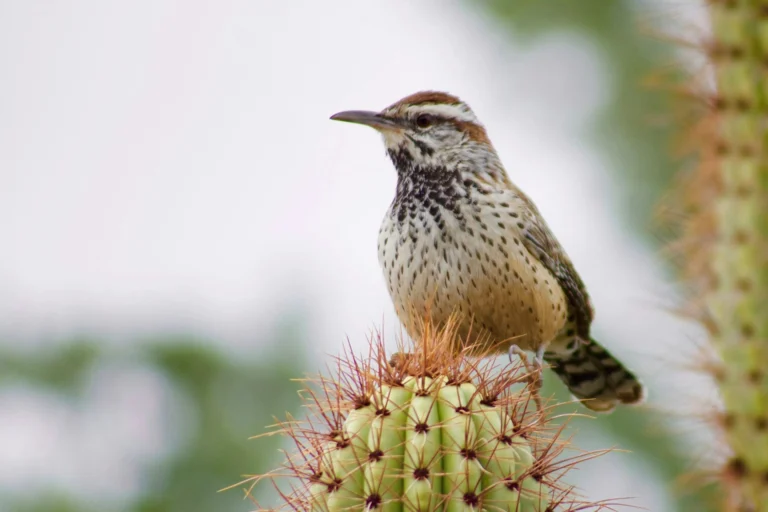
1. Cactus Wren
Appearance: The cactus wren is a chunky, medium-sized songbird with a bold white eyebrow stripe, cinnamon sides, and speckled brown and black plumage. Its tail is long and often held upright, giving it a spunky desert look.
Habitat: True to its name, the cactus wren lives in desert scrubland, especially around cholla and prickly pear cacti. It prefers dry areas with scattered vegetation and plenty of hiding spots.
Diet: These birds feast mostly on insects such as beetles, ants, and caterpillars. They’ll also eat seeds and small fruits when available.
Behavior:
Cactus wrens are loud and curious, known for their raspy, chattering calls. They often build bulky nests in cactus arms, using the sharp spines as protection against predators. They’re very territorial and will chase away intruders.
Conservation:
Listed as stable, though urban development threatens their native habitat. Keeping natural desert plants intact helps preserve their nesting and feeding areas.
Appearance: Gambel’s quail are plump, round-bodied birds with grey plumage, black faces, and creamy bellies. Their most charming feature is the comma-shaped black plume on top of their heads.
Habitat: Found in deserts and brushy areas, especially near mesquite, creosote bush, and dry riverbeds. They need some cover for nesting and shade.
Diet: Primarily herbivorous, they eat seeds, leaves, cactus fruits, and occasional insects. They forage in groups, scratching the ground like little chickens.
Behavior: Gambel’s quail travel in coveys (small groups), often seen crossing roads in single-file. They prefer running to flying and communicate with a distinctive “chi-ca-go” call.
Conservation
Populations are generally stable, though drought conditions can affect reproduction. Habitat conservation is essential for their long-term survival.
Appearance: This ground-dwelling bird has a streaky brown body, a long tail, a shaggy crest, and bright blue-and-orange skin behind the eye. It’s built for speed and stealth.
Habitat: Found in deserts, scrublands, and open country with scattered vegetation. Prefers areas with rocks, low shrubs, and cacti.
Diet: A carnivore at heart, it hunts insects, lizards, small mammals, snakes (even rattlesnakes), and birds. It stuns prey with rapid strikes from its sharp bill.
Behavior: Roadrunners are fast runners—up to 20 mph—and use their speed to chase down prey. They’re solitary and fiercely territorial, often seen sunbathing with wings and tail spread.
Conservation:
Populations are stable. Roadrunners benefit from open spaces and low vegetation, but urban sprawl and roads pose risks.
Appearance: Gila woodpeckers have a tan head and body with black-and-white barring on the wings and back. Males have a small red crown patch; females don’t.
Habitat:
Common in the Sonoran Desert, especially near tall saguaro cacti, where they excavate nesting holes. Also found in palm trees and desert towns.
Diet: Feeds on insects, cactus fruit, seeds, and even nectar. They’re opportunistic and visit hummingbird feeders for sugar water.
Behavior: Loud and active, they drum on metal and wood to communicate. They dig cavities in cacti for nesting—these holes are later used by owls, wrens, and other birds.
Conservation: Stable and well-adapted to desert living. Urban development can limit cactus availability, so planting native species helps support them.
Appearance: A medium-sized bird with grayish-brown plumage, a long tail, orange eyes, and a distinctive down-curved black bill.
Habitat: Loves arid desert scrub, especially areas with mesquite, cholla, and palo verde. Also common in suburban yards with native plants.
Diet:
Eats insects, seeds, berries, and cactus fruit. It forages on the ground using its bill to dig through leaf litter.
Behavior: Famous for its “whit-wheet!” call, it’s vocal and active. Thrashers are often seen perched on cactus tops, keeping watch over their territory.
Conservation: Populations are stable. They adapt well to human-altered environments as long as native plants are preserved.
6. Vermilion Flycatcher
Appearance:
The male is brilliant red with dark brown wings and back—hard to miss! Females are grey with a blush of salmon under the tail and belly.
Habitat:Found near open desert washes, riparian corridors, and mesquite bosques. Prefers spots with scattered perches to launch flycatching attacks.
Diet:
Feeds mostly on flying insects, which it grabs in mid-air using quick sallying flights from a perch.
Behavior: These birds love to perch and pounce, often returning to the same branch. Males perform dramatic display flights during mating season.
Conservation: Not currently threatened, though waterway management and loss of riparian habitat could impact future numbers.
7. Harris’s Hawk
Appearance: Dark brown body with chestnut shoulders, legs, and white at the base and tip of the tail. Large and powerful, with piercing eyes.
Habitat: Prefers desert scrub, mesquite trees, and open areas. Common near urban edges and along highways.
Diet: Feeds on rabbits, rodents, lizards, and birds. Known for hunting cooperatively in family groups—a rare trait among raptors.
Behavior:
These hawks live and hunt in groups, using strategy to flush out prey. One bird may flush, another chase, and a third catch.
Conservation: Populations are stable, and some even benefit from artificial nesting platforms and utility poles.
Appearance: The tiniest owl in the world—only about 5 inches tall! Sandy-grey feathers, big yellow eyes, and no ear tufts.
Habitat: Nests in old woodpecker holes in saguaros and mesquites. Found in desert washes and wooded canyons.
Diet:
Eats moths, beetles, scorpions, spiders, and other small insects. Active at night, often just after sunset.
Behavior: Elusive but vocal, elf owls give off a yipping call. They emerge at dusk and flutter from perch to perch like little shadows.
Conservation: Populations are threatened by habitat loss, especially of nesting sites in saguaros. Conservation efforts include protecting old-growth cactus stands.
9. Phainopepla
Appearance: The male Phainopepla is a glossy black bird with ruby-red eyes and a tall, elegant crest. Females are soft gray with similar crests and red eyes. Both sexes flash white wing patches when they fly.
Habitat:
Prefers desert washes and areas with mesquite and desert mistletoe. Also found near dry desert woodlands and scattered scrub.
Diet: Feeds heavily on mistletoe berries, which make up a large part of its diet. Also catches flying insects in midair.
Behavior: Phainopeplas are territorial and often perch high to survey their domain. Males sing from exposed perches and chase intruders. They regurgitate mistletoe seeds, helping the plant spread across the desert.
Conservation: Populations are relatively stable, though dependent on healthy desert mistletoe populations. Habitat conservation supports their food source and breeding areas.
10. Black-throated Sparrow
Appearance: A sleek and stylish sparrow with a pale grey body, black throat, white eyebrow stripes, and a neatly outlined black mask. Often described as the “gentleman of the desert.”
Habitat: Found in arid deserts, rocky hillsides, and scrubby plains with scattered bushes. Needs open ground for foraging.
Diet: Eats seeds and insects, especially during the breeding season. Forages on the ground, hopping around low vegetation.
Behavior: Sings a sweet, tinkling song, especially at dawn. It perches on low shrubs to sing and defend its territory. Solitary or in pairs during breeding, but forms small flocks in winter.
Conservation: Widespread and common, with no immediate conservation concerns. Thrives in protected desert habitat.
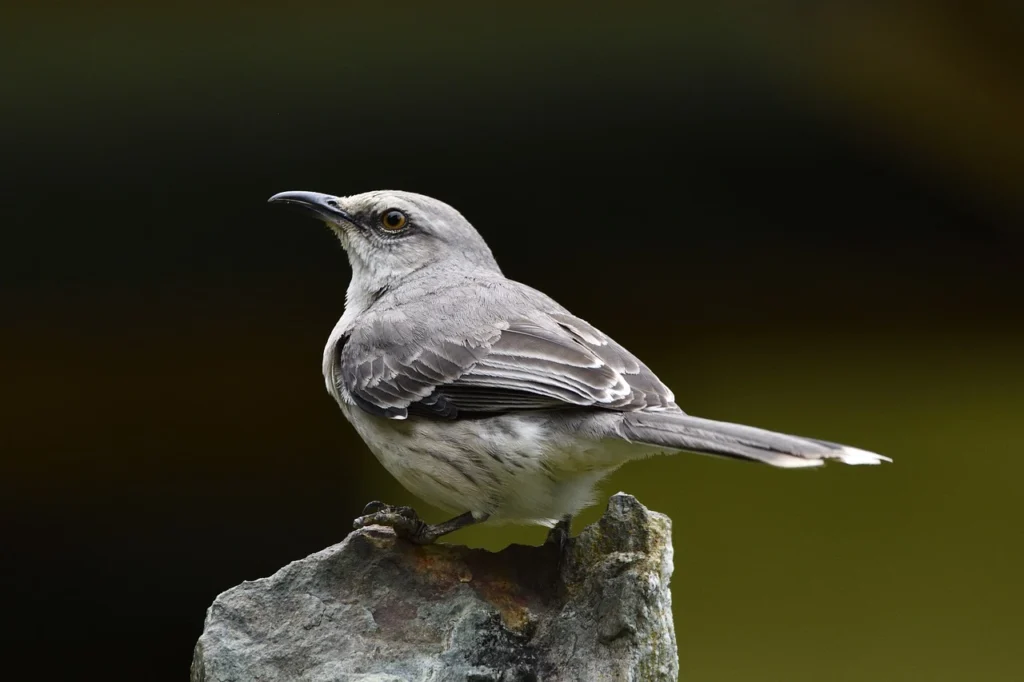
11. Northern Mockingbird
Appearance: Grey body with long tail and white wing patches visible in flight. Known for its graceful look and alert stance, with a sharp beak and watchful eyes.
Habitat:
Common in desert edges, suburban yards, and open scrub. Loves places with scattered trees or bushes.
Diet: Omnivorous—eats insects, berries, and fruits. Will visit feeders for suet or fruit bits.
Behavior: Incredibly vocal and creative singers—they mimic other birds, alarms, and even frogs. Males sing at all hours, especially during breeding season. Aggressively defend their nests.
Conservation: Thriving and adaptable. Urban sprawl hasn’t affected them much thanks to their versatile nature and broad diet.
Appearance: Tiny and soft-colored, Lucy’s Warbler is pale gray with a white belly and a reddish patch on the crown and rump. One of the smallest warblers in North America.
Habitat: Lives in dry mesquite bosques, desert washes, and riparian corridors. Nests in natural cavities or abandoned woodpecker holes.
Diet: Feeds on insects, including caterpillars, beetles, and spiders. Actively forages among branches and leaves.
Behavior: Frequently flicks its wings and tail while moving through low trees. Males sing sweet, high-pitched trills during breeding season. One of the earliest warblers to arrive in spring.
Conservation: Populations are declining due to habitat loss along desert waterways. Planting mesquites and protecting riparian zones can help their recovery.
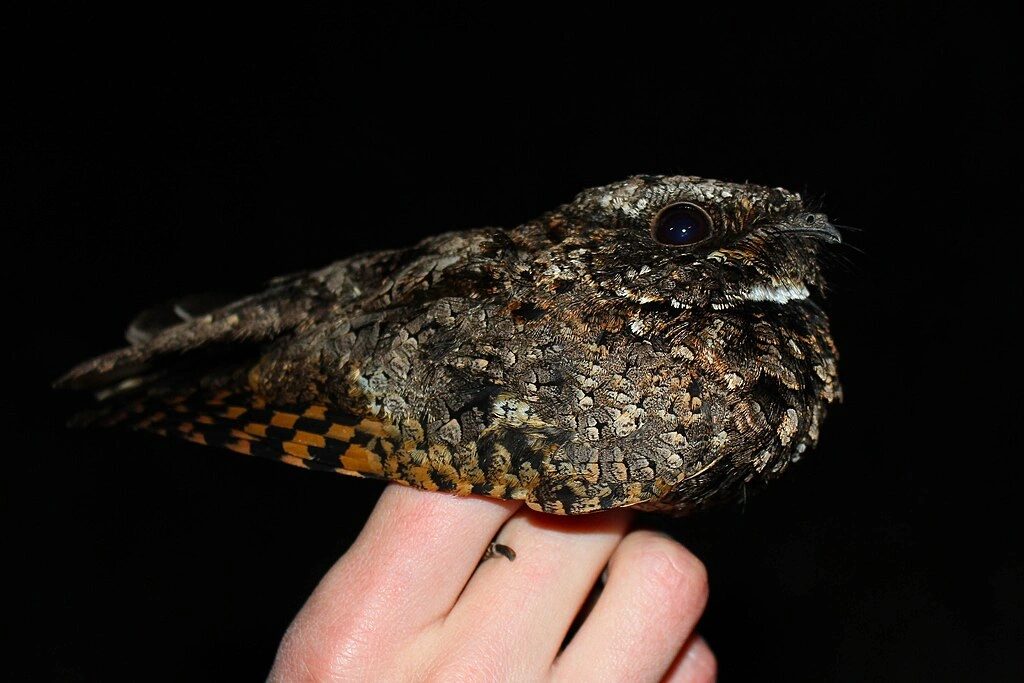
13. Common Poorwill
Appearance: Earth-toned and well-camouflaged, this bird has mottled brown and gray plumage that blends with desert rocks and soil. Has a flat head, large eyes, and a small beak surrounded by bristles.
Habitat: Prefers dry rocky slopes, open woodlands, and scrub-covered deserts. Often found resting on the ground, completely still during the day.
Diet: Feeds on nocturnal insects such as moths, beetles, and grasshoppers. Hunts on the wing or from the ground.
Behavior: Nocturnal and quiet, the poorwill emerges at dusk to feed. Remarkably, it can enter torpor—a hibernation-like state—to survive cold spells or food shortages, a rare trait in birds.
Conservation: Generally stable, but vulnerable to habitat destruction and vehicle collisions due to its ground-roosting habits. Conservation of desert landscapes helps support this elusive species.
14. Ash-throated Flycatcher
Appearance: A medium-sized bird with pale grey upperparts, a whitish throat, and a soft lemon-yellow belly. It has a ruffled crest and a slightly hooked bill. Subtle reddish highlights show in the tail feathers.
Habitat: Common in open desert scrub, mesquite thickets, and dry canyon areas. Nests in cavities such as old woodpecker holes or even nest boxes.
Diet: Feeds mainly on insects like grasshoppers, beetles, and wasps. Occasionally eats berries and small fruits.
Behavior: Known for its lazy-sounding “brrrt” call, this flycatcher often sits on open branches and launches into the air to catch flying insects. During breeding, it becomes territorial and quite vocal.
Conservation: Populations are stable. Providing nest boxes and protecting desert woodlands helps support their numbers.
15. Northern Flicker (Red-shafted form)
Appearance: A large woodpecker with brown plumage, black bars on the back, and bold black chest crescent. The western “red-shafted” form has a red moustache and flashes of red under the wings and tail.
Habitat: Lives in open woodlands, desert slopes with saguaros, and suburban areas with trees. Nests in tree cavities or large cactus holes.
Diet:
Unusually for a woodpecker, it forages mostly on the ground—eating ants, beetles, and insects. Also enjoys fruits and seeds.
Behavior
Recognizable by its loud, ringing “ki-ki-ki!” call and its bouncing flight. It often drums on metal poles or roofs to advertise territory.
Conservation: Widespread and secure, but local declines have occurred due to habitat loss. Providing nest boxes and conserving open desert woodland helps.
Conclusion
The Arizona desert is anything but lieless—it’s bursting with birds that dazzle, charm, and inspire. From the tiny Elf Owl to the fearless Harris’s Hawk, each bird tells a story of survival, song, and adaptation.
Whether you’re hiking through saguaro country or simply gazing out at your backyard, these birds remind us that beauty thrives even in the driest places. By protecting native plants, preserving natural habitats, and supporting conservation efforts, we can ensure that Arizona’s desert skies stay filled with wings and wonder for generations to come.
So the next time you hear a whistle, chirp, or rustle in the brush—look closer. A desert bird may be saying hello.
Arizona’s rich desert landscapes, rugged canyons, and rippling rivers are home to an extraordinary variety of birdlife—including a remarkable collection of brown birds. Though they may not boast the vibrant colors of cardinals or tanagers, these brown-feathered species are anything but dull. Their plumage blends beautifully with the natural terrain, and their behaviors, songs, and survival strategies are fascinating to observe.
From canyon dwellers to backyard visitors, this guide takes you through some of the most common and captivating brown birds in Arizona. Whether you’re birdwatching in the Sonoran Desert or your Tucson garden, these brown beauties are worth knowing.
Table of Contents
1. Cactus Wren
Appearance: The Cactus Wren is a medium-sized bird with a long, slightly curved bill. It has a streaky brown and white body, bold white eyebrows, and a speckled chest. Its tail is dark with white tips, often held upright.
Habitat: This bird is iconic in desert landscapes, particularly among saguaro cacti, cholla, and mesquite thickets. It thrives in arid scrublands and can be seen hopping across rocky outcrops and dusty trails in southern and central Arizona.
Diet: Cactus Wrens are omnivorous, feeding on insects like beetles, ants, and grasshoppers. They also eat seeds, fruits, and occasionally small lizards. They rarely drink water, getting moisture from their food.
Vocalizations: Their call is a loud, raspy “char-char-char,” repeated quickly. It sounds mechanical and harsh, carrying well through dry desert air. Both males and females sing to mark territory.
Behavior: Bold and curious, Cactus Wrens are often seen exploring with tail cocked and wings flicking. They’re active foragers, hopping around cactus spines to inspect hidden insects. These birds are not afraid of humans and may nest close to homes or campsites.
Nesting: They build large, football-shaped nests out of grass and twigs in thorny plants like cholla or saguaro. The entrance is often narrow to deter predators. Females lay 3–5 eggs, and multiple broods may be raised each season.
Conservation: Cactus Wrens are common and not currently threatened, but habitat loss due to urban sprawl and wildfires can affect local populations. Preserving native desert vegetation is key to their survival.
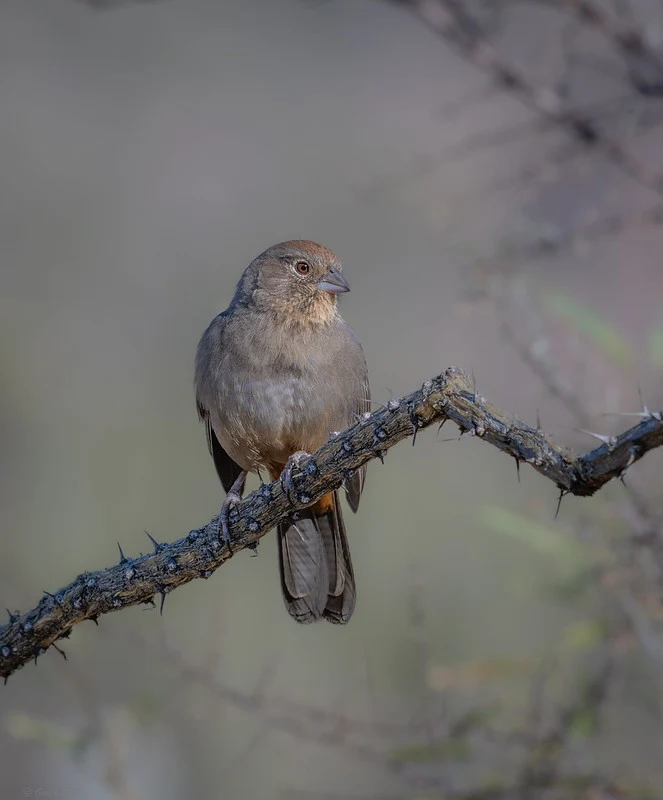
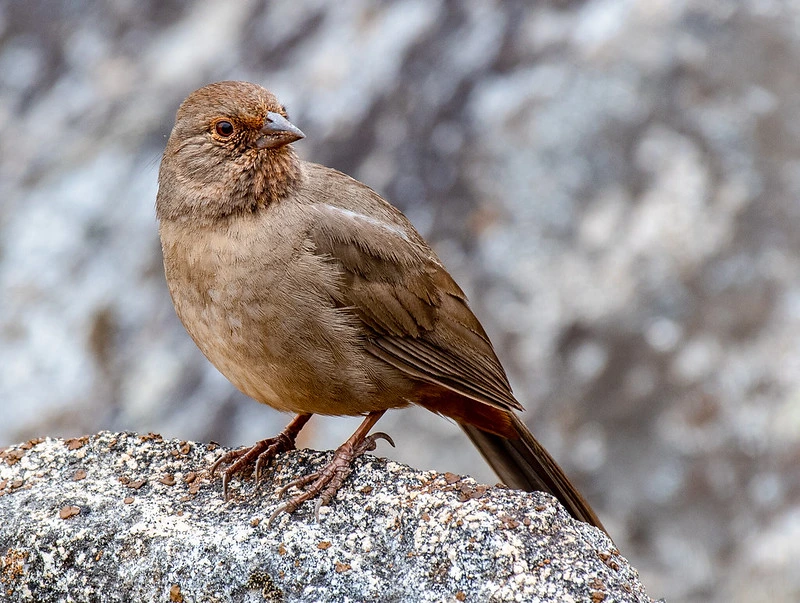
Appearance: The Canyon Towhee is a large, chunky sparrow-like bird with a mostly brown body, slightly rusty undertail, and a warm brown cap on its head. Its plumage is plain but blends beautifully with dry, rocky environments.
Habitat: This bird is commonly found in scrubby deserts, chaparral, canyon slopes, and even suburban areas across central and southern Arizona. It stays close to the ground and prefers areas with scattered bushes or rocks.
Diet: Canyon Towhees feed mostly on seeds, insects, and berries. They scratch at the ground with both feet to uncover hidden food beneath leaf litter or gravel.
Vocalizations: Their song is a soft, simple trill, often rising in pitch. Their call is a dry “chek” or “tseep,” frequently heard as they forage in pairs or alone.
Behavior: They’re ground-dwelling and somewhat shy, often seen darting into cover if startled. Mated pairs often stay together year-round and are territorial. You’ll see them hopping or running instead of flying long distances.
Nesting: Canyon Towhees build cup-shaped nests in shrubs or low trees, using grass, twigs, and plant fibres. Females usually lay 2–4 eggs per brood. They often reuse the same nesting area year after year.
Conservation: They’re considered stable across their range, and they adapt fairly well to human-modified landscapes. Maintaining natural brush and native landscaping helps support local populations.
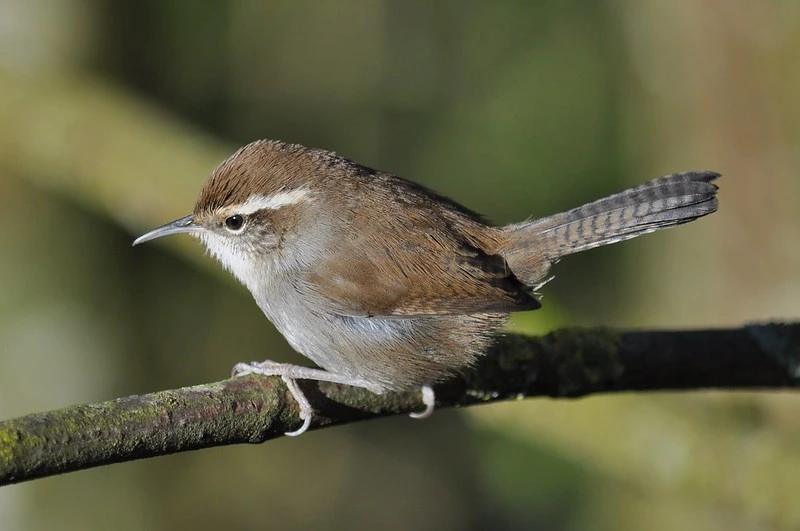
Appearance: This slender wren has a long white eyebrow, a grayish-brown back, and a pale underbelly. Its long tail is usually cocked upward and is black with white corners.
Habitat: Bewick’s Wrens live in brushy areas, wooded canyons, desert edges, and suburban yards with dense shrubs. They’re common in southeastern and central Arizona.
Diet: They feed primarily on insects and spiders, poking through bark crevices and leaf piles with their thin, curved bills. Occasionally, they’ll also eat small seeds or berries.
Vocalizations: Males sing long, musical phrases that vary by region. Their songs often sound cheerful and bright. Calls are sharp and quick, like “chirp” or “tcheh.”
Behavior: Agile and curious, they flit through bushes and low branches, constantly in motion. They are bold for their size and fiercely territorial, especially during the breeding season.
Nesting: Bewick’s Wrens nest in cavities—tree holes, nest boxes, or crevices in walls or fences. Their nests are cup-shaped and lined with soft materials. They lay 5–7 eggs and may have more than one brood per year.
Conservation: Populations are stable in Arizona, but declines have been noted in other regions due to habitat competition with House Wrens. Providing nest boxes and native vegetation supports this charming bird.
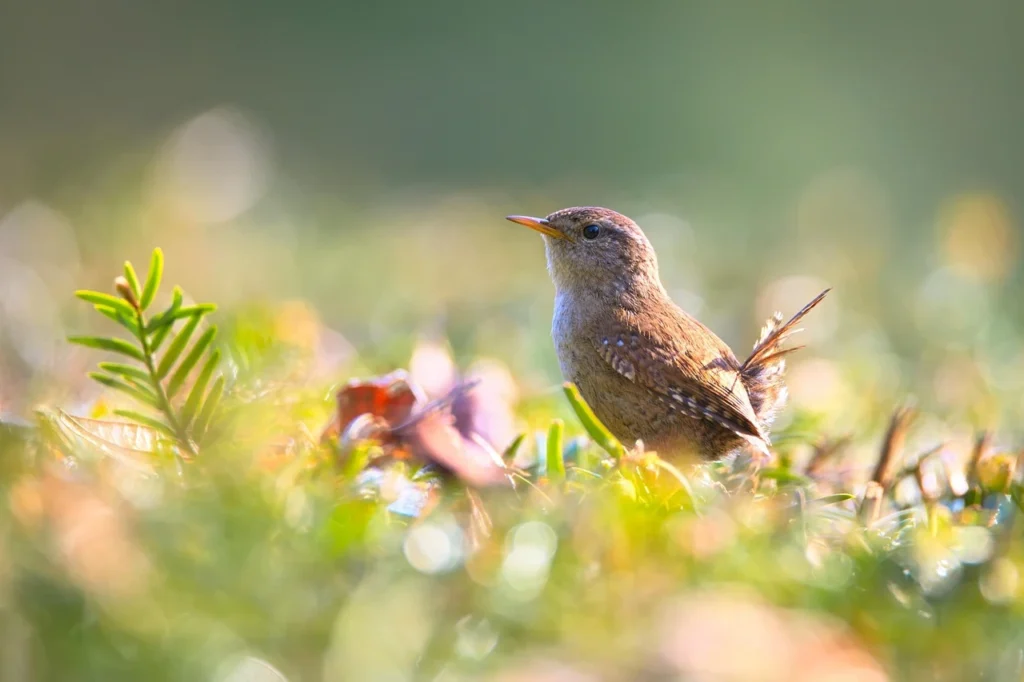
Appearance: The House Wren is a small, compact bird with earthy brown plumage, a pale throat, and fine barring on the wings and tail. It has a short, thin bill and a relatively flat head.
Habitat: This species adapts well to human environments and is found in gardens, woodlots, urban parks, and desert scrub. In Arizona, it breeds in cooler mountain zones and migrates through lower deserts.
Diet: Primarily insectivorous, House Wrens eat beetles, spiders, caterpillars, ants, and other small arthropods. They forage low in vegetation or on the ground, moving quickly through foliage.
Vocalizations: Their bubbly, high-pitched song is rapid and energetic. It’s often a complex series of trills and warbles. They also produce sharp “chek” calls when disturbed or excited.
Behavior: Energetic and feisty, House Wrens are bold for their size and known to outcompete other cavity-nesting birds. Males often fill multiple cavities with twigs to attract a mate.
Nesting: They nest in small cavities—tree hollows, nest boxes, or even discarded cans. The nests are packed with sticks and lined with soft material. Females typically lay 5–8 eggs.
Conservation: House Wrens are abundant and widespread. Their flexibility in nesting and diet allows them to thrive in a range of environments, from wilderness to city backyards.
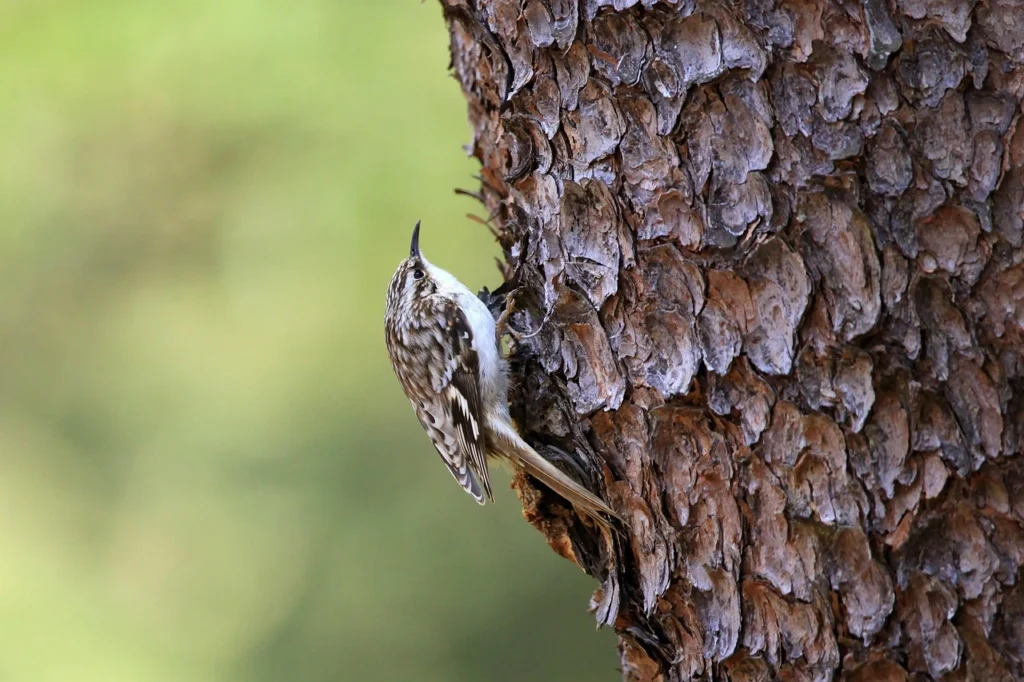
Appearance: The Brown Creeper is a tiny bird with streaky brown upperparts, a whitish belly, and a slender, down-curved bill. Its cryptic coloring helps it blend perfectly into tree bark.
Habitat: In Arizona, they’re mostly found in pine, fir, or mixed-conifer forests at higher elevations, especially in the Mogollon Rim and Sky Islands. They rarely descend into lowland deserts.
Diet: Brown Creepers eat insects, spiders, and larvae hidden under tree bark. They probe with their thin bill as they spiral up tree trunks.
Vocalizations: Their call is a faint, high-pitched “tsee.” Their song is soft and musical, sometimes described as a whispery “see-lee.”
Behavior: They forage by creeping upward along tree trunks in a spiraling motion, then flutter down to the base of another tree to repeat the process. They’re often solitary and hard to spot due to their camouflage.
Nesting: They nest behind loose bark or in bark crevices, lining the space with moss, feathers, and plant material. Females lay 4–5 eggs per clutch.
Conservation: Stable in forested habitats, but logging and forest degradation can impact local populations. Conservation efforts focus on preserving mature forest cover.
Appearance: Say’s Phoebe is a slim, elegant flycatcher with a brownish-gray head and back, a cinnamon-orange belly, and a black tail. It has a calm, clean look and is often perched upright on fences or posts.
Habitat: This bird thrives in open habitats—deserts, grasslands, canyons, and even suburban areas. In Arizona, it’s frequently seen around buildings, barns, and roadside fences.
Diet: Say’s Phoebes eat mostly flying insects—beetles, flies, grasshoppers, and wasps. They often catch prey midair or pounce from low perches to the ground.
Vocalizations: Their call is a soft, plaintive “peeurr” or “pit.” The song is a thin, descending whistle, often repeated and somewhat melancholy in tone.
Behavior: Say’s Phoebes are calm, patient hunters. They make short flights from perches to snatch prey, then return to the same spot. They wag their tails slightly and may appear curious but cautious.
Nesting: They build cup-shaped nests in sheltered ledges, eaves, rock walls, and barn rafters. The nest is made of grass, mud, and hair. Females lay 3–6 eggs, often raising multiple broods per season.
Conservation: This species is widespread and adapts well to human presence. Providing nest ledges and maintaining insect-rich open spaces helps support their populations.
Appearance: Abert’s Towhee is large and bulky, with mostly dusty brown plumage, a blackish face, and long legs. Its tail is long and rounded. The overall look is plain, but its size and habits make it stand out.
Habitat: They are desert specialists, living near riparian corridors with cottonwoods, willows, and mesquite. In Arizona, they are found along washes and streams, especially in the Sonoran Desert.
Diet: Their diet consists of insects, seeds, berries, and small fruits. They forage on the ground, scratching vigorously with both feet to uncover food.
Vocalizations: Calls include sharp “chip” notes, and the song is a series of soft whistles and trills, usually delivered from low shrubs or branches.
Behavior: They’re shy and secretive but may become tame in residential areas. Most of the time, Abert’s Towhees stay low to the ground and dash into cover if startled.
Nesting: They build cup nests in dense shrubs or low trees, hidden from view. Nests are made of grass, bark, and twigs. Females lay 2–4 eggs.
Conservation: This Arizona native has a limited range but stable population. Protecting desert riparian habitats is key to its continued health.
8. Song Sparrow
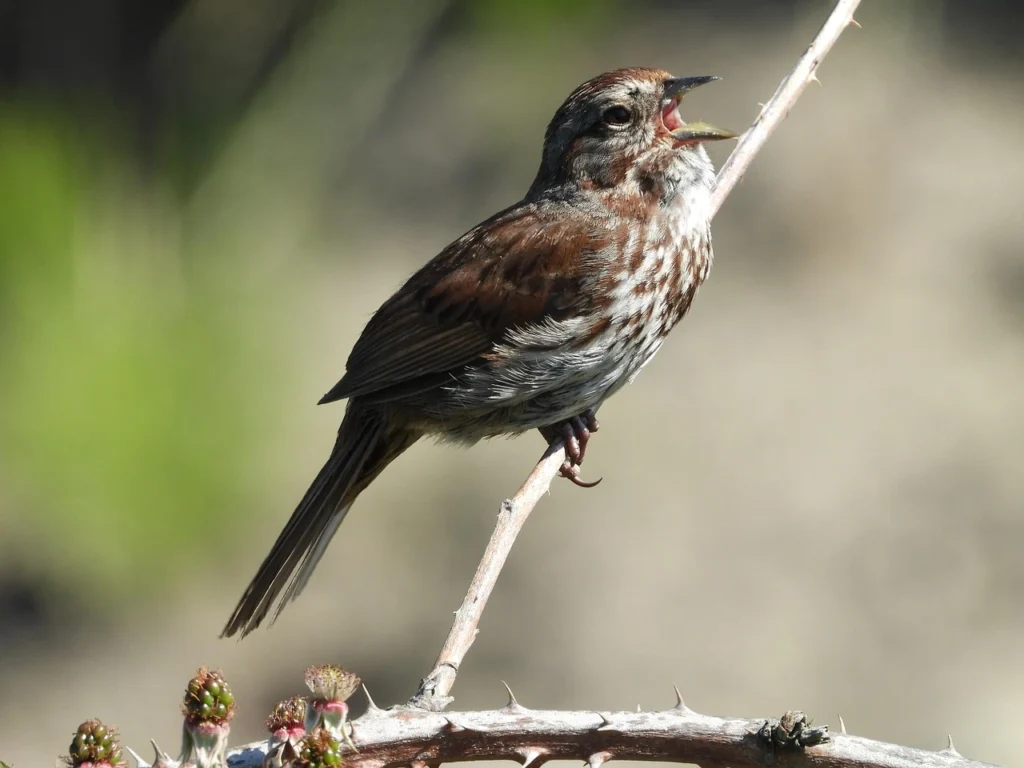
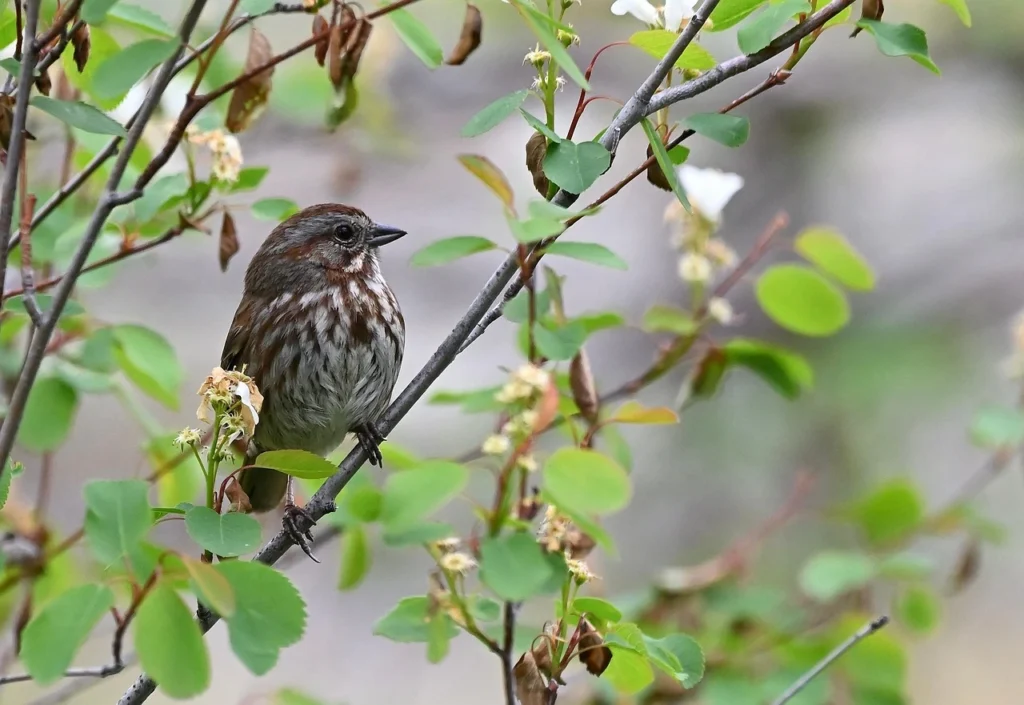
Appearance: Song Sparrows have a streaky brown back, heavily streaked breast, grayish face, and a dark central chest spot. Their plumage varies slightly across regions but always includes shades of warm brown.
Habitat: They are extremely adaptable and can be found in marshes, stream edges, desert washes, and even residential gardens throughout Arizona—especially where water is nearby.
Diet: Song Sparrows eat insects, spiders, and seeds. Insects dominate their diet in spring and summer, while seeds and berries are eaten more in winter.
Vocalizations: True to their name, they sing beautiful, complex songs—starting with a few clear notes followed by trills and buzzes. Their calls include sharp “chimp” and “tup” notes.
Behavior: These sparrows forage on or near the ground, often flicking their tails and hopping between cover. Males are territorial during breeding season and will sing persistently from a shrub or fencepost.
Nesting: Nests are usually well hidden in low shrubs, tall grasses, or even cactus bases. Females build the nest and lay 3–5 eggs. They may raise multiple broods each year.
Conservation: Song Sparrows are abundant and widespread. Planting native shrubs and allowing brushy undergrowth to grow helps attract them to yards and parks.
9. Verdin
Appearance: Although small and grayish-brown overall, Verdins have a striking yellow head and a reddish shoulder patch. Their slim shape and tiny size make them easy to identify in desert regions.
Habitat: Verdins live in dry desert scrub, often among mesquite, palo verde, or creosote bushes. They are well adapted to hot, arid environments and are commonly seen in central and southern Arizona.
Diet: They primarily eat insects, spiders, and some nectar. They occasionally sip sugar water from hummingbird feeders and also consume berries or dried fruits.
Vocalizations: Their call is a sharp “cheep” or “chip,” often repeated in short bursts. The song is high-pitched and whistly, but not complex.
Behavior: Verdins are active, constantly flitting through bushes or hanging upside down while foraging. Despite their small size, they are bold and persistent when feeding.
Nesting: They build large, globular nests with side entrances, often using thorny twigs for protection. They may construct several nests, some used for roosting and others for breeding. Females lay 3–6 eggs.
Conservation: Verdins remain common in Arizona deserts, although habitat destruction can affect their numbers. They readily adapt to native plant gardens with dense shrub cover.
10. Brown-headed Cowbird
Appearance: The Brown-headed Cowbird is a stocky blackbird with a short tail and thick, conical bill. Males have glossy black bodies with a rich brown head. Females are smaller, dull brown all over, with subtle streaking.
Habitat: They are widespread in open habitats—desert grasslands, farmland, pastures, and suburban areas across Arizona. They’re often seen in flocks, especially near cattle or bird feeders.
Diet: Cowbirds eat seeds, grass grains, and insects. They frequently forage on the ground near livestock, where they pick off disturbed insects and feed on spilled grain.
Vocalizations: Their call is a liquid-sounding “gurgle” or “bubble-up” note. Males produce a squeaky, high-pitched song often accompanied by puffed chest displays during breeding season.
Behavior: Brown-headed Cowbirds are known for brood parasitism—they lay their eggs in the nests of other birds, leaving the host parents to raise their chicks. Despite this, they are still welcomed by some backyard birders due to their unique behavior.
Nesting: They don’t build their own nests. Instead, females lay eggs in the nests of over 200 different bird species. This behavior often leads to the host bird raising the cowbird chick, sometimes at the expense of their own.
Conservation: Their population is stable, but their nesting habits have negatively impacted some songbird species. Conservationists monitor their impact in sensitive habitats.
11. Lincoln’s Sparrow
Appearance: This small, handsome sparrow has a finely streaked chest with a buffy wash, gray face, and brown back with black markings. It looks elegant and neatly patterned compared to other sparrows.
Habitat: In Arizona, Lincoln’s Sparrows are usually winter visitors, found in moist brushy areas, stream edges, and wet meadows, especially in canyons or riparian zones.
Diet: They eat mostly insects during breeding season and switch to seeds and grains in colder months. They forage low in vegetation or on the ground.
Vocalizations: Lincoln’s Sparrows sing a sweet, melodic tune that rivals even more celebrated singers. Their calls include a soft “tsip” or “tup.”
Behavior: Shy and secretive, they often stay hidden in thick vegetation. They’ll freeze when approached, then dart into dense cover rather than fly far away.
Nesting: They nest in grass clumps or low vegetation, often on or near the ground. Nests are well-concealed and contain 3–5 eggs. Rarely breeds in Arizona but nests in northern mountains during summer.
Conservation: Populations are stable. Providing dense, wetland-friendly native vegetation supports them during migration and wintering in Arizona.
12. Dusky Flycatcher
Appearance: The Dusky Flycatcher is a small, slender bird with soft brownish-gray plumage, pale underparts, and a short, narrow bill. It has a faint eye ring and subtle wing bars, giving it a delicate, plain appearance.
Habitat: This species breeds in mountainous areas of northern and eastern Arizona, particularly in pine-oak forests and shrubby canyon edges. During migration, it can be found in desert riparian zones.
Diet: They feed mostly on small flying insects—mosquitoes, flies, and beetles—often caught mid-air. They may also glean insects from leaves and occasionally eat berries.
Vocalizations: Their call is a sharp “whit” or “pit,” while the song is a soft, two-part “dew-hic,” often used to distinguish it from other similar flycatchers.
Behavior: Dusky Flycatchers are active and alert, frequently returning to the same perch after a quick sally to catch insects. They often flick their wings and tail while scanning for prey.
Nesting: Nests are cup-shaped, made of grass and moss, and placed in low shrubs or trees. The female lays 3–4 eggs. They raise one or two broods during the breeding season.
Conservation: Populations are stable, though climate shifts may affect their montane habitats. Preserving forest and canyon shrublands supports their breeding success.
Appearance: The Crissal Thrasher is a large, long-tailed bird with warm brown-gray plumage, a rich cinnamon-colored undertail (crissum), and a long, curved bill. Its subtle beauty blends into desert surroundings.
Habitat: Endemic to the Southwest, it inhabits dense desert thickets, mesquite bosques, and arid canyons of southern Arizona. It favors dry, brushy areas with dense cover.
Diet: Feeds on insects, spiders, seeds, and berries. Uses its curved bill to dig through leaf litter and soil in search of prey.
Vocalizations: Its song is a rich, melodious series of whistles, warbles, and chatters—less harsh than other thrashers. Calls include a sharp “chek” or “chack.”
Behavior: Elusive and secretive, Crissal Thrashers prefer running to flying and often stay hidden in brush. They are year-round residents and are most active during cool mornings.
Nesting: They build bulky nests low in thorny shrubs, lined with finer materials. Females lay 2–4 eggs, and both parents feed the young.
Conservation: Fairly stable but vulnerable to habitat fragmentation and brush clearing. Protecting native desert scrub is key to their long-term survival.
Appearance: The Rufous-crowned Sparrow is a small, subtly beautiful bird with a grayish-brown body, rufous-red crown, white eye ring, and faint streaking on its underparts. Its face often shows a rusty eyebrow and light mustache stripe.
Habitat: Prefers rocky slopes, grass-covered hillsides, desert scrub, and chaparral. In Arizona, it’s found in hilly or mountainous areas with scattered vegetation—especially around Tucson and the Mogollon Rim.
Diet: Feeds on seeds, small insects, and spiders. Forages primarily on the ground by hopping among rocks and dry grasses.
Vocalizations: Their song is a clear, sweet trill often followed by softer notes. Their call is a sharp “tsip” or “chink,” usually given from low shrubs or rocks.
Behavior: They’re often secretive, staying close to cover. When threatened, they’ll quickly vanish into rocky outcrops. Males sing from exposed perches during the breeding season.
Nesting: Ground nesters, they build a small cup of grasses, hidden in bunchgrass or under rocks. Females lay 2–4 eggs. Nests are extremely well-camouflaged.
Conservation: Populations are considered stable, though they are sensitive to habitat loss from development or overgrazing. Maintaining natural slopes and grasslands benefits this shy sparrow.
15. Northern Flicker (Red-shafted form)
(Though often known for their woodpecker habits, they’re frequently seen foraging on the ground and have warm brown coloring.)
Appearance: The Red-shafted Northern Flicker is a large woodpecker with brown, spotted plumage, a black crescent on the chest, and a reddish blush under the wings and tail. Males have a red mustache stripe.
Habitat: Common throughout Arizona, especially in open woodlands, saguaro-studded deserts, parks, and yards. They often forage on the ground near anthills and open dirt patches.
Diet: They eat mostly ants and beetles, digging them from the ground with their long tongues. They also consume fruits, seeds, and some nuts.
Vocalizations: Their loud “kleer!” call and rhythmic drumming are often heard before the bird is seen. They also have a wicka-wicka-wicka song during courtship.
Behavior: Unlike most woodpeckers, Northern Flickers frequently forage on the ground. They are often seen hopping around tree bases or dusty trails in pairs or small groups.
Nesting: They excavate nests in tree trunks or saguaro cactus cavities. Females lay 5–8 eggs, and both parents share incubation duties.
Conservation: Populations are stable, though urban tree removal and pesticide use can affect their food supply. They adapt well to bird-friendly backyards with open spaces and native trees.
Conclusion
From the rocky canyons to the desert scrublands, Arizona’s brown birds bring quiet charm and hidden brilliance to the landscape. Though their plumage may be subtle, their songs, behaviors, and adaptations are anything but boring. Whether you’re watching a Canyon Towhee scratch for seeds or spotting a Crissal Thrasher in a desert wash, these species enrich the birding experience with their resilience and beauty.
As you explore Arizona’s trails, parks, and backyard habitats, keep your eyes open for these earth-toned marvels. They may blend into the scenery, but once noticed, they leave a lasting impression.
Arizona’s breathtaking landscapes—stretching from cactus-filled deserts to pine-covered mountains—are home to some of North America’s most colourful birds. Among them, orange-feathered species stand out with their fiery hues, adding splashes of warmth to the skies and trees. From the brilliant Vermilion Flycatcher flashing over desert scrub to the elegant Hooded Oriole weaving its nest in palm fronds, these birds are as diverse as the state’s habitats.
Whether you’re an avid birder or just starting to notice flashes of colour on your walks, spotting orange birds in Arizona is always a delight. This guide explores some of the most striking species, detailing their appearance, habitats, diets, and behaviours to help you identify and appreciate them in the wild.
Table of Contents
Vermilion Flycatcher
Appearance
The Vermilion Flycatcher is a small but striking songbird, easily recognised by its fiery colours. Males display a bright scarlet-red body and crown with contrasting black wings, tail, and eye mask. Females and juveniles are more subdued, with greyish-brown upperparts, whitish underparts, and a faint orange or peachy wash on the belly. Their compact size and vivid flashes of red make them unmistakable in Arizona’s open spaces.
Habitat
This bird thrives in open country, desert scrub, and riparian zones near streams or ponds. In Arizona, you’ll often find them perched on exposed branches, fence posts, or wires, scanning the air for flying insects. They prefer semi-arid regions with scattered vegetation and are common in southern and central Arizona year-round.
Diet
As an insectivore, the Vermilion Flycatcher primarily eats flying insects such as flies, beetles, grasshoppers, and moths. They hunt by sallying out from a perch, snatching prey midair, and returning to the same spot. Occasionally, they will also pick insects from vegetation.
Behaviour
These birds are agile aerial hunters, often seen performing short, quick flights to capture insects. Males are especially conspicuous during breeding season, performing display flights with fluttering wingbeats to show off their dazzling plumage. They are generally solitary or found in pairs rather than large flocks.
Vocalisations
Their calls are sharp, quick “peets” or “pit” sounds, often repeated when perched. The song is a series of musical trills and chatters, used by males to defend territories and attract mates.
Nesting
Females take the lead in nest-building, weaving a cup-shaped structure of twigs, grass, and spider silk. Nests are usually placed on tree branches or shrubs, often near water. The female lays 2–4 eggs, which she incubates for about two weeks, while the male helps by providing food.
Conservation
The Vermilion Flycatcher is not currently threatened and is considered stable across its range. However, habitat loss due to urban expansion and water management in desert regions could impact populations locally. Birdwatchers and conservation groups emphasise the importance of preserving riparian zones to support these vibrant flycatchers.
The Hooded Oriole is a slim, medium-sized songbird with a long tail and slender, slightly curved bill. Males are striking, dressed in brilliant orange-yellow plumage with a black throat, face, wings, and tail. Their “hood” of glowing orange makes them one of Arizona’s most eye-catching birds. Females and juveniles are more muted, with olive-yellow bodies and less pronounced black markings, but still elegant in appearance.
Habitat
In Arizona, Hooded Orioles favour suburban neighbourhoods, desert oases, and palm-lined areas. They are particularly fond of ornamental palm trees, where they not only find food but also weave their nests among the fronds. They thrive in southern Arizona during spring and summer, arriving from Mexico as part of their breeding migration.
Diet
Their diet consists mainly of nectar, fruit, and insects. They are frequent visitors to hummingbird feeders, where they delicately sip sugar water with their long, curved bills. In the wild, they probe flowers for nectar, eat ripe fruits, and catch insects such as caterpillars and beetles.
Behaviour
Hooded Orioles are agile and active, often seen darting among trees in search of food. They are also acrobatic foragers, hanging upside down to reach blossoms or hidden insects. While shy compared to some orioles, they adapt well to backyards with nectar feeders and flowering plants.
Vocalisations
Their call is a series of soft whistles, chatters, and squeaky notes, less melodic than some other orioles but still distinctive. Males use songs to attract mates and mark territories, often singing from concealed perches.
Nesting
Females weave remarkable hanging nests, shaped like pouches, suspended from palm fronds or other drooping leaves. The nests are carefully stitched together from plant fibres, grasses, and even string. The female lays 3–5 pale eggs, incubating them while the male provides some food support.
Conservation
Hooded Orioles are considered stable and widespread, though their reliance on ornamental palms has tied them closely to urban and suburban environments. Providing nectar feeders, native flowering plants, and safe palm habitats can help sustain local populations.
Bullock’s Oriole is a striking medium-sized songbird with bold colours and crisp markings. Males showcase bright orange underparts, an orange face, and a black crown, throat, and eye-line that resembles a mask. Their wings are black with white wing bars, and the tail is tipped with orange. Females and juveniles are more subdued, displaying a yellowish-orange body with grey-brown wings, yet still elegant and easily recognisable.
Habitat
In Arizona, Bullock’s Orioles inhabit riparian woodlands, desert washes, orchards, and suburban areas with tall trees. They prefer cottonwoods, sycamores, and willows near streams and rivers, where they forage and build their hanging nests. They are most common in northern and central Arizona during the breeding season, migrating south to Mexico in winter.
Diet
These orioles feed on a mix of insects, nectar, and fruit. Caterpillars, beetles, and grasshoppers form the bulk of their protein intake, while nectar from flowers and sugary juices provide quick energy. In backyards, they are known to visit oriole feeders stocked with orange slices or jelly.
Behaviour
Bullock’s Orioles are energetic and agile, often seen flitting through treetops in search of food. They glean insects from leaves and bark but are equally skilled at sipping nectar or pecking into ripe fruit. During the breeding season, males are vocal and territorial, often chasing away rivals.
Vocalisations
Their song is a mix of clear whistles, chatter, and short warbles, delivered with a slightly harsh but musical quality. Calls include sharp “chuck” or “chek” sounds, which help pairs stay in contact while foraging.
Nesting
Like other orioles, Bullock’s Orioles weave elaborate hanging nests. The female creates a deep pouch-like structure suspended from the tips of branches using grasses, fibres, and even yarn or string when available. She lays 3–7 eggs, usually bluish-white with fine markings, and incubates them for about two weeks.
Conservation
Bullock’s Orioles are widespread and currently stable, though habitat destruction in riparian zones poses a potential threat. Backyard feeders and preservation of cottonwood and willow habitats play an important role in supporting their populations across Arizona.
The Western Tanager is one of Arizona’s most dazzling summer visitors. Males are instantly recognisable with their flaming orange-red head, bright yellow body, and black wings with white wing bars. The intensity of the red comes from pigments found in their diet. Females and juveniles are paler, with yellow-green bodies and greyish wings, but still carry a touch of golden brightness.
Habitat
Western Tanagers breed in Arizona’s coniferous and mixed woodlands, especially in higher elevations such as ponderosa pine forests. During migration, they can be spotted in riparian corridors, desert edges, and even backyards with fruiting trees. Their presence often signals the arrival of warmer months in northern and central Arizona.
Diet
Primarily insectivorous, they consume wasps, ants, caterpillars, beetles, and grasshoppers. In summer, they supplement their diet with berries and other small fruits. They occasionally sip nectar, making them opportunistic feeders in areas with flowering plants.
Behaviour
Western Tanagers are active foragers, gleaning insects from foliage or snatching them in midair. Males are territorial during breeding season, often perching high in conifers to sing and defend their area. Despite their bright colours, they can be surprisingly inconspicuous, often staying hidden among leaves.
Vocalisations
Their song is a short, burry series of phrases, often compared to a hoarser version of an American Robin’s song. They also use sharp “pit-er-ick” calls to communicate with mates and fledglings.
Nesting
The female builds a shallow cup-shaped nest of twigs, rootlets, and grasses, usually high in conifer branches. She lays 3–5 pale blue or greenish eggs with faint speckles. Both parents feed the chicks after hatching, ensuring rapid growth before migration season.
Conservation
The Western Tanager remains widespread and is not currently threatened. However, habitat loss in forests and the effects of climate change on insect availability could impact populations over time. Maintaining healthy woodland ecosystems is essential for their continued success.
Scott’s Oriole is a striking bird of the desert, known for its bold contrast of colours. Males have a bright lemon-yellow belly, chest, and undertail, set against a glossy black head, back, wings, and tail. Females are more subdued with olive-yellow underparts and grey-brown upperparts, though still showing hints of yellow that make them stand out. Their long tail and sharp bill give them a sleek look.
Habitat
In Arizona, Scott’s Orioles are strongly tied to desert landscapes. They favour yucca-studded slopes, arid hillsides, and open desert scrub, particularly in areas with agaves and Joshua trees. They are most common in southern and southeastern Arizona, where their vibrant colouring contrasts beautifully with the desert backdrop.
Diet
Scott’s Orioles are versatile feeders, eating insects, fruits, and nectar. Grasshoppers, beetles, caterpillars, and spiders form a large part of their diet, but they are also frequent visitors to blooming yucca plants, where they sip nectar and search for insects. In backyards, they may visit nectar feeders and take advantage of fruit offerings.
Behaviour
These orioles are deliberate foragers, often seen probing into yucca blossoms or methodically searching tree bark for insects. Males are territorial during breeding season, singing from exposed perches to mark their space. Unlike some orioles, they often forage lower to the ground, giving birdwatchers an easier view.
Vocalisations
Their song is a series of sweet, whistled phrases, somewhat reminiscent of a meadowlark’s tune but shorter and more variable. Calls include sharp “chuck” notes, used to keep in contact with mates.
Nesting
Scott’s Orioles build their nests in yuccas, agaves, or desert trees such as mesquite. The female weaves a deep, hanging pouch from yucca fibres, grass, and plant threads, cleverly concealed among the spiky leaves. She lays 3–5 pale eggs with light markings, and both parents feed the chicks.
Conservation
Currently, Scott’s Oriole populations are stable, though habitat loss due to desert development poses potential risks. Protecting desert plants such as yuccas and agaves is crucial for their nesting and feeding needs.
Black-headed Grosbeak
Appearance
The Black-headed Grosbeak is a stocky, medium-sized songbird with a powerful, conical bill built for cracking seeds. Males are striking, with a bold black head, wings, and tail, contrasted by bright orange-breast, sides, and neck. Their wings also show white patches that flash in flight. Females and juveniles are streaked brown with warm orange or buffy tones on the breast, giving them a more camouflaged look.
Habitat
In Arizona, Black-headed Grosbeaks favour riparian woodlands, oak forests, and mixed pine-oak habitats. During the breeding season, they are often found in canyons, foothills, and mountain streams, while in migration they may appear in desert oases, orchards, and backyard feeders.
Diet
These grosbeaks enjoy a varied diet of insects, seeds, and fruits. They are especially fond of beetles, caterpillars, and grasshoppers but also feed on berries and orchard fruits. Their strong bills allow them to crack sunflower seeds, making them frequent guests at bird feeders.
Behaviour
Black-headed Grosbeaks are active foragers, hopping through trees and shrubs to find food. Males are territorial in spring but share feeding duties with females when raising young. They are also known for their leisurely flight, alternating between flapping and gliding.
Vocalisations
Their song is rich, melodious, and often compared to a slightly slower, huskier version of the American Robin’s tune. Males sing from high perches to attract mates, while both sexes use sharp “chink” calls to stay in touch or warn of predators.
Nesting
The female builds a loosely woven cup-shaped nest of twigs, grasses, and rootlets, usually in shrubs or low trees. She lays 3–5 bluish-green eggs with darker speckles. Both parents share incubation and chick-feeding duties, a trait uncommon among many songbirds.
Conservation
Black-headed Grosbeaks are stable and widespread across western North America. Conservation efforts to protect riparian and forest habitats are important to maintain their breeding grounds in Arizona. Backyard feeders and native plantings also help support migrating individuals.
Pyrrhuloxia
Appearance
The Pyrrhuloxia, often called the desert cardinal, is a close relative of the Northern Cardinal but with a unique flair. Males have a mostly grey body with bright crimson-red highlights on the face, crest, wings, and tail. Their short, thick, yellow-orange bill is distinctly parrot-like and adapted for cracking seeds. Females are softer in colour, with warm grey plumage and subtle reddish tinges on the wings and crest.
Habitat
This bird is a true desert dweller, thriving in Arizona’s arid regions. It favours mesquite thickets, desert scrub, and cactus-filled washes. Pyrrhuloxias are especially common in southern Arizona, where they often share the landscape with Northern Cardinals.
Diet
Their diet is largely seed-based, relying on grass seeds and grains, but they also eat berries, cactus fruits, and insects. Their strong bill is perfectly suited for crushing hard seeds that many other birds can’t manage.
Behaviour
Pyrrhuloxias are social birds, often forming loose flocks outside of breeding season. They perch conspicuously on shrubs or fences, making short flights to the ground to feed. During the breeding season, males are territorial and put on display flights to defend their space.
Vocalisations
Their calls are sharp, metallic notes that resemble the sound of a whistle or “peenk.” The male’s song is a series of clear whistles, similar to the Northern Cardinal’s but generally softer and less varied.
Nesting
The female builds a cup-shaped nest of twigs, grasses, and plant fibres, usually placed in dense shrubs or low trees like mesquite. She lays 2–4 speckled eggs, and both parents share the responsibility of feeding the chicks once hatched.
Conservation
Pyrrhuloxias are stable and well-adapted to desert life, showing little sign of decline. However, extensive desert habitat loss could affect local populations. Protecting native desert plants ensures food and nesting resources for this charismatic bird.
Barn Swallow
Appearance
The Barn Swallow is a graceful, slender songbird with long, pointed wings and a deeply forked tail. Its glossy blue-black back contrasts beautifully with its rusty-orange forehead, throat, and underparts. The face glows with warm orange tones that deepen toward the breast. Females are similar but slightly paler with shorter tail streamers, while juveniles have more muted colours.
Habitat
Barn Swallows are widespread across Arizona during spring and summer. They prefer open areas such as fields, grasslands, and desert edges, often near water. True to their name, they frequently nest in barns, sheds, bridges, and other man-made structures, showing a remarkable adaptation to human presence.
Diet
These swallows are aerial insectivores, feeding almost exclusively on flying insects. Their diet includes flies, beetles, wasps, moths, and mosquitoes. They catch prey on the wing with incredible agility, often skimming low over fields or water surfaces.
Behaviour
Barn Swallows are highly social, often seen in pairs or flocks. Their swift, acrobatic flight is a defining trait, with sudden twists and turns as they chase insects. They are also known for their cooperative nature, roosting and migrating in large groups.
Vocalisations
Their song is a cheerful, twittering mix of chirps and whirs, often delivered in flight. Calls include sharp “vit” or “witt” notes, helping flocks stay coordinated while feeding.
Nesting
Barn Swallows build mud-based nests, shaped like open cups, attached to walls, beams, or ledges. Both parents gather mud pellets and line the nest with grass and feathers. They lay 3–7 white eggs speckled with brown, and both adults share incubation and chick feeding.
Conservation
Barn Swallow populations are stable overall, though declines have been noted in some areas due to habitat loss and reduced insect availability. Their adaptability to human structures has helped them thrive in Arizona, where they are a familiar and welcome sight around farms and towns.
American Robin
Appearance
The American Robin is one of the most recognisable songbirds in North America. It has a warm orange-red breast and belly, contrasting with a slate-gray back, wings, and tail. The head is dark, with a broken white eye-ring that gives it a distinctive look. Females are paler than males, with softer orange underparts, while juveniles have spotted breasts that gradually fade as they mature.
Habitat
In Arizona, American Robins are found mainly in cooler habitats such as pine forests, mountain meadows, and riparian woodlands. During migration and winter, they may also appear in orchards, parks, and suburban lawns where fruiting trees are abundant.
Diet
Robins are omnivores, eating a wide range of food. Insects such as beetles, grubs, caterpillars, and earthworms make up much of their diet in summer. In winter, they switch to berries and fruits like juniper, holly, and pyracantha. Their ability to adapt their diet allows them to thrive in varied habitats.
Behaviour
American Robins are often seen hopping across lawns or forest floors, cocking their heads to listen for earthworms underground. They are highly social in winter, forming large flocks that forage for fruit, but become territorial during the breeding season.
Vocalisations
Their song is a cheerful series of whistled phrases, often described as “cheerily, cheer up, cheer up, cheerily.” It is one of the most familiar bird songs of spring. They also give sharp “tut-tut” calls when alarmed.
Nesting
Robins build sturdy cup-shaped nests made of grass, twigs, and mud, lined with fine materials. The female lays 3–5 beautiful sky-blue eggs, which she incubates for about two weeks. Both parents feed the chicks, which grow quickly and fledge within two weeks.
Conservation
American Robins are abundant and widespread, with no major conservation concerns. Their adaptability to human environments has ensured their survival across the continent. Protecting fruiting trees and healthy lawns supports their year-round presence in Arizona.
Conclusion
Arizona’s diverse landscapes, from desert valleys to forested mountains, provide a haven for some of the most stunning orange-feathered birds in North America. From the fiery brilliance of the Vermilion Flycatcher to the cheerful songs of the American Robin, each species adds colour and character to the state’s skies and backyards. Whether you’re birdwatching in a cactus-studded desert or a mountain meadow, these orange birds are a reminder of the beauty and variety nature offers. By learning about their habitats, diets, and behaviours, bird enthusiasts can enjoy deeper connections with these species while helping protect their environments for generations to come.
California is a birdwatcher’s paradise—and if you’re hoping to spot a flash of crimson among the trees, you’re in for a treat. From urban gardens to desert canyons and lush forests, the Golden State is home to a stunning variety of red birds that captivate with their brilliant plumage and charming songs. Whether you’re in Northern California’s redwood groves or soaking in Southern California’s sun-drenched trails, red-feathered birds bring a vibrant splash of color to the landscape.
In this guide, we’ll explore some of the most beautiful red birds in California, helping you identify them by appearance, behavior, song, and more. From the iconic Northern Cardinal to the fiery Vermilion Flycatcher, get ready to meet the scarlet stars of California’s skies.
Table of Contents
Northern Cardinal
Appearance
The Northern Cardinal is one of the most easily recognized birds in California due to its brilliant crimson-red plumage. Males are entirely red with a black mask around the face and a pointed crest. Females are more muted, showing warm brown tones with hints of red on their wings and tail.
Habitat
Though more common in the eastern U.S., Northern Cardinals are found in parts of Southern California, especially in suburban neighborhoods, riparian woodlands, and landscaped parks with dense shrubs and trees.
Diet
They primarily eat seeds, fruits, and insects. Cardinals often visit backyard feeders for sunflower seeds and berries.
Song
Known for their rich, whistling songs, males and females both sing—a rare trait among songbirds. Their melodies include phrases like “cheer-cheer-cheer” and “birdie-birdie-birdie.”
Behavior
Northern Cardinals are territorial, especially during breeding season. Males often sing loudly to defend their space and may even attack their reflection thinking it’s a rival.
Nesting
They build cup-shaped nests in thick shrubs or low trees. Females typically lay 2–4 eggs, which hatch after about 12 days.
Conservation
Currently stable and even expanding westward, thanks to bird feeders and suitable landscaping in urban areas. They are protected under the Migratory Bird Treaty Act.
The Vermilion Flycatcher is a fiery gem of the bird world. Males flaunt a stunning bright red body with contrasting dark brown wings and back, while females are more subdued with peachy underparts and a grayish-brown back and head. The male’s color is truly eye-catching in open spaces.
Habitat
This bird thrives in arid, open habitats such as desert scrub, farmlands, golf courses, and river valleys. In California, it’s mostly spotted in the southeastern deserts and parts of Southern California, especially during warmer months.
Diet
True to its name, the Vermilion Flycatcher snatches flying insects mid-air. It often perches low on shrubs or fences, watching intently before darting out for its prey.
Song
Their call is a sharp “peet” sound, while the song is a high, rapid series of chirps, usually delivered during the breeding season. The male often sings from an exposed perch.
Behavior
They’re active and agile, known for their aerial acrobatics during hunting. Males perform fluttering courtship displays to impress potential mates.
Nesting
These birds build small nests in trees or shrubs near water. The female lays 2–4 eggs and incubates them for about two weeks.
Conservation
While not endangered, the Vermilion Flycatcher’s population is affected by habitat loss and pesticide use. Conservation of riparian areas supports their presence in California.
Male House Finches are known for their rosy red foreheads, throats, and chests, blending into brown-streaked backs and bellies. Females are entirely brown with streaking and lack red coloring. The intensity of red varies depending on diet—some males may appear orange or even yellowish.
Habitat
Extremely adaptable, House Finches are found throughout California, from coastal suburbs and urban neighborhoods to farmland and open woodlands. They’re frequent visitors to backyard feeders and patio gardens.
Diet
Their diet is mostly seeds, fruits, and buds. They especially enjoy black oil sunflower seeds and are common visitors to tube feeders, hanging baskets, and window ledges.
Song
Their song is a cheerful, warbling mix of notes that often ends in a rasp. Males sing persistently during spring and early summer.
Behavior
House Finches are social birds and can often be seen in small flocks. Males may puff out their chest and sing to attract a mate, while both sexes forage together peacefully.
Nesting
These finches build nests in sheltered spots like hanging planters, vents, light fixtures, and even wreaths. Females lay 2–6 eggs and incubate them for about two weeks.
Conservation
Widespread and thriving, the House Finch is considered a conservation success story, having expanded across North America. In California, it’s among the most common urban birds.
Male Red Crossbills have a reddish to orange-red body with darker wings and tail, while females are more olive or yellowish. Their most distinctive feature is their crossed bill tips—perfectly evolved for prying open conifer cones.
Habitat
They are most commonly found in coniferous forests across Northern California, particularly in the Sierra Nevada, Klamath Mountains, and other high-altitude pine or fir woodlands. Occasionally, they move to lower elevations in search of food.
Diet
Red Crossbills specialize in eating conifer seeds, particularly from pines, spruces, and firs. Their unique bill allows them to extract seeds from tightly closed cones.
Song
Their call is a sharp “kip-kip” or “jip-jip,” often heard in flight. The song is a series of short warbles and trills, usually sung from treetops.
Behavior
Highly nomadic, Red Crossbills move in flocks and can be unpredictable in appearance. They’re very acrobatic, often hanging upside down while foraging.
Nesting
They can nest at almost any time of year, depending on cone abundance. Nests are typically built high in conifer trees. Females lay 3–4 eggs, incubated for about 12–14 days.
Conservation
Although generally stable, their population fluctuates due to habitat changes and food supply. They are sensitive to logging and conifer die-off, which can reduce available food.
The male Hepatic Tanager sports a dusky, brick-red body with grayish highlights on the back and flanks, giving it a more muted look than the Summer Tanager. Females are yellowish-orange. Their name “hepatic” comes from the liver-like shade of red on the male’s plumage.
Habitat
In California, Hepatic Tanagers are rare summer visitors. They are occasionally spotted in oak woodlands, pine-oak forests, and mixed mountain canyons of southeastern California, particularly near Arizona border regions like San Bernardino County.
Diet
Like other tanagers, they mainly eat insects, especially during the breeding season. They’ll also feed on fruit and berries, particularly in late summer.
Song
Their song is a series of low, robin-like warbled notes, often slower and huskier than the Summer Tanager’s song. Their call note is a dry “chuck.”
Behavior
Hepatic Tanagers are relatively secretive. They forage methodically in the mid to upper canopy, moving slowly and deliberately, often gleaning insects from leaves and branches.
Nesting
They build cup-shaped nests in forks of tree branches, often well hidden. Females lay 3–4 eggs. Their nesting behavior is not well documented in California due to their rarity.
Conservation
While stable globally, the Hepatic Tanager’s California sightings are limited. Protecting mountain forest habitats helps ensure potential nesting and foraging areas remain intact.
Scarlet Tanager
Appearance
The male Scarlet Tanager is breathtaking, with vivid scarlet-red plumage offset by jet-black wings and tail. Females and non-breeding males are yellowish with olive wings, making them harder to spot. The contrast of colors on the male is striking and unmistakable during migration.
Habitat
Scarlet Tanagers are rare migrants in California, more often seen during spring and fall migration. They occasionally appear in wooded parks, riparian corridors, and forest edges—especially along the coast and Central Valley during migration stopovers.
Diet
They primarily feed on insects such as beetles, caterpillars, ants, and wasps. They also consume berries and fruits, especially during migration.
Song
Their song resembles a hoarse, robin-like warble—richer and rougher in tone. Their call is a sharp “chip-burr” or “chick-bree.”
Behavior
Scarlet Tanagers are typically quiet and stay hidden in dense foliage. Males sing from high perches, while both sexes forage quietly through the treetops. Migrants may join mixed-species flocks.
Nesting
Though they don’t breed in California, in their breeding range they construct cup nests high in deciduous trees. Females lay 3–5 eggs and raise the young largely on their own.
Conservation
While not currently threatened, Scarlet Tanagers face habitat loss and dangers during migration, such as window strikes and predation by domestic cats. California birders cherish each rare sighting.
Purple Finch
Appearance
Male Purple Finches have a raspberry-red wash over their head, chest, and back that looks like they’ve been dipped in berry juice. Unlike House Finches, their red coloring extends to the crown and back. Females lack red and are heavily streaked with brown and white, featuring a bold facial pattern with a white eyebrow stripe.
Habitat
In California, Purple Finches are found mostly in coniferous forests of the Sierra Nevada, coastal redwood areas, and mountain woodlands. They also visit feeders and forest edges, especially during the non-breeding season.
Diet
They eat seeds, berries, and buds, including those from trees like conifers, maples, and elms. They’re frequent visitors to sunflower seed feeders in winter and early spring.
Song
Their song is rich and melodic, consisting of rapid, warbling notes with an almost bubbly quality. Males sing from high perches to mark their territory during breeding season.
Behavior
Purple Finches are often seen in pairs or small flocks. They may mix with other finch species and are less aggressive at feeders than House Finches or Goldfinches.
Nesting
They build nests in conifer trees, often on horizontal limbs. Females lay 3–5 pale blue eggs and take on most of the incubation duties.
Conservation
Their population is stable in the western U.S., though they face some competition from House Finches in overlapping ranges. They are a delight for backyard birders and forest hikers alike.
Cassin’s Finch males have a rosy red crown, face, and breast, but unlike the Purple Finch, the red is more concentrated on the head and fades down the body. Their backs are streaked brown, and they have a longer, straighter bill. Females and immature birds are brown and streaked with a lightly marked face.
Habitat
In California, Cassin’s Finches are found mostly in high-elevation conifer forests of the Sierra Nevada and eastern mountains. They prefer pine, fir, and spruce woodlands, particularly in summer, but can move to lower elevations in winter.
Diet
They feed primarily on seeds, buds, and berries—especially from conifers. Insects and fruit may also supplement their diet during breeding season.
Song
Their song is a series of rich, sweet warbling notes—similar to other finches but more fluid. Their call is a sharp “pik” or “tip.”
Behavior
Cassin’s Finches are social and often found in small flocks outside the breeding season. They may mix with other finches like Pine Siskins and Red Crossbills during winter movements.
Nesting
They nest high in conifer trees, often close to the trunk on horizontal branches. Females build the nest and incubate 3–5 eggs, while males help feed the young once hatched.
Conservation
Populations are stable in the West, though they may be affected by conifer loss due to logging or climate change. Birders in California’s mountain regions enjoy their melodic presence during summer.
Pyrrhuloxia (Desert Cardinal)
Appearance
The Pyrrhuloxia resembles the Northern Cardinal but with a few key differences. Males have a gray body with deep red accents on the face, crest, wings, and tail. They sport a curved, yellow parrot-like bill and a striking red mask. Females are mostly gray with subtle reddish tinges.
Habitat
Primarily found in the desert regions of the American Southwest, Pyrrhuloxias are rare in California but may be seen in the far southeastern deserts near the Arizona border. They prefer arid scrublands, mesquite thickets, and cactus-filled landscapes.
Diet
Their diet consists of seeds, fruits, and insects. They forage on the ground or in shrubs and cacti, often picking seeds from mesquite pods or cactus fruit.
Song
Their song is a series of clear, metallic whistles similar to a cardinal’s but shorter and more abrupt. Calls include sharp “chew” or “chip” notes.
Behavior
Pyrrhuloxias are shy and often forage quietly in pairs or small groups. Males may sing from exposed perches during breeding season to establish territory.
Nesting
They build nests in thorny shrubs or mesquites. Females lay 2–4 eggs, which are incubated for around two weeks. The nest is often well hidden among spiny branches.
Conservation
Stable in their native desert range, but sightings in California are uncommon and considered a treat for birders. Climate change and habitat conversion may influence their range expansion.
Western Tanager
Appearance
The male Western Tanager is a showstopper with a bright red head, yellow body, and black wings and back. The red color comes from pigments in their diet—specifically from insects that contain rhodoxanthin. Females are more subdued with yellowish bodies and olive-gray wings.
Habitat
Commonly seen throughout California during spring and summer, Western Tanagers breed in coniferous and mixed woodlands, especially in the Sierra Nevada, coastal mountains, and forested parks. They also pass through urban backyards during migration.
Diet
They eat insects, spiders, and fruit. Western Tanagers often pluck insects from leaves or catch them mid-air, and enjoy berries when available.
Song
Their song is a short, hoarse series of chirpy, robin-like phrases, usually less musical than that of a Scarlet or Summer Tanager. Their call is a distinctive “pit-er-ick.”
Behavior
Often elusive, they forage high in the canopy. Males may flash their red heads as a territorial signal, while females move silently through foliage.
Nesting
They nest in conifers or aspens, building cup-shaped nests well above the ground. Females lay 3–5 eggs and incubate for about two weeks.
Conservation
Their population is stable, though logging and wildfires can affect breeding habitats. They are among the most colorful birds in California’s mountains and a favorite for birdwatchers during spring.
Anna’s Hummingbird
Appearance
Male Anna’s Hummingbirds are striking with an iridescent reddish-pink (rose-red) head and throat that glows in sunlight. Their body is mostly green and gray. Females lack the full red crown but may show red flecks on the throat. Their shimmering plumage changes with the angle of light, often appearing dull until it flashes brilliantly.
Habitat
One of the most common hummingbirds in California, Anna’s Hummingbirds thrive in urban gardens, coastal scrub, oak woodlands, and desert edges. Unlike many hummingbirds, they are year-round residents—even in winter.
Diet
They sip nectar from flowers, feeders, and even tree sap wells. They also eat small insects and spiders for protein—often caught in flight or plucked from leaves.
Song
Anna’s Hummingbirds have a high-pitched, buzzy song and a sharp “chip” call. Males also produce a loud “chirp-pop” sound with their tail feathers during their dramatic dive displays.
Behavior
Highly territorial, especially around feeders or favorite flowers. Males perform a swooping U-shaped courtship flight, climbing high before diving with a tail-produced “whistle.” They’re incredibly fast and agile.
Nesting
Females build tiny nests out of plant fluff, moss, and spider silk. Nests are often placed on branches, vines, or even wires. They lay 2 tiny eggs and raise chicks solo.
Conservation
Their population is increasing thanks to the popularity of backyard feeders and native plantings. Anna’s Hummingbird is a California icon—buzzing through gardens with dazzling flashes of red.
California Towhee
Appearance
The California Towhee is mostly dusty brown with a subtle but noticeable reddish-rust patch under the tail and around the face. While not bright red, this rufous coloring gives it a warm-toned appearance, especially when seen in good light. Its overall look is plain, but charming in its simplicity.
Habitat
Endemic to California and Baja California, this towhee is a fixture in chaparral, oak woodlands, suburban backyards, and landscaped gardens. It’s especially common in the coastal and foothill regions of both Northern and Southern California.
Diet
They feed on seeds, berries, and insects, foraging mostly on the ground. You’ll often see them hopping through leaf litter or scratching at the soil under shrubs and trees.
Song
Their call is a sharp metallic “chip,” repeated frequently. Males sing a rapid series of high-pitched notes—often heard at dawn or from a shrub perch during the breeding season.
Behavior
California Towhees are bold, curious, and often tame around humans. They’re known for thumping against windows or car mirrors when they see their reflection and mistake it for a rival.
Nesting
Nests are well-concealed in shrubs or low trees. Females build the nest and lay 2–4 eggs. They may raise multiple broods in a single season.
Conservation
Populations are stable and thriving, especially in suburban areas where they’ve adapted well to human presence. They’re a familiar backyard bird in much of the state.
Painted Bunting
Appearance
Male Painted Buntings are among the most dazzling birds in North America. They feature a bright red breast and belly, vivid blue head, and green back—like a living rainbow. Females and juveniles are a soft lime green throughout, making them beautiful in a more understated way.
Habitat
While not native to California, Painted Buntings occasionally appear as rare migrants or vagrants, especially in Southern California during late fall and winter. They are typically found near brushy edges, hedgerows, and low vegetation when spotted.
Diet
Their diet consists of grass seeds, small fruits, and insects. During migration or winter visits, they forage quietly near thickets and ground vegetation.
Song
Males sing a lovely, musical series of high-pitched notes and warbles. The song is used to defend territory and attract mates during the breeding season (in their southeastern US range).
Behavior
Shy and secretive, Painted Buntings often remain hidden in dense cover. Males are more visible when singing from exposed perches, but during migration, they tend to be quiet and solitary.
Nesting
They do not breed in California. In their native range, they nest in shrubs or dense vegetation, with females laying 3–4 eggs and raising the young alone.
Conservation
Although their population is declining in parts of their breeding range due to habitat loss and illegal trapping, Painted Buntings remain a sought-after rarity for California birders lucky enough to glimpse one.
Red-naped Sapsucker
Appearance
The Red-naped Sapsucker is a small woodpecker with striking markings. Males feature a bright red crown and throat, with a bold black-and-white face pattern and a pale yellowish belly. Females are similar but have a smaller red throat patch or a mix of red and white. The red “nape” (back of the neck) gives this bird its name and helps distinguish it from similar species.
Habitat
This species breeds in mountainous forests of eastern and northern California, especially where aspens, pines, and mixed woodlands are present. During migration and winter, they may venture into foothill areas, orchards, and riparian corridors.
Diet
Red-naped Sapsuckers feed primarily on tree sap, which they access by drilling neat rows of holes in trunks. They also consume insects, berries, and tree cambium, and may return repeatedly to sap wells.
Song
Their vocalizations include sharp “wee-ah” or “querr” calls, along with distinctive rhythmic drumming on trees. Their drumming is slower and more deliberate than other woodpeckers.
Behavior
They are solitary and often observed climbing vertically along tree trunks. They defend feeding territories and can be seen hovering briefly to glean insects from bark.
Nesting
They excavate nest cavities in live or dead trees, usually choosing aspens or pines. Females lay 4–6 eggs, which are incubated by both parents.
Conservation
Stable overall, though habitat loss and fire suppression in montane regions can reduce suitable nesting areas. Protected by conservation efforts focused on preserving mixed forest habitats.
Tips for Spotting Red Birds in California
Bring binoculars and a field guide: Especially helpful for identifying subtle differences between finches and tanagers.
Use native plants and feeders: Sunflower seeds attract House Finches and Purple Finches; sugar water brings in Anna’s Hummingbirds.
Visit during migration seasons: Spring and fall are ideal times for spotting rare species like Scarlet Tanagers or Painted Buntings.
Check forest edges and water sources: Many red birds prefer areas with both cover and nearby food or water.
Be patient and listen: Some species, like the Summer Tanager, are more often heard than seen.
FAQs
What is the most common red bird in California?
The House Finch is the most common, seen year-round in urban and suburban areas statewide.
Are Northern Cardinals native to California?
No, but they are established in parts of Southern California, especially near Arizona borders.
What red bird has a black face and red body?
That’s likely the Northern Cardinal (male), known for its red plumage and black mask.
Can I attract red birds to my backyard?
Yes! Use sunflower seeds, native plants, and nectar feeders to draw in finches, hummingbirds, and more.
Conclusion
California’s birdlife is as diverse as its landscapes—and red birds add a special burst of beauty to any outing. From the blazing red flash of a Northern Cardinal to the jewel-toned Anna’s Hummingbird, there’s no shortage of crimson-colored charmers. Whether you’re hiking through the Sierras, exploring desert trails, or sipping coffee in your garden, keep your eyes open for these fiery-feathered wonders. They’re not only a delight to watch but also a reminder of the natural brilliance that calls California home.
Have you ever sat outside on a warm California night and heard birds singing in the dark? While most birds tuck in at sunset, some fill the nighttime air with unexpected music. From the sharp, clever melodies of the Northern Mockingbird to the haunting calls of owls echoing through wooded canyons, these Birds That Sing at Night in California create a mysterious and magical soundtrack. Their nighttime choruses are more common than you might think—especially in the Golden State.
California’s mild climate, urban lighting, and diverse habitats make it a hotspot for nocturnal bird activity. Whether you’re hearing songs in your backyard, a local park, or along the coast, there’s a good chance you’re not alone—birds are talking too.
In this guide, we’ll explore which birds sing at night in California, why they do it, where to find them, and how to identify their calls. Get ready to uncover the secret life of California’s night-time songbirds!
Table of Contents
Why Do Birds Sing at Night in California?
Birdsong is usually a sunrise ritual—but in California, several factors stir certain birds to sing after dark. Here’s why you might hear chirps, whistles, or hoots long after the sun has set:
1. Territory and Mating
Some birds, especially males, sing at night to mark their territory or attract a mate. The quiet of night helps their song travel farther without competing with daytime noise. For example, the Northern Mockingbird is known to sing all night during mating season—especially if he’s still looking for love.
2. Urban Light Pollution
Streetlights, porch lights, and city skylines can confuse birds into thinking it’s still daytime. This disruption of their internal clocks leads some species to sing at odd hours. Urban areas like Los Angeles or San Diego often have more night-singing birds than rural zones.
3. Migration and Restlessness
During migration seasons (spring and fall), birds may fly at night and pause to feed or rest. Some sing briefly during these nighttime stops, especially species like thrushes and warblers.
4. Communication and Alerting
Some owls and other nocturnal species sing or call to communicate with mates or warn intruders. Their haunting hoots or screeches are not just noise—they’re part of the bird’s survival system.
Northern Mockingbird
Appearance
The Northern Mockingbird is medium-sized with grey plumage, a pale chest, and distinct white patches on its wings that flash during flight. Its long tail and slender build give it a graceful silhouette even at night.
Habitat
Found across urban, suburban, and rural areas of California, mockingbirds thrive in neighborhoods, parks, open woodlands, and desert edges. They’re one of the most common backyard birds in the state.
Song
Mockingbirds are night-time superstars when it comes to song. Males often sing for hours after sunset, especially during spring. They’re known for their ability to mimic other birds, animals, and even mechanical sounds—sometimes stringing together over 200 unique phrases in one performance.
Behavior
These bold birds are territorial and will perch visibly on rooftops or fences while singing. A single mockingbird can sound like an entire chorus, thanks to its wide vocal range. They’re also active defenders of their nests and may chase away cats, hawks, or even people.
Breeding
Night singing peaks during the breeding season (March to August), especially when a male has not yet found a mate. Once paired, he sings less at night and focuses on guarding the nest.
Where to Find in California
You can hear mockingbirds singing at night in almost every part of the state—from downtown Los Angeles to quiet Central Valley towns and coastal suburbs.
The Common Poorwill is a small, plump nightjar with cryptic brown, grey, and black mottled plumage that blends seamlessly into leaf litter or rocky ground. Its wide mouth and large eyes are built for nocturnal life.
Habitat
This elusive bird prefers dry, open habitats like chaparral, deserts, canyon edges, and grassy foothills. In California, you’ll find it in areas like the Sierra Nevada foothills, Mojave Desert, and coastal scrublands.
Song
At night, the poorwill gives a rhythmic and persistent “poor-will…poor-will…poor-will” call, which sounds haunting and distant. The call is soft but can travel far in the stillness of night, often repeated hundreds of times.
Behavior
Poorwills are strictly nocturnal and rarely seen during the day. They often sit motionless on the ground or roadways at dusk, feeding on moths and insects. Unique among birds, the Common Poorwill is capable of entering a hibernation-like state called torpor in cold weather.
Breeding
They lay their eggs directly on the ground with minimal nesting material. Their quiet, camouflaged lifestyle helps protect nests from predators.
Where to Find in California
Search rocky hillsides, desert slopes, or oak-covered foothills at night. Listen quietly and patiently—this bird is heard more often than seen.
The Great Horned Owl is one of California’s most iconic night birds. It’s large and powerful, with striking yellow eyes, mottled brown feathers, and prominent feather tufts resembling horns. Its barrel-shaped body and silent flight make it an efficient nocturnal predator.
Habitat
This adaptable owl can be found almost everywhere in California—from deep forests and deserts to suburban parks, farmland, and even city outskirts. It thrives in both rural and urban environments.
Song
Its deep, resonant “hoo-hoo hooooo hoo-hoo” call is unmistakable and often heard at nightfall or just before dawn. Males and females may duet during mating season, with the female’s voice slightly higher-pitched.
Behavior
The Great Horned Owl is mostly solitary and fiercely territorial. It hunts at night using incredible stealth, snatching rabbits, rodents, and even skunks with its strong talons. It’s known as the “tiger of the sky” due to its ferocity.
Breeding
Breeding begins early in the year—sometimes as soon as January. Pairs often reuse old hawk or crow nests. Vocalizations increase during courtship and egg-laying season.
Where to Find in California
Look or listen for them in woodlands, foothills, palm groves, city parks, and canyons. If you hear a soft hooting echoing through the night, there’s likely a Great Horned Owl nearby.
The Western Screech-Owl is a small, stocky owl with a short tail, yellow eyes, and ear tufts that lie flat when relaxed. Its plumage is a mottled mix of gray or reddish-brown, offering perfect camouflage against tree bark.
Habitat
This owl favours wooded habitats across California—including oak woodlands, pine forests, suburban backyards, orchards, and desert canyons. It often roosts in natural tree cavities or nest boxes.
Song
Despite its name, it doesn’t screech. Instead, it gives off a series of soft, bouncing hoots or trills, like a ping-pong ball dropping in pitch. These calls are mostly heard after dark and can last several seconds.
Behavior
The Western Screech-Owl is strictly nocturnal and uses its excellent hearing and vision to hunt insects, rodents, and small birds. It flies low and silently, snatching prey from the ground or foliage. It’s often motionless by day, blending into tree trunks.
Breeding
Pairs form monogamous bonds, often reusing the same nest cavity for years. During breeding season, the male sings nightly to defend territory and attract a mate.
Where to Find in California
Listen for their trilling calls in residential areas, canyon woodlands, riparian zones, and coastal forests, especially from March to June.
The Barn Owl is instantly recognisable by its heart-shaped white face, pale underparts, and golden-buff wings and back. Its dark, soulful eyes and long legs give it a ghostly look in low light—fitting for a bird that haunts the night.
Habitat
Barn Owls are widespread throughout California. They nest in barns, old buildings, church steeples, palm trees, and cliffs, and forage over fields, grasslands, orchards, and marshes. They’re especially common in agricultural regions and coastal valleys.
Song
Rather than hooting, Barn Owls emit an eerie, drawn-out screech—a harsh, raspy “shreeee” that can sound chilling at night. They also hiss or click during courtship or when defending territory.
Behavior
Silent and stealthy, Barn Owls are superb nocturnal hunters, using keen hearing to track small mammals in total darkness. They fly low over open ground, striking without warning. Unlike other owls, they are mostly non-vocal except during the breeding season.
Breeding
Barn Owls breed in spring and may raise two broods in warmer California regions. They often use nest boxes or cavities in man-made structures. Young owlets hiss and screech loudly when begging for food.
Where to Find in California
Spot them in Central Valley farms, Southern California suburbs, San Francisco Bay wetlands, and even abandoned buildings. Night-time screeches near farmland usually mean a Barn Owl is nearby.
The Yellow-breasted Chat is a large, chunky warbler with a striking bright yellow chest, olive-green back, white belly, and bold white markings around the eyes. Its size and appearance can confuse birders expecting a smaller warbler.
Habitat
In California, chats prefer dense thickets, riparian scrub, willow groves, and overgrown areas near streams. They’re commonly found in coastal valleys, Sierra foothills, and Central Valley riparian zones during spring and summer.
Song
Unusual for a warbler, the chat sings at night, especially during mating season. Its voice is a chaotic mix of whistles, cackles, gurgles, and clucks, often delivered from a hidden perch or in flight. The song can resemble a medley of different bird species and even mimicry.
Behavior
Shy and secretive by day, the Yellow-breasted Chat becomes more vocal at night. Males often perform display flights during twilight or full darkness, singing as they flutter with slow wingbeats over brushy territory.
Breeding
Nesting begins in late spring. Males sing both day and night to establish territory and attract a female. Their nests are hidden deep within thickets, making them hard to spot.
Where to Find in California
Look and listen for them at dusk or night in riparian corridors, brushy wetlands, and nature preserves throughout the Sacramento Valley, coastal canyons, and low-elevation mountain areas.
Hermit Thrush
Appearance
The Hermit Thrush is a small, slender songbird with a warm brown back, white belly with dark spots, and a slightly reddish tail that sets it apart from other thrushes. Its gentle, soft-eyed expression matches its delicate voice.
Habitat
In California, Hermit Thrushes prefer coniferous forests, wooded canyons, and mountain groves, especially in the Sierra Nevada, coastal ranges, and higher elevation oak woodlands. They are winter residents in milder lowlands and summer breeders in cooler forests.
Song
The Hermit Thrush’s song is often described as one of the most beautiful in North America—a flutelike, echoing melody with clear, whistled notes and pauses. Males may sing during early dawn and dusk, and occasionally well into the night, especially in quiet forested areas.
Behavior
Solitary and quiet during the day, the Hermit Thrush becomes more vocal during the breeding season. Males perch low in trees or on fallen logs to sing, and they often retreat quickly if disturbed.
Breeding
They nest on the ground or in low shrubs in dense woodland areas. Songs increase in early spring to late summer when territories are being established and mates are sought.
Where to Find in California
You’ll hear them singing around twilight or at night in mountain forests, redwood groves, and shaded ravines. Areas like Big Sur, Yosemite, and the San Bernardino Mountains are excellent spots.
Pacific Wren
Appearance
The Pacific Wren is a tiny, energetic brown bird with a short tail often held upright. Its feathers are dark, finely barred with black, and its small size and flickering movements make it easy to miss in dense undergrowth.
Habitat
This wren thrives in moist forests, coastal redwoods, and mountain woodlands. In California, it’s common in Northern coastal forests, the Sierra Nevada, and shady canyon bottoms with thick understory and fallen logs.
Song
Despite its size, the Pacific Wren has a powerful and lengthy song—a rapid-fire, cascading series of trills and whistles that can last up to 10 seconds. Males often sing well into dusk and may continue into the night, especially during the breeding season in spring.
Behavior
The Pacific Wren is skulking and shy, often darting into crevices or low brush. It sings from hidden spots on stumps, logs, or low branches. During cool, damp evenings, its song fills the forest like a bubbling creek of sound.
Breeding
Males build multiple dome-shaped nests in mossy crevices and sing to attract females to choose one. Their night singing peaks from March to June, when territorial boundaries are being established.
Where to Find in California
Head to foggy redwood forests along the North Coast, shady streambeds in the Klamath Mountains, or high-altitude forests in the Sierra Nevada. You’re more likely to hear than see this vocal little bird.
American Robin
Appearance
The American Robin is a familiar sight with its rusty-orange breast, dark gray back, and white eye ring. It’s medium-sized, with a cheerful presence and an upright stance that makes it easy to recognize on lawns and in trees.
Habitat
Robins are found across urban neighborhoods, parks, woodlands, gardens, and farmlands throughout California. They’re one of the state’s most widespread birds and adapt easily to both wild and developed environments.
Song
Their melodic “cheerily, cheer-up, cheerily” song is usually a dawn chorus staple, but robins are also known to sing at night, especially near streetlights or during spring and early summer. Their clear, flute-like phrases can be heard even in suburban areas under the glow of artificial lights.
Behavior
Though often seen hopping on lawns during the day in search of worms, male robins may perch and sing persistently at night—particularly when light pollution tricks them into thinking it’s still dawn. This is most common during breeding season when males are actively defending territory.
Breeding
Males begin singing before sunrise and may continue well after sunset. Nesting season in California starts early, around February or March, and night singing increases when establishing new territories.
Where to Find in California
Anywhere! From Los Angeles suburbs to Lake Tahoe forests, American Robins are widespread and vocal, especially near porch lights, parks, and campuses.
Killdeer
Appearance
The Killdeer is a slender, medium-sized plover with long legs, a white chest marked by two bold black bands, brown upperparts, and a bright orange rump visible in flight. Its large, dark eyes and quick movements give it an alert look.
Habitat
Killdeer are commonly found in open fields, gravel roads, parking lots, golf courses, and shorelines. In California, they frequent agricultural areas, coastal flats, and desert basins. They often live near human activity.
Song
Their loud, ringing “kill-deer! kill-deer!” cry is often heard at night, especially during migration or when disturbed. They also give sharp, alarm-like calls and plaintive whistles—making them one of the more vocal birds after dark.
Behavior
Active both day and night, Killdeer are known for their dramatic “broken-wing” display to distract predators from nests. At night, they forage or fly between locations, calling constantly as they move through open areas or across city skies.
Breeding
They nest on the ground, often in bare gravel or dry dirt, using camouflage rather than cover. During the breeding season, night calls increase—especially in wide-open nesting territories where visibility is low.
Where to Find in California
Widespread throughout the state, especially in Central Valley farmlands, Southern California deserts, and coastal plains. Listen for their distinctive cries at night while driving through rural or suburban areas.
Black-crowned Night Heron
Appearance
The Black-crowned Night Heron is a stocky, medium-sized wading bird with gray wings, a black crown and back, red eyes, and short yellow legs. Immature birds are streaky brown with yellowish streaks, often mistaken for other species.
Habitat
These herons live near marshes, lakes, rivers, reservoirs, and coastal estuaries. In California, they’re widespread in wetlands, urban ponds, and coastal regions from San Diego to the Bay Area and up into the Sacramento Delta.
Song
True to its name, this bird becomes active at night and gives a loud, raspy “quawk” or “wok” call. It’s not a songbird, but its harsh croaks are frequently heard in flight or near roosting sites after dark.
Behavior
Nocturnal by nature, Black-crowned Night Herons roost silently by day in groups and emerge at dusk to feed on fish, frogs, and insects. They often perch quietly in shallow water before striking with lightning speed. Unlike daytime herons, they rely more on stealth than wading.
Breeding
They nest colonially in trees or reeds near water, often forming mixed rookeries with egrets. During breeding season (spring to early summer), their night-time calls increase as they become more active around dusk and early evening.
Where to Find in California
Look for them in Golden Gate Park, Salton Sea, Sacramento River Delta, and wetlands from San Diego to Humboldt Bay. You’ll often hear their call before you spot them flying low over water at night.
Spotted Towhee
Appearance
The Spotted Towhee is a striking sparrow-sized bird with a black hood and back, bold white spots on its wings, and a rufous-orange belly and flanks. Its long tail with white outer edges is often flicked while foraging on the ground.
Habitat
Towhees prefer dense shrubs, chaparral, forest edges, and overgrown thickets. In California, they’re common in coastal sage scrub, Sierra Nevada foothills, oak woodlands, and even suburban yards with brushy cover.
Song
Usually a daytime singer, the Spotted Towhee sometimes gives harsh mews, trills, and short songs after dark, especially in spring and early summer. Their nighttime calls can sound like sharp “chewink” or drawn-out rasps, often mistaken for other birds.
Behavior
Spotted Towhees are ground-feeding specialists, scratching noisily in leaf litter with a distinctive two-footed hop. Males often perch atop shrubs to sing loudly, and they may continue sporadically into the night when establishing territory.
Breeding
Nesting season runs from April to July. Males increase their vocal activity—including some night calling—while defending territory and attracting mates. Nests are usually hidden low in shrubs or on the ground.
Where to Find in California
Abundant in Southern California chaparral, Bay Area foothills, and Northern coastal forests. Listen for their sharp calls during late evenings in shrubby habitats.
FAQs
Why do birds sing at night in California?
Birds sing at night for several reasons—defending territory, attracting mates, or reacting to light pollution in cities. In spring and summer, males are especially vocal after dark
Which bird is most commonly heard singing at night in California?
The Northern Mockingbird is the most frequent night singer. Its nonstop medley of mimicked songs can carry late into the night, especially in urban areas.
Do owls actually sing at night?
Owls don’t sing in the traditional sense, but their hoots, screeches, and calls serve the same purpose—communication, territory defense, and courtship.
Are night-singing birds a bad sign?
Not at all. While some may interpret it as unusual, in most cases it’s natural behavior. Only excessive, restless singing outside of breeding season may indicate disorientation due to urban lighting.
Where can I hear night birds in California?
Listen in city parks, suburban neighborhoods, wetlands, and mountain forests. Common spots include the Central Valley, coastal regions, and Sierra Nevada foothills.
Conclusion
California nights are never truly silent. From the melodic flute-like notes of the Hermit Thrush to the sharp cries of the Killdeer and the haunting hoots of the Great Horned Owl, many birds fill the darkness with their voices. Some sing to defend their territory, others to attract mates, while a few are simply following instincts shaped by migration or artificial lights.
Whether you live in the heart of Los Angeles, near the coast of Monterey, or in the shadow of the Sierra Nevada, you can step outside after dusk and experience this hidden soundscape. Learning to identify these nocturnal singers not only deepens your appreciation for California’s birdlife but also connects you to the rhythms of nature that continue long after the sun sets.
So next time you hear a mysterious chirp or haunting call in the dark, pause and listen—you may be witnessing the secret night chorus of California’s birds.
Northern California isn’t just known for its redwoods and rocky coastlines—it’s also a paradise for small birds in Northern California that fill the skies with song! From backyards in Berkeley to forests near Mount Shasta, these pint-sized wonders flutter, flit, and brighten the air with chirps, trills, and warbles.
Whether you’re a beginner birder or someone who just loves spotting feathered visitors at the feeder, this guide will introduce you to 15 small birds in Northern California. We’ll dive into their appearance, habitat, diet, and behavior—so the next time you see a quick flash of yellow or hear a bubbling tune in the bushes, you’ll know exactly who’s stopping by.
Table of Contents
1. Bushtit
Appearance
Tiny and fluffy, the Bushtit measures just about 4.5 inches long. It has a round body, long tail, and a short, stubby bill. Its soft plumage is mostly grayish-brown with subtle pinkish or buff tones. Males and females look quite similar, though females often have pale eyes while males have dark eyes.
Habitat
Bushtits are year-round residents in oak woodlands, mixed chaparral, suburban gardens, and even city parks throughout Northern California. They love shrubs and thickets that offer both shelter and foraging opportunities.
Diet
These little birds are insectivores, dining mainly on small insects, spiders, and larvae. They glean bugs from leaves and twigs in a hyperactive fashion, rarely sitting still.
Behavior
Bushtits are extremely social and almost always travel in noisy flocks. You’ll often spot a swirling cloud of them bouncing through shrubs, sometimes hanging upside down while foraging.
Vocalizations
They make high-pitched, soft “tsit-tsit-tsit” calls that help the flock stay together as they forage.
Breeding/Nesting
They build fascinating hanging nests—large, sock-like structures made from spiderwebs, moss, and feathers. Both sexes help with nest-building and chick-rearing.
Conservation
Bushtits are common and stable in population. Their adaptability to human-altered landscapes helps them thrive even in residential areas.
This adorable chickadee stands out with its rich chestnut-brown back and flanks, contrasting with a dark cap and bib, white cheeks, and a stubby little black beak. It’s petite—only about 4.5 inches long—and always looks a little round and fluffy.
Habitat
Chestnut-backed Chickadees thrive in the coastal coniferous forests of Northern California. You’ll also find them in mixed woods, residential areas, and parks with mature trees.
Diet
They enjoy a balanced diet of insects, spiders, and seeds. In winter, they eagerly visit feeders for sunflower seeds, suet, and peanut butter.
Behavior
True to chickadee style, they’re curious, energetic, and agile, often seen flitting between branches, sometimes hanging upside down. They frequently join mixed-species flocks in the non-breeding season.
Vocalizations
They have a distinctive high-pitched “see-see-see” or buzzy “chicka-dee-dee” call. Their vocalizations help them communicate and warn others of predators.
Breeding/Nesting
They prefer to nest in tree cavities or nest boxes lined with fur or moss. Females do most of the incubation while the males provide food.
Conservation
Although not considered threatened, their range is somewhat limited to the Pacific coast, making them a special sight for NorCal birders.
The Oak Titmouse is a plain but perky little bird, about 5.5 inches long, with a grayish-brown body and a modest crest on its head (like a subtle mohawk!). Though it lacks flashy colours, its expressive face and alert posture make it surprisingly charismatic.
Habitat
As its name suggests, it’s often found in oak woodlands across Northern California, especially in the foothills and dry valleys. It also frequents backyard feeders and city parks with mature trees.
Diet
This bird munches on insects, caterpillars, spiders, and occasionally acorns and seeds. During fall and winter, it will visit feeders for suet, peanuts, and sunflower seeds.
Behavior
Oak Titmice are often seen in pairs or small groups, flitting about branches in jerky motions. They’re curious and alert, often popping out to investigate movement—even from humans!
Vocalizations
Their call is a loud, clear “pit-chu” or “peter-peter-peter” song, which sounds sharper and less musical than a chickadee. Males sing most frequently during breeding season.
Breeding/Nesting
They nest in tree cavities, natural hollows, or nest boxes. The female lays about 5–9 eggs, and both parents feed the young once hatched.
Conservation
The Oak Titmouse has a stable population, but habitat loss (especially oak woodland clearance) poses a long-term threat. Providing nest boxes helps them in suburban areas.
Anna’s Hummingbird is a tiny, jewel-toned bird just about 4 inches long. Males dazzle with their iridescent pink-magenta throat and crown, which catch the sunlight in spectacular flashes. Females are greener with pale bellies and a light speckling on the throat.
Habitat
This hummingbird is a year-round resident in gardens, parks, chaparral, and urban areas across Northern California. It adapts well to human environments and can be seen hovering near feeders or flowering shrubs.
Diet
Anna’s feeds primarily on nectar from flowers, especially native plants like manzanita, sage, and currants. It also consumes small insects and spiders for protein, especially during breeding.
Behavior
They’re bold and territorial—males often dive-bomb rivals in dramatic, high-speed displays. They’re also known to hover and chirp inquisitively at humans, especially near feeders.
Vocalizations
Anna’s Hummingbirds have a sharp, scratchy “chip-chip” call and a buzzy song that includes squeaks and mechanical-sounding notes, often heard during courtship dives.
Breeding/Nesting
A female builds a tiny cup-shaped nest from spider silk and plant fluff on a branch. She lays 2 eggs and raises the chicks alone. In mild climates, breeding can begin in mid-winter!
Conservation
Their population is increasing, thanks to urban gardens and feeders. Anna’s has expanded its range due to human influence and warmer winters.
The Black Phoebe is sleek and elegant, about 6.5 inches long, with sooty-black plumage, a crisp white belly, and a slightly crested head. Its long, wagging tail and upright posture make it easy to spot near water.
Habitat
You’ll often find this bird perched near creeks, ponds, fountains, and even backyard birdbaths throughout Northern California. It prefers areas close to water with open perching spots.
Diet
A classic flycatcher, the Black Phoebe eats flying insects like gnats, flies, mosquitoes, and moths. It catches prey mid-air with quick aerial dives, returning to the same perch repeatedly.
Behavior
It’s known for its tail-wagging habit, bobbing rhythmically while perched. These birds are solitary or seen in pairs, often perching low before darting out for food.
Vocalizations
The song is a sweet, sharp “sisee, sisee” or “fee-bee” repeated in series. Their call is soft and musical, often heard near water.
Breeding/Nesting
They build mud nests under bridges, eaves, or rock overhangs, usually near water. The nests are cup-shaped and lined with grass. Both parents feed the chicks.
Conservation
Black Phoebes are thriving, especially in urban settings with year-round water sources. Their adaptability makes them common in both rural and developed areas.
6. American Goldfinch
Appearance
This petite bird is pure sunshine in feathered form. Males in summer sport bright yellow bodies, black wings with white bars, and a black cap on their forehead. Females are more muted, with olive-yellow tones. In winter, both sexes adopt a drabber, tan look—but still show a touch of gold.
Habitat
American Goldfinches love weedy fields, thistle patches, open meadows, and suburban gardens across Northern California. They’re often spotted balancing delicately on plant stems while feeding.
Diet
Strict vegetarians, they feed mainly on seeds—especially from thistle, dandelions, sunflowers, and asters. They rarely eat insects, making them unique among small songbirds.
Behavior
These cheerful birds are bouncy fliers, with an undulating flight pattern and a sweet, fluttery energy. They’re social and often gather in small flocks, especially around feeders stocked with nyjer seed.
Vocalizations
Their song is a sweet, warbling series of chirps, and their flight call sounds like “per-chick-o-ree” or “po-ta-to-chip!”, often repeated mid-flight.
Breeding/Nesting
Goldfinches nest later than most birds—waiting until mid to late summer when thistles bloom. The nest is a tidy cup, often lined with thistle fluff. Only the female incubates the eggs, but both parents feed the young.
Conservation
Their population is strong and widespread, aided by backyard feeders and native seed-bearing plants. Avoid using pesticides to help them thrive naturally.
7. Yellow-rumped Warbler
Appearance
The Yellow-rumped Warbler is about 5.5 inches long and oh-so-stylish. In breeding season, males flaunt slate-gray feathers, black streaks, white wing bars, and bold yellow patches on the throat, flanks, and—yes—the rump! Females and non-breeding birds are browner but still show that signature “butter butt.”
Habitat
These adaptable warblers are found in a wide range of habitats—from coniferous forests to city parks and coastal scrublands. In winter, they often hang out in open woodlands, gardens, and areas with berry-producing shrubs.
Diet
They eat insects during the warmer months and shift to berries (especially wax myrtle and bayberry) in winter. This unique digestive ability allows them to stay farther north than many warblers.
Behavior
Active and acrobatic, they’re always flitting between branches, catching insects mid-air, or darting out from a perch in pursuit of prey. They’re often seen in mixed-species flocks during migration.
Vocalizations
Their song is a soft, musical trill, while the call is a sharp “chek” that helps them stay in touch with flockmates.
Breeding/Nesting
Yellow-rumped Warblers nest in conifer trees, often on horizontal branches. The female builds a neat cup-shaped nest and incubates the eggs while the male brings food.
Conservation
This species is thriving thanks to its flexible diet and adaptability. It’s one of the most widespread warblers in North America.
8. Bewick’s Wren
Appearance
Bewick’s Wren is a small, slender bird with a long tail that flicks constantly, a curved beak, and a bold white eyebrow stripe. Its plumage is warm brown above and pale gray below, with fine barring on the tail—dainty yet expressive.
Habitat
You’ll find this wren in chaparral, brushy woodlands, oak scrub, and even suburban backyards across Northern California. It loves areas with tangled vegetation or thickets where it can skulk and sing.
Diet
A true insectivore, it dines on beetles, caterpillars, spiders, ants, and earwigs. It gleans prey from crevices, bark, and leaf litter with precision.
Behavior
These wrens are inquisitive, quick-moving, and a little sassy. They often hop with their tails cocked high, investigating holes and cracks in search of insects. Males are particularly territorial, especially during the breeding season.
Vocalizations
The male sings a long, bubbly, musical song made up of clear, whistled phrases. Each bird has a large repertoire, and no two wrens sound quite the same!
Breeding/Nesting
They nest in cavities or nest boxes, often choosing garages, sheds, or crevices in woodpiles. The nest is a messy cup made of twigs and lined with softer materials.
Conservation
Once in decline due to competition from House Wrens, Bewick’s Wrens have rebounded in the west and are stable and thriving in Northern California.
9. Pacific-slope Flycatcher
Appearance
Delicate and olive-toned, the Pacific-slope Flycatcher is around 5.5 inches long. It has a greenish back, yellowish belly, teardrop-shaped white eye-ring, and two faint wing bars. It might look plain, but its gentle features and flicking tail give it subtle charm.
Habitat
This bird breeds in shady, moist forests, especially redwood groves, oak woodlands, and dense riparian corridors in Northern California. You’re most likely to spot one darting from a shady perch in the understory.
Diet
It survives almost entirely on insects—catching flies, gnats, moths, and beetles mid-air or plucking them from leaves and branches.
Behavior
True to flycatcher form, it perches quietly, then dashes out to snatch prey, often returning to the same perch. It flicks its tail downward frequently and is usually solitary or in pairs.
Vocalizations
Its call is a soft, descending “ps-SEET” or a whistled “pee-wee”, echoing through shady canyons. Males sing most often during early morning and dusk.
Breeding/Nesting
Nests are built on ledges, tree roots, or in building nooks—made of moss, bark, and spider silk. Females do most of the incubation, while both parents feed the chicks.
Conservation
While their population is stable, their forest habitat is sensitive to logging and fire damage. They are seasonal migrants, wintering in Mexico and returning each spring.
10. House Wren
Appearance
The House Wren is a small, compact bird, about 5 inches long, with a plain brown back, fine barring on the wings and tail, and a pale grayish throat and belly. Its slightly curved beak and perky tail (often held upright) give it loads of character.
Habitat
True to its name, it loves living around people! House Wrens are found in gardens, parks, yards, farmland, and forest edges throughout Northern California. They’ll readily nest in birdhouses, mailboxes, or old boots left in the garage.
Diet
They’re superb little bug hunters, feasting on beetles, caterpillars, earwigs, spiders, and other small insects they find crawling and flying about.
Behavior
Always on the move, House Wrens dart, hop, and flit through shrubs and low branches. Males are territorial and have been known to fill nearby nest boxes with sticks just to block rivals.
Vocalizations
Their song is a bubbly, gurgling series of trills and rattles, loud for such a tiny body! Males sing persistently, especially when establishing territory in spring.
Breeding/Nesting
House Wrens love cavities—they’ll nest in tree holes, crevices, pipes, or boxes, stuffing the nest cavity with sticks. Females line the nest with feathers and lay 5–8 eggs.
Conservation
They are very common and widespread, often thriving in urban and suburban areas. Their adaptability makes them one of North America’s most familiar small birds.
11. Ruby-crowned Kinglet
Appearance
Tiny and fast-moving, the Ruby-crowned Kinglet is about 4.25 inches long with olive-green plumage, a pale eye ring, and flickering wings with white bars. Males sport a hidden ruby-red crown that flares up when excited—but is often concealed.
Habitat
These little dynamos inhabit coniferous forests, mixed woodlands, and urban trees and shrubs during migration and winter. In spring and summer, they prefer higher-elevation forests, but they’re common winter guests in lower elevations throughout Northern California.
Diet
Ruby-crowned Kinglets are insect specialists, feeding on tiny spiders, aphids, and insect eggs. They also supplement with berries, sap, and seeds during colder months.
Behavior
Flick-flick-flick! That’s their signature move—constantly flicking their wings while hopping and hovering to grab food. Though tiny, they’re bold and curious, often zipping quite close to human observers.
Vocalizations
Their song is surprisingly powerful for their size—a series of rising and falling whistles, ending in a fast trill. Males sing frequently during breeding season, especially at dawn.
Breeding/Nesting
They nest in conifers, often placing a globe-shaped nest high above the ground, hidden among needles. The female lays 6–12 eggs and handles incubation solo.
Conservation
Ruby-crowned Kinglets are widespread and stable, though they are vulnerable to habitat loss from logging and climate change affecting their breeding range.
12. Song Sparrow
Appearance
The Song Sparrow is a medium-small, chunky sparrow, about 6 inches long, with streaky brown plumage, a rounded head, grayish face, and a dark central spot on the chest. Their plumage can vary slightly by region, but they always look neatly streaked and expressive.
Habitat
Extremely adaptable, Song Sparrows live in wetlands, fields, gardens, shrublands, and urban backyards across Northern California. They especially love areas with low, dense cover for foraging and nesting.
Diet
They enjoy a diet of insects in spring and summer, shifting to seeds and berries in fall and winter. They’ll visit bird feeders for cracked corn, millet, and sunflower bits.
Behavior
Song Sparrows are shy but bold singers. You’ll often hear one before you see it, perched low in a bush or singing from a fencepost. They forage on the ground with energetic hops and short flights.
Vocalizations
Their song is a delightful mix of trills, chirps, and buzzes, starting with a couple of sharp notes and ending in a jumbled phrase. No two songs are quite the same!
Breeding/Nesting
Nesting low in shrubs or tall grasses, they weave cup-shaped nests of grass and rootlets. Females lay 3–5 eggs and may raise 2–3 broods per season in California’s mild climate.
Conservation
Song Sparrows are abundant and thriving, although local populations can be impacted by habitat development or overly tidy landscaping that removes essential brushy cover.
13. Dark-eyed Junco
Appearance
Dark-eyed Juncos are handsome, sparrow-sized songbirds, about 5.5 inches long. In Northern California, the most common variety is the “Oregon” form—which has a black hood, rusty-brown back, pale pink bill, and white outer tail feathers that flash when they fly. Males are darker than females.
Habitat
You’ll spot them in coniferous forests, oak woodlands, and open woodland edges, as well as yards, parks, and winter feeders. During cooler months, they’re one of the most familiar backyard visitors.
Diet
Juncos feed mostly on the ground, eating seeds, grains, and small insects. They’re fond of millet and cracked corn at feeders, especially when sprinkled under bushes.
Behavior
They forage in hopping flocks, often scratching in leaf litter and darting out from under shrubs. They may seem shy, but they’re quite alert and responsive, with tails always twitching.
Vocalizations
Their song is a simple, musical trill, often compared to a ringing telephone. Calls include soft “tchip” notes, especially while feeding in flocks.
Breeding/Nesting
They nest on or near the ground, hidden under logs, rocks, or grassy tufts. The nest is a tidy cup, and females typically lay 3–5 eggs. Both parents help feed the chicks.
Conservation
Dark-eyed Juncos are common and widespread. They’ve adapted well to human environments, and winter flocks in Northern California swell as migrants arrive from colder regions.
14. Orange-crowned Warbler
Appearance
True to its name—but not always visible—the Orange-crowned Warbler has a yellow-olive body, a faint eyeline, and a barely noticeable orange crown patch that’s usually hidden. It’s about 5 inches long, slim, and softly colored, making it easy to overlook in the foliage.
Habitat
You’ll find this warbler in coastal scrub, oak woodlands, chaparral, riparian thickets, and even urban gardens in Northern California. During migration, they’ll visit backyards with flowering shrubs and low trees.
Diet
They primarily eat insects and spiders, picking them off leaves and twigs. They’ll also sip nectar from flowers, and may even check out hummingbird feeders for a sweet treat.
Behavior
Active and sneaky, they flit through shrubs and trees, often staying low and hidden in dense foliage. They’re restless foragers, constantly probing for bugs while flicking their tails.
Vocalizations
Their song is a fast, buzzy trill, often descending in pitch. It sounds like a compressed version of a junco’s trill and can be hard to distinguish in noisy bird-rich areas.
Breeding/Nesting
They build cup-shaped nests on or near the ground, hidden under vegetation. Females handle the construction and incubation, while males defend the territory and help feed the young.
Conservation
Orange-crowned Warblers are stable and widespread, and one of the more common western warblers. Still, maintaining native plants and shrubs in your garden helps support their habitat needs.
15. Lesser Goldfinch
Appearance
The Lesser Goldfinch is a tiny, energetic bird—just 4.5 inches long—with bright yellow underparts, a black cap, and black or dark greenish backs, depending on the population. Males are bold and glossy, while females wear a more subdued olive-yellow outfit. Both have a stubby bill and short notched tail.
Habitat
Common throughout Northern California, they’re found in oak woodlands, parks, suburban neighborhoods, gardens, and even desert scrub. They love areas with sunflowers, thistle, and sycamore trees.
Diet
Primarily seed-eaters, they adore sunflower seeds, dandelion, and thistle. In fact, they’re one of the best birds to attract with a nyjer feeder. They also nibble buds and occasionally small insects.
Behavior
Lesser Goldfinches are social and acrobatic, often feeding in flocks. They bounce through the air with a cheerful flight pattern and chatter while perched in groups. Watch for them hanging upside down on flower heads.
Vocalizations
Their song is a sweet, rambling jumble of whistles and twitters—often incorporating mimicry of other birds. Their call is a nasal “cheeee” or a sharp “tee-yew!”
Breeding/Nesting
They nest in shrubs or small trees, building cup-shaped nests hidden in foliage. Females do most of the nest building, and both parents help raise the young.
Conservation
These finches are abundant and widespread, thriving in natural and human-altered environments. A pollinator-friendly yard with native plants and feeders helps keep them around.
Conclusion
Northern California is a haven for bird lovers, and its tiny feathered residents prove that good things come in small, chirpy packages. From the brilliant flash of an Anna’s Hummingbird to the secretive flutter of a Pacific-slope Flycatcher, each bird brings its own charm, song, and spark to the region’s woodlands, backyards, and coastlines.
Whether you’re filling a feeder, walking through an oak forest, or sipping coffee near your garden window, there’s always a chance to spot one of these delightful creatures. Keep your binoculars handy and your ears open—there’s a whole world of birdsong waiting just outside your door.
🪶 Tip: Want to attract more of these beauties? Plant native shrubs, offer fresh water, and avoid pesticides. Your yard could become the next hotspot on their feathered flight path!
California is full of sunshine, palm trees, beaches… and Brown Birds in California! Yes, those feathered friends might not wear flashy colors but totally make up for it with their songs, smarts, and surprise beauty. Whether you’re hiking through redwood forests, chilling in a backyard garden, or just strolling the city streets, chances are a brown bird is watching you — or maybe singing you a tune!
So, if you’ve ever looked at a fluttering brown bird and thought, “Who’s that little cutie?”, this guide is for you. Let’s explore some of California’s most charming brown birds — from the loudest singers to the sneakiest ground-hoppers. Trust us, these birds may be brown, but they’re never boring!
Table of Contents
1. California Towhee — The Backyard Buddy
Appearance
Not flashy, but totally adorable! The California Towhee is a chunky brown bird with a warm cinnamon patch under its tail and around its face. Think “cozy autumn vibes” in bird form.
Habitat
You’ll find this bird in suburban gardens, brushy hillsides, and park trails all over California. If you have a yard, you might already be roommates and not even know it!
Diet
They’re ground feeders with simple tastes. Towhees love seeds, berries, and small insects — basically nature’s snack platter. You’ll often see them kicking around dry leaves with both feet like little feathered detectives.
Behavior
California Towhees are homebodies. They mate for life and stay in the same area year-round. Their sharp “chip-chip” call is like the neighborhood gossip — always letting you know what’s going on.
Nesting
They build messy, low-to-the-ground nests and raise two or three broods each year. Talk about committed parents!
Fun Fact
People often mistake them for being boring because of their plain color, but birdwatchers know: once you spot a Towhee’s sassy attitude and loyal nature, they’re unforgettable!
2. Song Sparrow — The Musical Genius
Appearance
Song Sparrows wear streaky brown stripes on their chest with a dark central spot. They’ve got a soft, speckled vibe—like they’re dressed in nature’s flannel shirt.
Habitat
From wetlands to backyards to desert scrub, these sparrows are flexible roommates. If there’s a patch of shrubs or reeds nearby, they’re probably already rehearsing their next hit single.
Diet
They munch on seeds, bugs, and berries. You’ll often see them hopping on low branches or foraging on the ground like tiny food critics.
Behavior
Their name isn’t just for show—Song Sparrows are serious about music. Males belt out complex, cheerful tunes that can vary from one neighborhood to the next. Think of them as the indie rockers of the bird world.
Nesting
Moms hide their nests in tall grass or bushes, safe from curious critters. They raise several broods each year, making sure their songs keep echoing through the seasons.
Fun Fact
Each male has his own unique playlist of songs, and he’ll sing all day long to defend his turf and impress the ladies. Talk about multitasking!
Small and slim, Bewick’s Wrens are brown on top and pale underneath with bold white eyebrow stripes and a tail that never sits still. That tail flicks more than a barista with a coffee tamper!
Habitat
You’ll find them in chaparral, oak woodlands, backyards, and brush piles. These wrens love a little clutter—it’s like their version of home décor.
Diet
Their menu? Mostly insects and spiders. They poke and prod around like little brown detectives, always on a mission for protein.
Behavior
Their voices are LOUD for their size. Males sing sweet and complicated songs from rooftops, shrubs, or your fence post. Don’t be surprised if you hear them before you see them.
Nesting
These birds use everything from feathers to dryer lint to build cozy nests in crevices, nest boxes, or old tin cans. They’re rustic and resourceful!
Fun Fact
Their tail is constantly bouncing up and down, kind of like they’re dancing to their own tune. Can’t stop, won’t stop!
Soft grayish-brown with a little tuft on its head like it just got out of bed—messy but cute. This bird looks like it knows where the snacks are hidden.
Habitat
Found in oak and pine woodlands across California. If you’re hiking in dry woods and hear quick chattering, an Oak Titmouse is probably eavesdropping.
Diet
They eat insects, acorns, and seeds. They’ll even store snacks in bark crevices for later. Prepper birds? You bet.
Behavior
Their calls are raspy and dry, like a tiny radio static. Not the most musical bird, but full of character.
Nesting
They love using tree holes or nest boxes. If you’re a birder with a nest box, don’t be shocked if they move in rent-free.
Fun Fact
They often hang out in pairs and may stick with their partner all year long. True love in the treetops!
Small, round, and cinnamon-brown with fine barring on the wings and tail. They look like a cinnamon bun with wings!
Habitat
From forests to cities, these wrens are adaptable and bold. They’ll happily move into a birdhouse or flower pot on your porch.
Diet
Bugs, beetles, caterpillars—you name it. If it crawls, the House Wren has probably already snacked on it.
Behavior
Endlessly chatty! Their bubbly, high-speed song sounds like a wind-up toy running out of steam. They’ll sing even while hopping around.
Nesting
These birds are known for stuffing every nook and cranny with twigs—like little hoarders with a building obsession.
Fun Fact
They sometimes “booby trap” rival nest sites with sticks to keep other birds from moving in. Competitive much?
6. Brown Creeper — The Tree-Hugger
Appearance
Brown and streaky with a white belly and a curved bill. Their color blends so well with tree bark, they basically vanish into the trunk.
Habitat
Loves mature forests, especially where tall trees offer a good climbing wall. If you’re walking quietly, you might just spot one spiraling up a tree trunk like a little feathered ninja.
Diet
All about those bugs hiding in the bark. They creep up trees in a zigzag, picking out tasty insects and spiders.
Behavior
They sing a high-pitched, tinkly song that sounds like a musical snowflake. Subtle but sweet.
Nesting
They tuck their nests behind loose bark—nature’s hidden nursery. Soft moss, feathers, and spider silk make it extra cozy.
Fun Fact
Once they reach the top of a tree, they swoop down to the base of the next one and do it all over again. Fitness goals: unlocked.
7. Northern Flicker — The Ground-Loving Woodpecker
Appearance
Brown and speckled with a black bib and a polka-dotted belly. But wait! Flash a wing and BAM—bright pops of yellow (or red, depending on where you are). This bird’s got surprise flair.
Habitat
You’ll find them in woodlands, city parks, and even on lawns. Unlike other woodpeckers, these guys love being on the ground. Classy rebels!
Diet
Ants. Lots and lots of ants. They lap them up with their long, barbed tongue like a feathered anteater. They’ll also snack on beetles and berries.
Behavior
Their call is a loud, clear “kleer!” that echoes through open spaces. And yes, they do drum on metal poles sometimes. It’s their version of dropping a mixtape.
Nesting
They carve out nest cavities in trees or telephone poles. Flicker real estate: rustic but reliable.
Fun Fact
They’re one of the few woodpeckers that migrate—and they can often be seen sunbathing. True California behavior.
8. Bushtit — The Teeny Feather Puff
Appearance
Tiny, round, and mostly soft gray-brown with a stubby little tail and beady eyes. They look like flying cotton balls with a mission.
Habitat
Common in oak scrub, chaparral, and suburban gardens. You’ll spot them flitting in flocks, zipping through shrubs like a feathered flash mob.
Diet
They feed on small insects and spiders. Constantly on the move, they rarely stop for a proper meal—it’s more of a bug buffet on the go.
Behavior
Quiet little peeps and gentle chittering are all you’ll hear as they bounce from branch to branch in hyper-speed.
Nesting
Their hanging, sock-shaped nests are built from spider webs and soft materials. It’s a cozy hammock house for baby birds!
Fun Fact
They stick together like a big, chaotic family—especially in winter, when up to 40 bushtits might cram into one nest to keep warm. Cuteness overload!
9. Hermit Thrush — The Woodland Flute Player
Appearance
Brown above and pale with subtle spots below. Their reddish tail stands out a bit like an autumn leaf caught mid-twirl.
Habitat
Found in shady forests, coastal redwoods, and dense undergrowth. They’re shy and quiet—introverts of the bird world.
Diet
They eat insects and small fruits. Watch for them hopping on the forest floor, flipping leaves like nature’s tidy-up crew.
Behavior
Their song is legendary. It’s a fluted, echoey melody that sounds like a fairy playing a crystal piano. If birds had a Grammy Awards, this one would win “Best Solo Performance.”
Nesting
Nests are built low in shrubs or on the ground, perfectly camouflaged. Think rustic elegance.
Fun Fact
Many poets and musicians have been inspired by the Hermit Thrush’s magical song. Listen closely—it might inspire you too!
10. Marsh Wren — The Swampy Secret Singer
Appearance
Brown on the back with bold white eyebrows and a black-and-white streaked cape between the shoulders. Basically the masked bandit of the marsh.
Habitat
Lives in cattail swamps, wet meadows, and reeds. It’s all about that soggy real estate.
Diet
Marsh Wrens snack on insects, spiders, and other tiny water-loving bugs. They’re always busy foraging—marsh buffet style.
Behavior
Their song is loud, buzzy, and scratchy—and they’re not shy about repeating it a thousand times in a row. It’s like a squeaky toy in a bird’s body!
Nesting
They weave round nests that hang in the reeds like little grassy basketballs. Males often build decoy nests just to confuse rivals.
Fun Fact
They’re known for poking holes in other birds’ eggs. Yep—don’t let the cute look fool you, Marsh Wrens play hardball.
11. Wrentit — The West Coast Whisperer
Appearance
Small, round, and softly brown all over, with a faint reddish tint and piercing pale eyes. It has a long tail that flicks like a paintbrush with attitude.
Habitat
Found along the Pacific Coast in dense chaparral and coastal scrub. This shy bird loves thickets where humans rarely wander—nature’s introvert!
Diet
They nibble on insects, spiders, berries, and seeds. These birds forage low, hopping and sneaking through shrubs like little ground gnomes.
Behavior
Its call sounds like a ping-pong ball bouncing rapidly across a table—p’t-t-t-t-t-t! Once you hear it, you’ll never forget it.
Nesting
Wrentits nest low in shrubs, hiding their homes deep in tangles where no predator (or curious hiker) can see them.
Fun Fact
Wrentits are homebodies for life! They rarely leave the patch of brush they’re born in. Some spend their entire lives within a few acres. Talk about loyal to the soil.
12. Pacific-slope Flycatcher — The Hush-Hush Hunter
Appearance
Olive-brown above with a pale yellow belly and a slightly crested head. Not flashy, but that gentle glow is perfect for shady redwood forests.
Habitat
Loves shady canyons, moist forests, and wooded streams—places where dappled sunlight filters through tall trees.
Diet
A skilled bug-catcher! They dart out from branches to snatch insects mid-air, then return to their perch like tiny feathered ninjas.
Behavior
They’re known for their subtle “ps-SEET!” call. You might not notice them until they speak—then it’s like, “Oh! You’ve been there the whole time?”
Nesting
Nests are placed on ledges, tree roots, or tucked into sheltered nooks. They prefer secret, shadowy hideaways for raising young.
Fun Fact
These flycatchers are hard to tell apart from their cousins—but their love for the West Coast gives them away. Only true California locals know their vibe!
13. Canyon Towhee — The Chill Desert Cousin
Appearance
Plain brown with a slightly rufous (reddish) wash under the tail. It’s like the California Towhee’s laid-back desert relative.
Habitat
Found in rocky canyons, desert scrub, and foothills. They’re used to the heat and like their space, so you’ll find them away from the hustle and bustle.
Diet
Seeds, berries, and insects. Canyon Towhees love kicking around in dry dirt looking for tasty morsels. They don’t need fancy food—just good ol’ ground snacks.
Behavior
Not the most musical bird, but they make short, dry chips to stay in touch with their partner—kind of like sending a daily “hey, you good?” text.
Nesting
Their nests are hidden in shrubs or low trees, made from grass and twigs. They like their homes simple and secure.
Fun Fact
They may look like a twin of the California Towhee, but they’ve got more desert zen energy. If birds did yoga, this one would totally lead a canyon class at sunrise.
A true looker! Black head and back (on males), rufous flanks, and white belly—plus dramatic white spots on the wings. Females wear more brown, but both strut like they own the place.
Habitat
They adore overgrown edges, thickets, and backyard hedges. They’re common in both wild chaparral and suburban gardens.
Diet
These birds scratch the ground with both feet in a backward hop, tossing leaves like little compost chefs. Seeds, bugs, berries—nothing is safe!
Behavior
Their call is a buzzy “chewink!” and their song is a long, trilled whistle followed by a quick tremble. Think “jazz bird solo.”
Nesting
They nest in ground depressions or low shrubs, tucking in behind leaves and twigs. Talk about cozy landscaping!
Fun Fact
Despite their bold look, they’re surprisingly sneaky. You’ll hear them rustling before you see them.
Neatly streaked chest with a buffy wash, warm brown back, and a fine mustache. This bird looks like it’s always wearing a classy scarf.
Habitat
Found in wet meadows, forest edges, and dense willow thickets during migration and winter. They love peace and quiet.
Diet
Insects and seeds, carefully picked from the ground or just above it. They don’t like to rush.
Behavior
They sing one of the most beautiful sparrow songs—soft, sweet, and tinkling like wind chimes in a breeze.
Nesting
Their nests are hidden in thick grasses or near streams. They raise families in summer havens up north, but winter in California.
Fun Fact
Despite being shy and secretive, Lincoln’s Sparrows have voices that deserve a spotlight. Nature’s introverted soloists.
16. Western Wood-Pewee — The Shadowy Sitter
Appearance
Plain grayish-brown with a pale belly and a no-nonsense attitude. Looks a bit like a leaf with wings—perfect for staying unnoticed.
Habitat
Open woodlands, forest edges, and groves with scattered trees. Always perched in the shade, scanning for bugs.
Diet
They’re patient flycatchers. Perch. Watch. Dart. Snap. Repeat. Who needs drama when you’ve got precision?
Behavior
A distinctive “pee-a-wee!” call gives them their name. It echoes through forests like a sleepy whisper.
Nesting
Their cup nests sit high in trees on horizontal branches. Parents both take turns feeding—relationship goals!
Fun Fact
They’re so chill, birdwatchers often miss them unless they hear the call. Cool, calm, and calculated.
Conclusion
Brown may not scream for attention like neon green or sky blue, but in the world of birds, it whispers beauty, resilience, and charm. From the leaf-kicking California Towhee to the tail-flicking Bewick’s Wren, and the fly-catching elegance of Say’s Phoebe, each of these birds adds a special note to California’s wild symphony.
Whether you’re hiking through a misty canyon, sipping coffee on your patio, or taking your pup for a morning walk, keep an eye (and ear!) out for these brown-feathered wonders. They might blend into the landscape, but once you notice them—really notice them—you’ll never walk through your day the same way again.
So grab your binoculars, a notepad, or just your curiosity. California’s brown birds are waiting to be spotted, appreciated, and maybe even serenaded.